

You scroll through a job board, spot a role that matches your skills perfectly, and then hit a wall. "Native English speaker required." "Recent graduates preferred." "Looking for a young, energetic team player." That's not neutral language. That's a door being slammed in your face before you ever get a chance to interview. Callback gaps in hiring run 28 to 43% lower for Black men, Black women, and Hispanic men in jobs with high subjective evaluation. So if something about a posting feels off, there's a good chance it is. This guide breaks down exactly what discriminatory job postings look like, why they persist, and what we can do about them together.
Table of Contents
- What is a discriminatory job posting?
- Disparate impact: When neutral requirements become discriminatory
- Real-world consequences: From callbacks to algorithms
- Hidden signals and edge cases: What most people miss
- How to respond to and report discriminatory postings
- Why discrimination in job postings is every applicant's problem
- Keep the job market honest: Take action with Job Gatekeeping
- Frequently asked questions
Key Takeaways
| Point | Details |
|---|---|
| Legal definition matters | Discriminatory job postings violate laws if they specify or imply preferences based on protected traits. |
| Neutral can be biased | Even neutral-sounding requirements can unfairly exclude groups and trigger legal scrutiny. |
| Both people and algorithms discriminate | Bias can creep in through subjective hiring or ranking algorithms, impacting real applicant outcomes. |
| Subtle signals count | Coded phrases and visual cues in job ads can quietly discourage qualified applicants. |
| Advocacy changes outcomes | Reporting discriminatory ads and pushing for fair practices can help open hiring gates for everyone. |
What is a discriminatory job posting?
Let's start at the foundation. A discriminatory job posting is any advertisement that expresses a preference, limitation, or exclusion based on a protected characteristic. Under Title VII of the Civil Rights Act and related laws enforced by the EEOC, those characteristics include race, color, religion, sex, national origin, age (40+), disability, and genetic information.
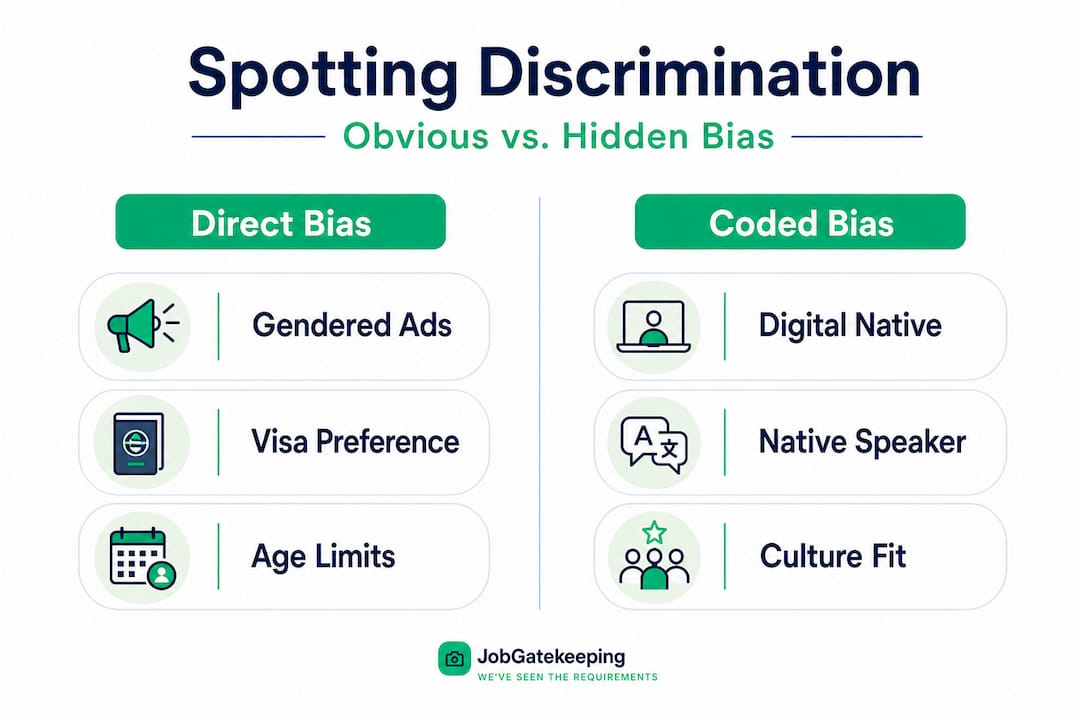
The tricky part? Discrimination doesn't always show up wearing a neon sign. It comes in two flavors:
Direct (explicit) discrimination is the obvious stuff. An ad that says "male only," "H-1B visa holders preferred," or "recent graduates only" is directly excluding people based on sex, national origin, or age. The EEOC national origin guidance is crystal clear: phrases like "native speaker required" or "young dynamic team" are red flags, full stop, unless the employer can prove a bona fide occupational qualification (BFOQ). That standard is extremely narrow, by the way. Almost nothing qualifies.

Indirect (coded) discrimination is subtler and arguably more dangerous because it hides in plain sight. Think requirements like "no gaps in employment," which punishes caregivers, or "must have lived in the U.S. for 10+ years," which targets immigrants without saying so explicitly.
| Type | Example language | Protected class impacted |
|---|---|---|
| Direct | "Male candidates only" | Sex |
| Direct | "Recent graduates preferred" | Age (40+) |
| Direct | "Native English speaker" | National origin |
| Indirect | "No employment gaps" | Gender, disability |
| Indirect | "Cultural fit is essential" | Race, national origin |
| Coded | "Long-term U.S. resident" | National origin |
Employment agencies are not off the hook either. If an agency places an ad on behalf of a discriminatory employer without pushing back, they share liability. Understanding what makes a posting cross the line is the first step toward spotting reasonable job requirements versus exclusionary ones.
🚨 "Looking for a motivated self-starter to join our young, energetic team. Recent grads encouraged to apply!" — This type of language appears harmless but signals age discrimination and discourages applicants over 40.
Watch out for job posting jargon traps too. Phrases like "digital native" or "clean-cut appearance" embed bias without mentioning a protected class at all.
Disparate impact: When neutral requirements become discriminatory
Here's where it gets really nuanced. A requirement doesn't have to mention race, sex, or any protected class to be illegal. If it disproportionately screens out a protected group and isn't genuinely tied to job performance, it can still violate the law. That's called disparate impact.
The EEOC uses the four-fifths rule to benchmark this. The rule works like this: if the selection rate for a protected group is less than 80% of the highest group's selection rate, that's evidence of adverse impact. For example, if 50% of white applicants pass a screening test but only 30% of Black applicants do, that 60% ratio falls below the 80% threshold. The employer then has to prove the requirement is both job-related and a business necessity.
Common "neutral" requirements that frequently trigger disparate impact issues:
- Requiring a four-year college degree for roles that don't need one. Studies consistently show this screens out Black and Hispanic applicants at higher rates.
- Minimum credit score checks for non-financial roles. Lower credit scores correlate with economic disadvantage, which disproportionately affects minority communities.
- Physical fitness tests for desk jobs. Unless the role genuinely demands physical performance, this can unfairly screen out applicants with certain disabilities.
- Specific GPA cutoffs from selective universities. This embeds socioeconomic bias under a neutral-sounding benchmark.
- "English fluency required" versus "native speaker required." The first is often legitimate. The second is not, and the distinction matters enormously.
| Requirement | Appears neutral? | Potential disparate impact |
|---|---|---|
| College degree for data entry | Yes | Race, socioeconomic status |
| Credit check for warehouse role | Yes | Race, national origin |
| Native English speaker | Coded | National origin |
| GPA cutoff from top schools | Yes | Race, income |
Pro Tip: When you see a qualification that feels excessive for the role, ask whether it's actually measuring job performance or just filtering by background. If it's the latter, it may be more than just gatekeeping. It could be legally problematic in labor laws.
The gap between "fluency required" and "native speaker required" is a prime example worth unpacking. Requiring fluency is legitimate if communication is central to the job. Requiring a "native speaker" implies that non-native speakers are inherently inferior communicators, regardless of their actual fluency level. That implication targets national origin directly. Document it. Screenshot it. Share it.
Real-world consequences: From callbacks to algorithms
Discrimination in job postings is not a hypothetical. The callback gap data is sobering: Black men and women, White women, and Hispanic men receive 28 to 43% fewer callbacks in management roles where evaluation is subjective. Let that sink in. Nearly half the callbacks, gone, before a single interview.
📊 Stat callout: Algorithms on freelancing platforms rank women and Black women lower in search results, meaning the bias isn't just in the job posting itself. It's baked into the whole infrastructure of how job seekers get seen.
Here's what that looks like in practice:
- ✗ A freelancing platform sorts by "client rating" without correcting for the fact that certain groups receive lower ratings due to bias, not quality of work.
- ✗ An applicant tracking system (ATS) filters resumes by school name, effectively penalizing people who attended HBCUs or state schools.
- ✗ A job board algorithmically promotes ads to certain ZIP codes, ensuring that demographically homogeneous neighborhoods see opportunities that others don't.
- ✗ A platform weights "recommendations from connections" heavily, favoring applicants who already have access to professional networks, which are often segregated.
This is why understanding algorithmic bias in hiring matters. The discrimination isn't always written in the posting. Sometimes it's buried in the ranking logic, the delivery system, or the screening tool.
The solution starts with scrutinizing postings critically. Ask yourself: Does this requirement match the actual job? Does this language imply a preference for one group? Is this posting showing up in communities that reflect the full range of qualified applicants? Learning to spot fair hiring pitfalls early saves you time and protects your mental energy.
We also need hiring process transparency and real recruiting transparency to break the cycle. Without visibility into how decisions are made, bias compounds quietly.
Hidden signals and edge cases: What most people miss
Once you move past the obvious red flags, you enter the land of subtle gatekeeping. And this is where a lot of people get caught off guard. Because it doesn't feel like discrimination. It feels like "company culture."
"Cultural fit" is one of the most overused and legally risky phrases in hiring. It sounds benign. Everyone wants to work somewhere they feel comfortable, right? But cultural fit and referral programs perpetuate homogeneity. When a homogeneous team hires for "fit," they're often hiring for similarity. And similarity correlates with race, class, educational background, and more.
Watch for these hidden signals:
- ✗ Ad imagery: If every person shown in a company's job ad is the same race or gender, that's a message. Applicants from other groups may self-select out before even applying.
- ✗ Where the ad is posted: A posting placed only in alumni networks from specific universities, or on platforms with a homogeneous user base, limits who even sees the opportunity.
- ✗ Requirements only some can meet: Needing your own vehicle for a role in a city with strong transit. Requiring after-hours availability without additional pay. These block applicants based on economic status or caregiving responsibilities.
- ✗ DEI language that backfires: Some postings overload the "diversity" framing in ways that signal a checkbox exercise rather than genuine inclusion, which turns off strong candidates of all backgrounds.
🔥 "We're a tight-knit team that values cultural alignment and prefers candidates referred by current staff." Translation: We are not set up to fairly evaluate anyone outside our existing network.
Pro Tip: Use resources that help you decode job ad language before you invest time in an application. If a posting trips three or more of these red flags, it's probably not worth your energy — and it's definitely worth sharing with the community.
Employers who write inclusive job captions know the difference between language that welcomes and language that quietly warns off. Learn to spot it both ways.
How to respond to and report discriminatory postings
So you've spotted a discriminatory posting. Now what? Don't just close the tab. Take action. Here's how:
-
Screenshot everything. Capture the full posting including the job title, company name, URL, date, and the specific language that raised the flag. Timestamps matter for evidence.
-
File a charge with the EEOC. You can do this online at eeoc.gov. There are time limits, typically 180 to 300 days from when the discrimination occurred, so don't wait.
-
Report to your state's fair employment agency. Many states have their own anti-discrimination laws that go further than federal rules. California, New York, and Illinois, for example, cover additional protected classes.
-
Contact advocacy organizations. Groups like the NAACP Legal Defense Fund, ACLU, or local legal aid organizations can provide support, especially if you faced actual harm from a discriminatory posting.
-
Share the posting publicly and responsibly. Anonymized screenshots with clear captions help the community recognize patterns. This is community-driven accountability at work.
-
Advocate for structural change. Push for blind recruitment, where names and identifying information are removed from initial applications. Advocate for structured interviews with standardized questions. These aren't just good practices — they're proven to reduce bias.
Pro Tip: When documenting a discriminatory posting, note the platform where it appeared, the employer's location, and whether the language also violates state or local law. Use a job posting checklist to guide your review before applying anywhere.
Knowing how to recognize exploitative job postings is just as important as knowing how to respond to them. Arm yourself with both.
Why discrimination in job postings is every applicant's problem
Here's the uncomfortable truth we need to sit with: even if you've never been personally excluded by a discriminatory job posting, you are still harmed by them. When the job market runs on bias, everyone's ability to trust the process erodes. You never know if you were rejected because you weren't qualified or because of something you can't control. That uncertainty is demoralizing. It's exhausting. And it's totally by design.
The conventional wisdom says that this is a minority problem, a woman's problem, a "certain group's" problem. That framing is wrong. When employers use coded language or subjective evaluations, they make the entire process unpredictable. Merit stops mattering as the primary factor. That hurts qualified applicants across the board.
Now, we also need to be honest about the other edge of this sword. DEI policies that use race or sex quotas can themselves violate Title VII. The EEOC has pursued cases where employers, in attempting to diversify, denied qualified white or male candidates positions solely based on their race or sex. That's reverse discrimination, and it's also a real problem. Fairness isn't selective.
The goal isn't to replace one form of exclusion with another. It's to build a system where what is fair hiring actually gets practiced consistently. That means structured criteria, transparent processes, and accountability from all sides. Not quotas. Not coded language. Actual merit, assessed fairly.
Lasting change requires vigilance from job seekers who keep calling this stuff out, and structural reform from the employers and platforms that have the power to fix it. Both are necessary. Neither is optional.
Keep the job market honest: Take action with Job Gatekeeping
You now have the tools to recognize discriminatory job postings, understand the legal framework, and take meaningful action. But awareness alone doesn't change systems. Collective action does.
That's exactly what Job Gatekeeping is built for. When you uncover gatekeeping practices, you're not just venting. You're building a record. You're warning other job seekers. You're creating pressure for employers and platforms to do better. Upload a screenshot of a discriminatory or absurd posting, write a caption that names the issue, and let the community react. Every shared post adds to a growing body of evidence that the job market needs serious reform. Together, we make it harder for these postings to go unnoticed. 🔥
Frequently asked questions
What words indicate a job posting is discriminatory?
Phrases like "male only," "native speaker," or "recent graduates" often indicate illegal discrimination unless the employer can prove a bona fide occupational qualification. When in doubt, document it.
Is advertising a job on certain platforms discriminatory?
Yes, it can be. If a job ad appears only in media targeting one demographic, advertising only in specific media may signal exclusion based on intent and impact, even without explicit discriminatory language.
How can job seekers challenge discriminatory postings?
You can report to EEOC, document the ad with screenshots and timestamps, and advocate for blind recruitment and structured hiring criteria to create systemic change.
What is the four-fifths rule for disparate impact?
The EEOC four-fifths rule means that if a protected group's selection rate falls below 80% of the highest group's rate, the requirement is presumed to create adverse impact unless the employer proves business necessity.
Can diversity hiring quotas be discriminatory?
Yes. Race or sex quotas in DEI programs can violate Title VII if they result in denying qualified candidates based solely on their protected characteristics, including being in a majority group.