

Most people assume the hiring process works something like a meritocracy. You apply, you're evaluated on your skills, and the best candidate gets the job. But the reality is a lot messier. Resume audit studies show that candidates with white-sounding names receive 50% more callbacks than equally qualified applicants with names that read as Black. Only 33.1% of U.S. job postings disclose pay. And 60% of job seekers skip listings that don't show a salary range. The system is not broken by accident. This guide will show you exactly what fair hiring looks like, where it breaks down, and what you can actually do about it.
Table of Contents
- Defining fair hiring: Laws, principles, and practical realities
- How bias creeps in: Methods and metrics for true fairness
- Salary transparency and its role in fair hiring
- What job seekers and advocates can do: Spot red flags and take action
- Why "perfect" candidates are a myth and what most job seekers miss
- Want more insights on hiring accountability and gatekeeping?
- Frequently asked questions
Key Takeaways
| Point | Details |
|---|---|
| Legal foundation matters | True fair hiring is anchored in anti-discrimination laws, but real-world practices often fall short. |
| Process flaws drive bias | Even neutral procedures can exclude qualified groups, so watch for subtle forms of gatekeeping. |
| Salary transparency is key | Disclosing pay is a deal-breaker for applicants and makes hiring more equitable. |
| Advocacy changes outcomes | Job seekers and advocates can spot unfairness and demand accountability in recruitment. |
Defining fair hiring: Laws, principles, and practical realities
Let's start with the basics. Fair hiring is not just a feel-good phrase. It has a legal definition and real teeth behind it.
According to the EEOC, fair hiring means non-discriminatory recruitment, selection, and promotion practices that comply with Equal Employment Opportunity laws. These laws prohibit employers from making decisions based on race, color, religion, sex, national origin, age, disability, or genetic information. Full stop.
The key federal laws that back this up include:
- Title VII of the Civil Rights Act covers discrimination based on race, color, religion, sex, and national origin.
- The Age Discrimination in Employment Act (ADEA) protects workers 40 and older from age-based bias.
- The Americans with Disabilities Act (ADA) requires employers to make reasonable accommodations and prohibits disability-based discrimination.
- The OFCCP (Office of Federal Contract Compliance Programs) enforces additional standards for businesses that hold federal contracts.
Those are your baseline protections. But here's where it gets complicated. Legal compliance is not the same as actual fairness. A company can technically avoid lawsuits while still running a deeply exclusionary hiring process. They can ask for "culture fit," write requirements so specific that only insiders qualify, or use ambiguous criteria that favor whoever already looks like the leadership team.
"Legal compliance sets a floor. Genuinely fair hiring requires building a ceiling way higher than the minimum."
There's also the myth of meritocracy. A lot of hiring managers believe they're purely evaluating talent and skill. But research consistently shows that subjective criteria, even things like "communication style" or "executive presence," are often coded ways to filter out candidates from underrepresented groups. True meritocracy requires structured, objective evaluation. Without that structure, bias fills the gaps.
This is why understanding fair hiring matters beyond just knowing your rights. It's about recognizing when the process is rigged, even when nobody says anything overtly biased out loud.
How bias creeps in: Methods and metrics for true fairness
With the legal foundation in mind, it's essential to recognize how process flaws and hidden biases undermine fairness even today. Most discrimination in hiring is not some hiring manager twirling a villain mustache. It's quieter, more systematic, and often unintentional.
Two key concepts help explain how this works:
Disparate treatment is intentional bias. A recruiter who tosses resumes with "ethnic-sounding" names is practicing disparate treatment. It's deliberate, even if the recruiter tells themselves it's about "fit."
Disparate impact is subtler. A hiring practice appears neutral but ends up excluding a protected group at a much higher rate. Requiring a college degree for a job that doesn't genuinely need one, for example, can have disparate impact on Black and Hispanic candidates who face greater systemic barriers to higher education.
To keep their processes fair and defensible, companies that take EEOC best practices seriously do the following:
- Define objective, job-related criteria before reviewing any applications. Know what you're looking for before you look.
- Diversify the applicant pool through intentional outreach to underrepresented communities, not just posting on the same platforms every time.
- Monitor for adverse impact using tools like the four-fifths rule.
- Validate selection procedures to confirm that tests, criteria, and interview questions actually predict job performance.
- Conduct structured interviews where every candidate answers the same questions, scored on the same rubric.
The four-fifths rule (also called the 80% rule) is one of the most practical screening tools available. Here's how it works: if the selection rate for one group is less than four-fifths of the selection rate for the highest-scoring group, that's a red flag for adverse impact. It doesn't automatically mean discrimination happened, but it's a signal worth investigating.
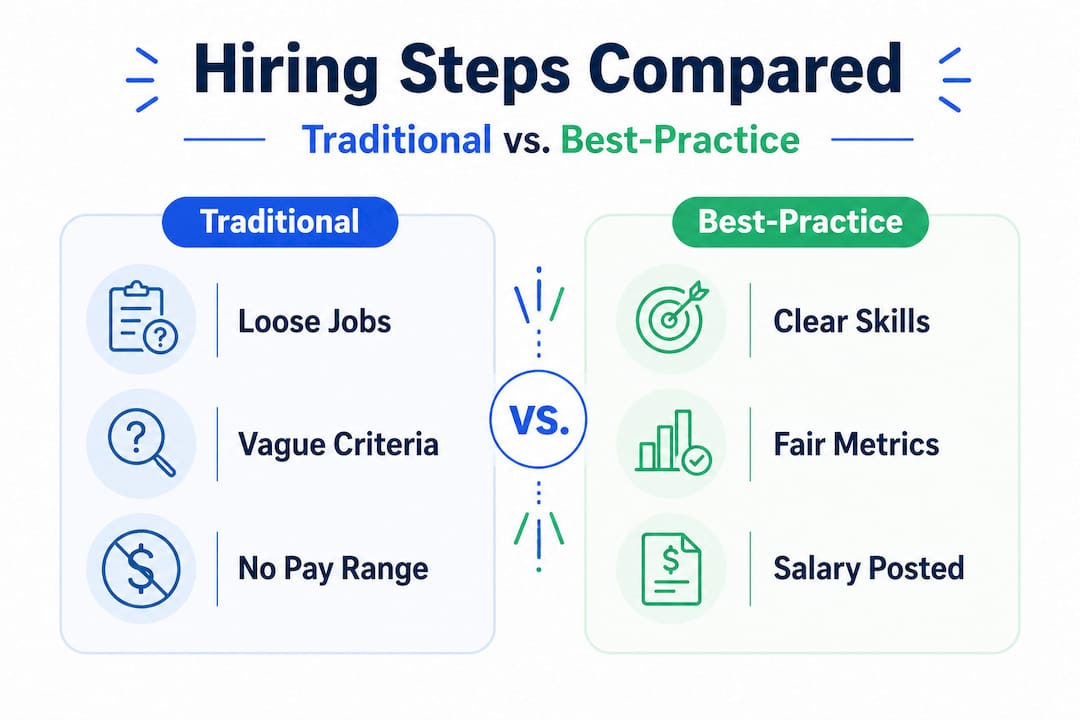
Here's a quick comparison of how traditional hiring stacks up against best-practice hiring:
| Step | Traditional hiring | Best-practice hiring |
|---|---|---|
| Job requirements | Written loosely, often aspirational | Defined specifically from job analysis |
| Resume screening | Subjective, subject to name bias | Blind screening or structured criteria |
| Interview process | Informal, "vibe"-based | Structured, standardized questions |
| Evaluation | Gut feeling, "culture fit" | Scored rubrics, multiple reviewers |
| Pay offer | Negotiated from unknown baseline | Transparent, banded salary range |
Cognitive ability tests are worth a special mention. They have real predictive validity (roughly 0.40 to 0.51 correlation with job performance). But they also tend to show group differences in scores, which can create disparate impact if used as a sole selection tool. Best practice is to use them as one data point among many, never as a pass/fail gate.
Pro Tip: If a job posting lists ten requirements and you meet seven or eight of them, apply anyway. Many postings are written as "aspirational wish lists" rather than true minimums. Employers regularly hire candidates who don't check every box.
Salary transparency and its role in fair hiring
Bias in job criteria is only part of the story. Pay transparency is one of the most revealing signals of how fair a hiring process truly is.
Think about it this way: if a company is serious about paying people fairly, why would they hide the salary? The answer is usually that transparency would expose inconsistencies they don't want scrutinized.
The numbers back this up. 60% of job seekers skip postings that don't include a salary range. People aren't just annoyed by the omission. They're actively choosing not to engage. And only 33.1% of U.S. job postings currently disclose pay, with wild variation by state.
Here's a snapshot of where things stand:
| State | Pay disclosure rate |
|---|---|
| New York | 72.7% |
| National average | 33.1% |
| Georgia | 2.6% |
That gap between New York and Georgia is staggering. And it's almost entirely driven by legal requirements. New York passed pay transparency legislation that made disclosure mandatory. Georgia didn't. This tells you something important: employers will not voluntarily share pay information at scale unless they're required to.
Pay transparency matters for fairness in a few concrete ways:
- It closes the negotiation gap. Historically, women and candidates from underrepresented groups negotiate less aggressively, partly because they lack information. A published salary range levels that playing field.
- It prevents lowball offers. When employers know the range is visible, they're less likely to start candidates far below what the role actually pays.
- It signals organizational honesty. A company willing to be upfront about pay is signaling that they take equitable treatment seriously.
When you're evaluating a posting, look for a specific salary band rather than vague language like "competitive compensation" or "commensurate with experience." Those phrases are almost always code for "we'll pay you as little as you'll accept." You can also explore effective hiring strategies from the employer side to understand what legitimate, transparent recruiting actually looks like in practice.
🔥 Salary transparency isn't just a nice-to-have. It's a direct indicator of how much an employer respects the people they're trying to hire.
What job seekers and advocates can do: Spot red flags and take action
Recognizing unfairness is vital. But knowing what to do about it is where theory meets real-world impact.
Let's get practical. Here are the clearest red flags that a job posting or hiring process may be engaging in gatekeeping or outright discrimination:
✗ Requirements that seem impossible for the level (e.g., "5 years of experience" for an entry-level role) ✗ No salary range or vague compensation language ✗ Criteria that aren't clearly tied to actual job duties ✗ Questions about age, marital status, or family plans during interviews ✗ An interview process that differs noticeably for different candidates
Once you spot them, here's what you can do:
01. Document everything. Screenshot the posting before it disappears. Save email correspondence. Write down dates, names, and what was said in interviews. Documentation is your strongest tool.
02. Name the issue. Talk to trusted peers, mentors, or advocacy groups. Naming what you experienced helps you process it and builds a record of the pattern, especially if others have experienced the same thing with the same employer.
03. Report it formally. If you believe you experienced discriminatory hiring practices, you can file a charge with the EEOC at eeoc.gov. For companies with federal contracts, the OFCCP is the relevant agency. You generally have 180 to 300 days from the date of the discriminatory act to file, depending on your state.
04. Engage your network. Advocacy doesn't have to be formal to be effective. Share your experience (especially anonymously if needed) to warn other job seekers. Call out specific postings. Community awareness is a form of power.
05. Push for transparency at work. If you're already employed, advocate for structured hiring processes, pay bands, and diverse interview panels. Change often starts from the inside.
Pro Tip: Connect with other job seekers who've experienced the same patterns, especially in the same industry or with the same employer. Collective documentation is significantly more powerful than isolated complaints. It builds the kind of case that agencies and journalists take seriously.
It's worth noting that discrimination persists through both disparate treatment and disparate impact, and both are grounds for EEOC complaints. You don't need to prove intent. If a neutral-sounding policy disproportionately excludes a protected group, that's potentially actionable.
Why "perfect" candidates are a myth and what most job seekers miss
Now that we've covered practical steps, let's step back and reconsider what "qualified" really means in a fair hiring world.
Here's something that doesn't get said enough: most job requirement lists are fiction. They're written by committee, often by people who've never done the job themselves, and they reflect an imaginary ideal rather than what the role actually needs to succeed. We've all seen it. "Entry-level position requires 7 years of experience in a framework that's only existed for 4 years." That's not gatekeeping by mistake. That's gatekeeping by design.
Research consistently shows that many job requirements are aspirational, not operational. Employers regularly hire candidates who don't meet every listed criterion. In fact, the EEOC explicitly recognizes that selection criteria must be validated against actual job performance, and many commonly listed requirements would fail that test.
The downstream effects of excessive requirements are significant. They reduce the diversity of the applicant pool. They screen out talented people who came from non-traditional paths. They favor candidates who had access to unpaid internships, expensive certifications, or prestigious educational institutions, none of which necessarily predict better job performance.
There's also a psychological dimension here that we need to talk about. Studies consistently show that women are far more likely to only apply when they meet nearly all of a job's stated requirements, while men apply when they meet around 60%. That's not a reflection of actual capability. It's a reflection of how excessive, aspirational requirements interact with social conditioning to make some candidates self-select out before they've even tried.
The uncomfortable truth is that the "perfect candidate" standard often functions as a way to keep hiring in a narrow lane. It rewards familiarity over potential. It favors whoever already looks and sounds like the people making the decision.
What this means for you: apply strategically, not perfectly. If you meet the core requirements and can speak to the job's real challenges, you're a legitimate candidate. Don't let a bloated wish list convince you otherwise. And when you see postings that are clearly built to exclude rather than attract, call them out. That's exactly what this community is here for.
Fair hiring, done right, balances genuine merit with real accountability. It asks what skills the job actually requires, builds structured ways to evaluate those skills, and pays candidates fairly for the work. That's not an impossibly high bar. It's just the baseline we all deserve.
Want more insights on hiring accountability and gatekeeping?
Ready to go deeper and join others pushing for fair hiring?
If you're frustrated with the job market and tired of absurd requirements, hidden salaries, and opaque hiring processes, you're not alone. JobGatekeeping is built for exactly this. We expose ridiculous job postings, share community stories, and give you the tools to recognize and challenge gatekeeping wherever it shows up.
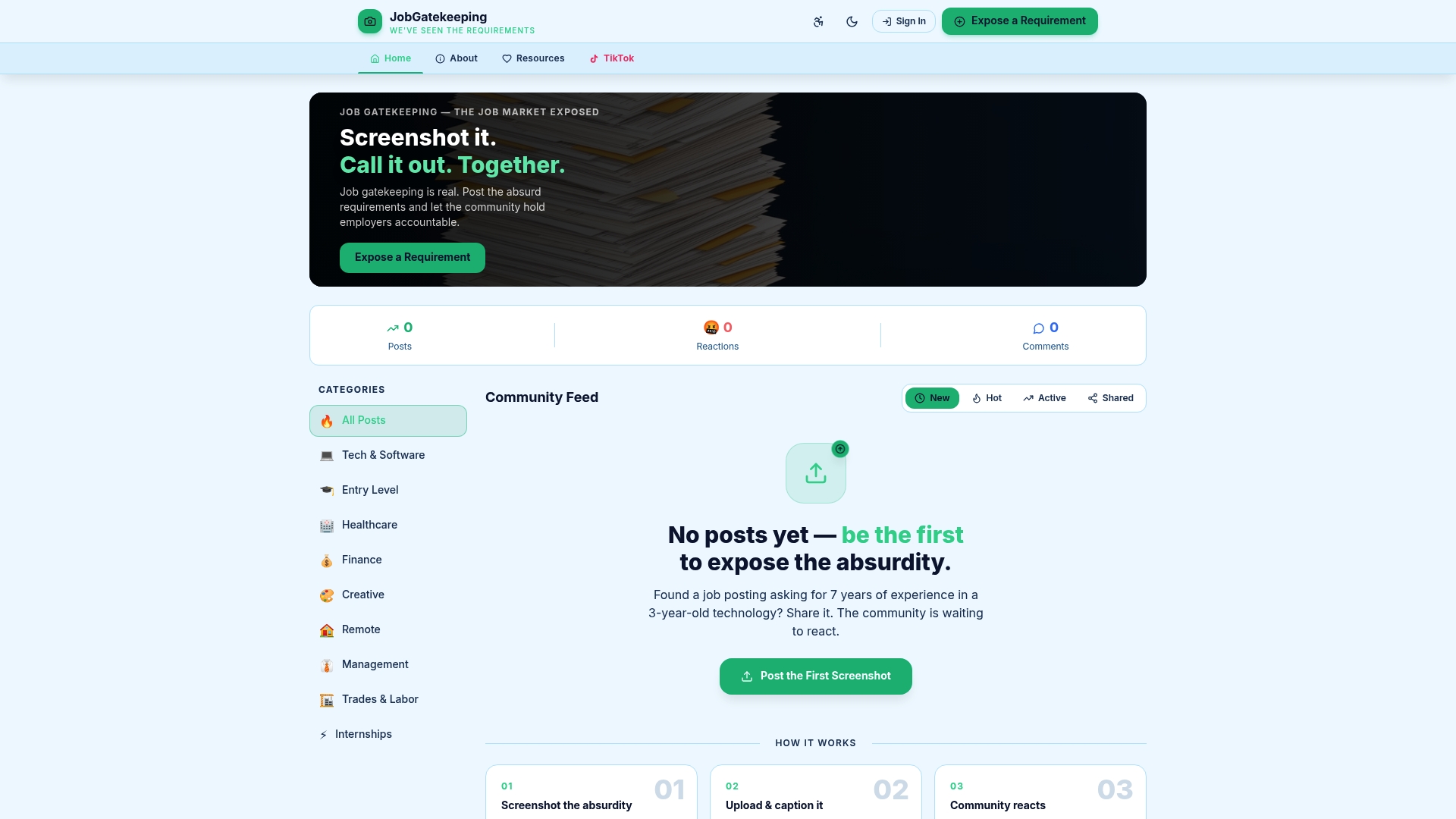
Browse our in-depth guides on unfair hiring tactics, share your own screenshot of a gatekeeping post, and join a community that's pushing back on the broken status quo. Together, we can make the job market more transparent, more fair, and more accountable. Visit JobGatekeeping to start exploring, or upload your own experience and let the community weigh in. Your screenshot could be the one that sparks a real conversation. 🔥
Frequently asked questions
How do I know if a job posting is unfair or discriminatory?
Look for excessive or irrelevant requirements, missing salary information, and criteria that don't connect to actual job duties. These patterns often signal gatekeeping or bias, and 60% of job seekers already treat missing pay ranges as a red flag worth walking away from.
What should I do if I suspect hiring discrimination?
Document what you experienced and file a formal charge with the EEOC or OFCCP if your situation involves a federal contractor. You have 180 to 300 days from the discriminatory act to file, depending on where you live.
Does salary transparency really improve fairness?
Yes, significantly. Pay disclosure closes negotiation gaps, reduces lowball offers, and signals organizational honesty. With only 33.1% of U.S. postings disclosing pay, most employers are still hiding the information job seekers need most.
Are job requirements always necessary for the role?
Not at all. Many job requirements are aspirational and would fail validation tests under EEOC standards. If you meet the core criteria, apply. Don't let an inflated wish list talk you out of it.