

Not every job requirement you see in a listing is actually necessary. In fact, a huge number of entry-level postings are loaded with demands that have nothing to do with the core work. We're talking "3 to 5 years of experience" for a role labeled junior, or requests for AWS certifications for a basic admin position. It's exhausting, and it's not accidental. Understanding what truly constitutes a reasonable job requirement isn't just useful knowledge — it's a tool for protecting yourself and pushing back against a hiring culture that gatekeeps talent behind inflated wish lists.
Table of Contents
- What makes a job requirement reasonable?
- Common pitfalls: Unreasonable demands in entry-level jobs
- How core skills and attributes factor in
- A framework for evaluating and challenging job requirements
- The uncomfortable truth: Why 'reasonable' is still up for debate
- Take the next step toward fairer job searches
- Frequently asked questions
Key Takeaways
| Point | Details |
|---|---|
| Core duties matter most | Job requirements should closely reflect the actual tasks and responsibilities of a role. |
| Look for soft skills focus | Attributes like teamwork, integrity, and problem-solving are valued more than long lists of technical requirements in entry-level jobs. |
| Challenge red flags | If a requirement seems excessive, question its relevance or seek clarification from the employer. |
| You can shape fair hiring | By pushing for transparency, you help ensure hiring is based on true potential, not arbitrary hurdles. |
What makes a job requirement reasonable?
Let's be direct. A reasonable job requirement is one that directly connects to what the person in the role will actually do on a daily basis. That's it. It sounds simple, but you'd be surprised how often employers bury that logic under layers of "preferred qualifications" that have no bearing on performance.
There are real legal and practical standards that should guide this. The Americans with Disabilities Act and the EEOC both have clear expectations for how employers should define the essential functions of a job. According to guidance on essential job functions, these functions should be quantified based on the proportion of time spent on them, the degree of independent decision-making involved, and the specialization required. If a task only takes up 5% of someone's week, it's probably not essential. If removing it doesn't break the job, it's not essential.
Here's a quick breakdown of what actually makes a requirement legitimate:
- It reflects a core duty. The skill or qualification is tied directly to a primary responsibility, not a rare edge case.
- It has a clear performance link. You can explain exactly why this skill affects job outcomes.
- It's proportionate. The level of expertise demanded matches what the job actually requires.
- It doesn't create unnecessary barriers. Requirements that exclude broad groups without justification are a red flag.
- It survives the "removal test." If you remove the requirement and the job can still be done effectively, the requirement probably shouldn't be there.
"The legitimacy of a job requirement lives or dies based on its connection to what actually needs to get done — not what sounds impressive in a listing."
The distinction between "nice to have" and "must have" matters enormously. Employers often write listings based on their ideal candidate rather than their minimum viable hire. The result? Lists of 12 qualifications when 4 would do.
Pro Tip: When you're reviewing a job listing, ask yourself: if a strong candidate had every skill except this one, would they still be able to do the job well? If the answer is yes, it's likely a preferred quality masquerading as a requirement. Don't let it scare you off.
Common pitfalls: Unreasonable demands in entry-level jobs
With those standards in mind, let's look at where things typically go wrong. Entry-level job listings are some of the worst offenders for stacking up unreasonable requirements. And the consequences hit real people — talented candidates who self-select out because the list looks impossible.
Here are the most common patterns we see posted and called out regularly:
- Experience paradoxes. "Entry-level position — 3 to 5 years of experience required." This is arguably the most notorious example of gatekeeping in hiring. Entry-level, by definition, is for people entering the field.
- Degree inflation. Requiring a bachelor's or master's degree for roles that could easily be performed by someone with a certificate, portfolio, or demonstrable skill set.
- Technical overload. Asking for 5 specific tools, 2 programming languages, and an industry certification for a position that primarily involves data entry or scheduling.
- Leadership demands. Expecting "proven leadership experience" or "team management" history from someone applying for their first professional role.
- Culture fit vagueness. Listing "culture fit" as a requirement without defining it, which often acts as cover for unconscious bias in screening.
Research backs up what many applicants already know from experience. Entry-level benchmarks from career experts consistently show that positive attitude, teamwork, integrity, and communication are the actual top qualities employers value for these roles. Not a PMP certification. Not five years in the field.
Here's a look at how common these unreasonable demands actually are:
| Requirement type | Frequency in entry-level listings | Reasonable? |
|---|---|---|
| 2+ years experience | Very common | ✗ Usually not |
| Bachelor's degree required | Common | Depends on role |
| 3+ specific software tools | Common | Rarely all essential |
| Leadership/management history | Occasional | ✗ Almost never |
| Unpaid "trial projects" | Less common but increasing | ✗ Exploitative |
| Communication skills | Universal | ✓ Yes |
| Teamwork/collaboration | Universal | ✓ Yes |
| Willingness to learn | Common | ✓ Absolutely |
The impact of inflated requirements goes beyond individual frustration. It shrinks the applicant pool, filters out talented people from non-traditional backgrounds, and actively hurts workplace diversity. Employers who write these listings often wonder why they can't find good candidates. The irony is thick.

Pro Tip: When you see a long list of requirements in a job posting, mentally split them into two columns: "Would my job performance genuinely suffer without this?" and "Is this just padding?" Apply to the roles where most of the must-haves land in that first column.
How core skills and attributes factor in
Beyond calling out what's unreasonable, it's worth knowing what genuinely matters. For entry-level roles especially, the most predictive factors of success are almost never the technical specifics — they're the transferable skills and personal attributes that show up across jobs and industries.
Top qualities for entry-level roles include positive attitude, teamwork, effective communication, and problem-solving ability. These aren't soft extras. They're the foundation of how someone will actually perform when they're new to a role and still learning the technical side.
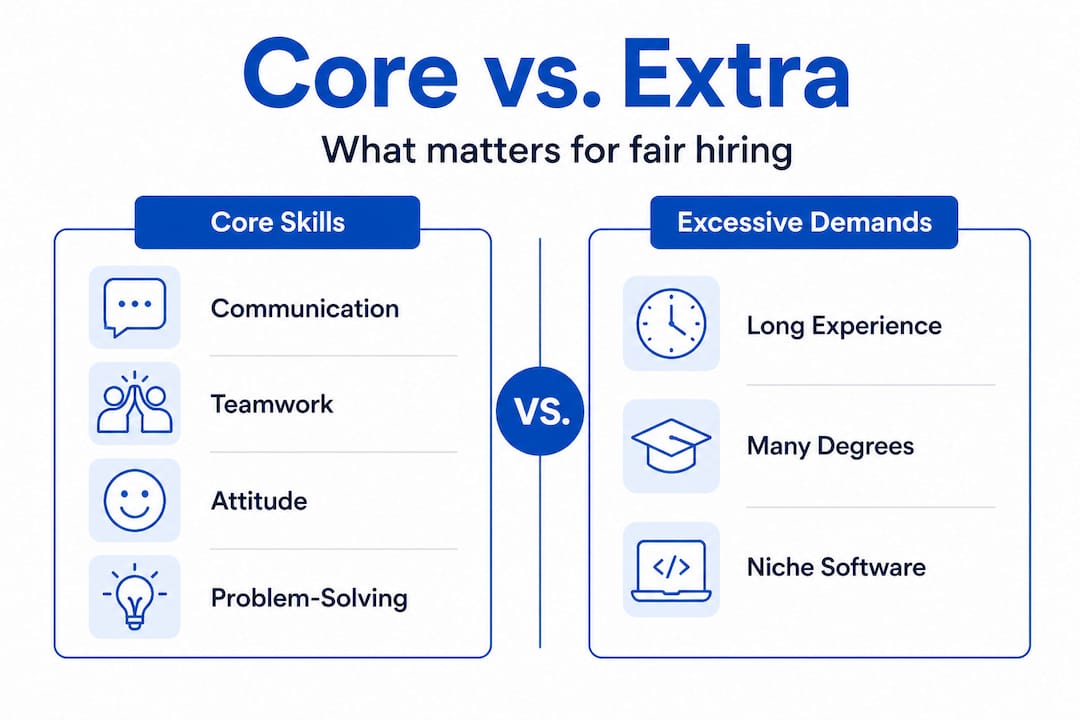
Here's a comparison that puts this in perspective:
| Attribute type | Example | Relevance for entry-level |
|---|---|---|
| Transferable skill | Communication, problem-solving | High — applies across all tasks |
| Core attitude | Positive mindset, adaptability | High — shapes learning speed |
| Technical expertise | React.js, Salesforce CRM | Medium — trainable on the job |
| Degree credential | Bachelor's in Marketing | Low to medium — depends on field |
| Years of experience | "3+ years in role" | Low for entry-level — often irrelevant |
Notice how the qualities that actually predict entry-level success rank highest, while the ones gatekeeping employers demand most often rank lowest in real-world relevance. That mismatch is the whole problem.
The transferable skills that genuinely open doors include:
- Communication — writing clearly, speaking confidently, listening well
- Collaboration — working across teams, adapting to group dynamics
- Critical thinking — solving problems without being handed a solution
- Time management — handling multiple responsibilities without constant supervision
- Adaptability — learning new tools and workflows without resistance
- Accountability — owning mistakes and course-correcting quickly
When employers prioritize these, they create a positive work environment where people can grow into technical skills. When they lead with obscure technical demands upfront, they filter out exactly the kind of motivated, capable people who would thrive with the right support.
"The best entry-level hires are rarely the most technically polished. They're the ones who show up ready to learn, communicate, and problem-solve their way through challenges."
The shift from experience-focused to skills-focused hiring isn't just good for equity. It's good for business. Companies that invest in candidates with strong foundational skills and a growth mindset consistently outperform those that screen for rigid technical boxes.
A framework for evaluating and challenging job requirements
Now let's get practical. You've read a job posting. Something feels off. There are 14 requirements listed, half of them seem extreme, and you're not sure if you should even bother applying. Here's a step-by-step process to work through it.
01. Identify the core duties Read through the "responsibilities" section, not just the "requirements." The actual daily tasks tell you more about what the job really needs than the qualifications list.
02. Flag the essentials vs. the extras Go through each requirement. For each one, ask: "Is this needed to perform the core duties I just identified?" If yes, it's likely essential. If no, it might be padding.
03. Check the ADA/EEOC framework Per that guidance, essential functions are defined by proportion of time, specialization, and what happens when the function is removed. Apply that same lens to each listed requirement. Could you remove it and still do the job? Then it's probably not essential.
04. Look at the language Words matter. "Required" and "preferred" are supposed to be different categories. If everything is listed as required, that's a red flag in itself. Some employers blur this intentionally.
05. Make your decision to apply If you meet 60 to 70% of what looks genuinely essential, apply. You don't need to hit every bullet point. Studies consistently show that many candidates, especially women and first-generation professionals, self-select out far too early.
06. Ask smart questions If you land an interview, you're allowed to respectfully ask about requirements. Try something like: "I noticed the listing mentioned X — can you tell me how central that is to day-to-day work in this role?" It shows critical thinking and genuine interest, not pushback.
Pro Tip: If a hiring manager gets defensive or dismissive when you ask a respectful question about a listed requirement, that tells you something important about the company culture. A good employer welcomes a candidate who thinks critically.
Your rights matter here too. Hiring requirements that have a discriminatory impact and can't be justified by job necessity may violate fair employment laws. You don't have to confront every situation, but knowing that these standards exist gives you ground to stand on.
The uncomfortable truth: Why 'reasonable' is still up for debate
Here's something we don't say enough. Even with a clear framework, even with legal standards, even with all the research on what actually predicts job success — the definition of "reasonable" is still being fought over in real time, in real hiring rooms, by real people making judgment calls.
Many organizations genuinely can't tell the difference between what they want and what they need. They've been writing job descriptions the same way for a decade. They copy-paste from old listings. They add requirements because a manager insists on them, not because those requirements reflect the actual job. The framework exists, but humans are stubborn, and systems are slow to change.
Here's what that means for you. Your instinct when a listing feels inflated? Trust it. Your read on whether a requirement makes sense for the role? It's probably accurate. You're not imagining things when a "coordinator" role asks for five years of project management experience. That's absurd, and your gut is right.
But here's the harder truth. Frustration alone doesn't change the system. What does change it is visibility, conversation, and consistent pressure. When job seekers start calling out these postings publicly, when communities share and react to these screenshots, when employers see that the market is watching, the culture slowly shifts. It's not fast. But it's real.
Don't let inflated lists stop you from applying. Don't let a 14-bullet requirements section convince you that you're not qualified for work you could absolutely do. And when you find a posting that's genuinely ridiculous, share it. Call it out. Let the community pile on. That collective voice matters more than any single application.
Take the next step toward fairer job searches
You now have the language, the framework, and the clarity to evaluate job postings critically. But knowing what's unreasonable is only half the equation. The other half is doing something about it.

At JobGatekeeping, we've built a space where job seekers like you can expose the listings that cross the line. See a posting asking for 4 years of experience for an internship? Screenshot it, upload it, caption it, and let the community react. 🚨 Whether the reaction is outrage, laughter, or pure relatability, every post adds to a growing public record of what's really happening out there. And before you dive in, take a moment to review our site policy so you know how we handle your data and keep the platform safe and transparent for everyone. Together, your voice and your screenshots are how this changes.
Frequently asked questions
What is considered a reasonable job requirement for entry-level roles?
A reasonable requirement is one that reflects the core duties of the job and does not create unnecessary barriers for qualified candidates. Per ADA/EEOC guidelines, requirements should be tied to essential functions, measured by time spent and decision-making involved.
How can I tell if a job requirement is excessive or discriminatory?
If a qualification goes well beyond what someone would need to actually do the job, it's likely excessive. The ADA/EEOC standard looks at proportion of time, specialization, and what happens when the requirement is removed from the equation.
Which skills do employers value most in entry-level applicants?
Employers consistently value communication, teamwork, positive attitude, and problem-solving over narrow technical skills for entry-level roles. Top benchmarks show these attributes outrank years of experience in predicting actual job performance.
Can I apply if I don't meet every single requirement?
Yes, absolutely. Apply if you meet most of the core, genuine requirements. Many listed qualifications are aspirational rather than essential, and employers frequently hire candidates who don't check every box.