

Job seekers waste hours chasing roles that hide the salary, obscure the screening process, or demand credentials that have nothing to do with the actual work. That is not an accident. It is a pattern. And it costs candidates dignity, time, and opportunity while costing employers the talent they actually need. The good news is that building a transparent hiring workflow is not complicated. It requires the right tools, a clear process, and a genuine commitment to treating candidates like adults. This guide walks through every step, from the prerequisites you need before you post a single role to the metrics that tell you whether your changes are actually working.
Table of Contents
- What you need to launch a transparent workflow
- Creating and structuring transparent job postings
- ensuring compliance and promoting fairness
- measuring the impact of transparent postings
- A new era for job posting transparency: Why candidate-first workflows matter
- Supporting your journey to truly transparent hiring
- frequently asked questions
Key Takeaways
| Point | Details |
|---|---|
| Transparency prerequisites | Gather legal requirements, salary benchmarks, and compliance tools before creating postings. |
| Stepwise workflow | Follow a clear process for drafting and structuring postings to ensure compliance and fairness. |
| Continuous verification | Regularly audit and update postings for bias, new laws, and effectiveness. |
| Track impact | Monitor results, including diversity of candidates and application rates, to measure workflow success. |
What you need to launch a transparent workflow
Before you write a single job posting, you need to gather the right materials. Think of this as your transparency toolkit. Without it, you are just guessing, and guessing leads to the vague, misleading postings that frustrate candidates and invite legal risk.
The legal landscape is shifting fast. Pay transparency laws, such as Colorado's, now mandate salary ranges in postings, and research shows they have increased wages across the board. States and cities are adding new disclosure requirements every quarter, and 2026 compliance trends show that AI screening disclosure and ban-the-box rules are also becoming standard. If you are hiring in multiple states, you need a jurisdiction-by-jurisdiction checklist before you even open a text editor.
Here is what your toolkit should include:
- A current compensation benchmark for every role, sourced from salary surveys, internal equity data, or market tools
- A standardized job description template that separates required qualifications from preferred ones
- A compliance checklist covering salary disclosure, AI tool usage, background check timing, and accessibility standards
- A record of any automated screening or ranking tools your applicant tracking system uses
- A designated owner for each element, whether that is HR, legal, or a hiring manager
The table below summarizes what you need and why it matters:
| What you need | Why it matters | Who owns it? |
|---|---|---|
| Pay range data | Legal compliance and candidate trust | HR/compensation team |
| Job description template | Role clarity and auditability | HR or hiring manager |
| AI/screening tool disclosure | Legal and reputational protection | HR and legal |
| Background check policy | Ban-the-box and timing compliance | Legal |
| Internal equity analysis | Pay fairness across demographics | HR/compensation team |
Using transparency compliance tools can help you stay organized across multiple roles and departments without reinventing the wheel each time.
Pro tip: Do not try to overhaul every department at once. Pick one role or one team, run the full transparent workflow, document what works, and then expand. A small pilot is far easier to fix and refine than a company-wide rollout that collapses under its own weight.
Creating and structuring transparent job postings
Once your toolkit is ready, building the actual posting becomes a structured process rather than a creative writing exercise. Every element should serve the candidate's ability to make an informed decision.
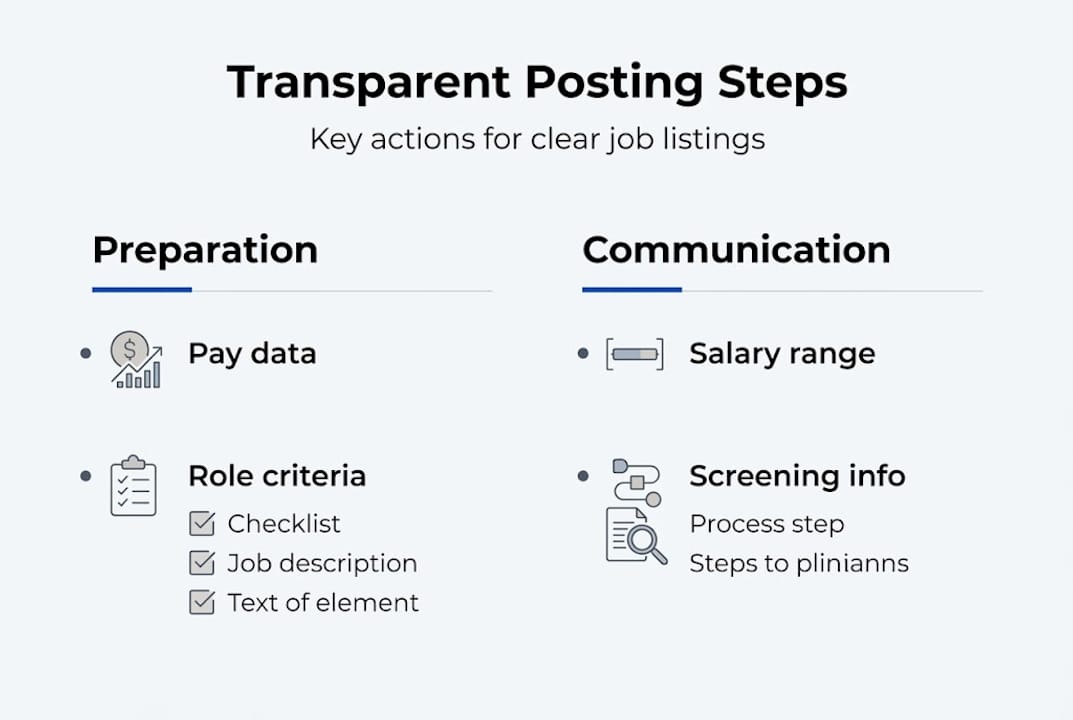
Here is a step-by-step approach:
- Write a clear, specific job title. Skip the "rockstar" and "ninja" labels. Use the title that matches what the role actually is, something a candidate would type into a search bar.
- Draft a concise job summary. Two to three sentences on what the team does, what the role contributes, and who the person will work with.
- List responsibilities in plain language. Use bullet points. Keep each one to one clear action. If a task requires a specific tool or skill, name it explicitly.
- Define required versus preferred qualifications separately. This is critical. "Required" means the person cannot do the job without it. "Nice to have" should never be disguised as a requirement.
- Include the full salary range and benefits. Not a vague "competitive salary." An actual range, plus details on health coverage, PTO, and remote work options.
- Name any AI or automated screening tools your process uses, and explain how they affect candidate ranking or filtering.
- Add a transparency contact. A name or email candidates can reach if they have questions about the process.
The stakes for skipping steps five and six are real. Pay transparency research shows mixed wage effects: in some markets, disclosure can reduce average wages and affect perceived fairness, which means how you communicate the range matters as much as the number itself.
"When employers fail to disclose salary or AI screening methods, they signal that the process is designed for the company's convenience, not the candidate's informed consent. That erodes trust before the first interview."
For roles where pay is genuinely variable, such as commission-heavy sales positions or contract work, explain the structure clearly. "Base salary of $X plus commission, with average total compensation of $Y" is far more honest than a range so wide it tells candidates nothing.
Pro tip: Use consistent formatting and language across every posting. This is not just about brand consistency. It creates an auditable record that shows your process is systematic, not arbitrary. That matters if your postings are ever reviewed for compliance or bias.
Managing candidate expectations from the first line of the posting is one of the most underrated tools for reducing drop-off and improving offer acceptance rates.

ensuring compliance and promoting fairness
Writing a transparent posting is one thing. Making sure it actually holds up to legal and ethical scrutiny is another. This is where many organizations fall short, not because they are acting in bad faith, but because compliance is treated as a one-time checkbox rather than an ongoing practice.
Start with a verification checklist every posting should pass before it goes live:
- Does it include a specific salary range? Not a placeholder, not "DOE" (depends on experience).
- Does it disclose any AI or automated screening tools? AI screening omission creates negative candidate perceptions and is increasingly required by law.
- Does it follow ban-the-box rules for your jurisdiction, meaning criminal history questions are not on the initial application?
- Is the posting accessible? Screen-reader-compatible formatting, plain language, and no jargon that excludes non-native speakers.
- Are qualifications genuinely required, or are some just legacy requirements that have never been reviewed?
Here is a comparison of common mistakes versus the transparent alternative:
| Common mistake | What it signals | Better approach |
|---|---|---|
| "$50,000-$120,000 DOE" | No real commitment to fairness | "$72,000-$85,000 based on defined criteria" |
| No mention of screening tools | Hidden process, erodes trust | "We use [Tool X] to rank applications" |
| "5 years required" for entry roles | Classic gatekeeping | List only genuinely required skills |
| Criminal history on page one | May violate ban-the-box laws | Move to conditional offer stage |
As for ownership, compliance should not live in one person's inbox. The most effective setups use a cross-functional team: HR owns the job description, legal reviews jurisdiction-specific requirements, and a hiring manager confirms that qualifications reflect the real role. Q1 2026 laws are adding new reporting responsibilities that make this shared ownership model even more important.
For continuous improvement, build in a feedback loop. After each hire, ask candidates, both those who accepted and those who declined, what was unclear in the posting. Their answers will surface issues no internal review would catch. You can also use auditing transparency measures to track compliance over time and spot patterns before they become problems.
measuring the impact of transparent postings
Transparency is not just an ethical stance. It produces measurable results. But you have to track the right things to see them.
Pay disclosure measurably alters application volumes by gender and candidate quality perceptions. That means your data will shift when you make postings more transparent, and you need a baseline to understand what changed and why.
Here is how to gather and interpret that data:
- Record your baseline. Before making any changes, document your current applicant demographics, offer acceptance rates, and time-to-fill for each role type.
- Run your transparent workflow for at least one full hiring cycle. One or two postings is not enough data. Give it at least a quarter.
- Compare applicant demographics before and after. Look for shifts in gender balance, age distribution, and whether you are seeing more first-generation or career-change candidates.
- Track offer acceptance rates. If candidates have clear salary and process information upfront, acceptance rates typically rise because there are fewer surprises at the offer stage.
- Monitor early retention. Are new hires staying past the 90-day mark at higher rates? That often signals better role clarity from the start.
The table below outlines the key metrics worth tracking:
| metric | what it tells you | how to track it |
|---|---|---|
| Application volume by gender | Whether transparency is broadening your pool | ATS demographic data |
| Time-to-fill | Whether clarity speeds up the process | ATS reporting |
| offer acceptance rate | Whether candidates feel informed and respected | HR records |
| 90-day retention | Whether role expectations matched reality | HR records |
| candidate feedback scores | Whether the process felt fair | Post-process surveys |
If your key metrics do not improve after a full cycle, do not abandon the approach. Instead, audit the specific elements that candidates found unclear. Often the issue is not the salary range itself but how qualifications are framed or whether the process steps are explained.
A new era for job posting transparency: Why candidate-first workflows matter
Here is something most compliance guides will not tell you: meeting the legal minimum is not the goal. It is the floor. Organizations that treat transparency as a box to check, post a salary range because they have to, disclose AI use in fine print, and call it done, are missing the actual opportunity.
The real shift is about power. For decades, hiring has been designed to maximize employer leverage. Keep candidates guessing about pay. Use opaque screening tools. Stack requirements to thin the pool before a human ever reads a resume. That system benefits no one in the long run. It filters out capable people who cannot afford to gamble on an unknown salary. It rewards candidates who are good at gaming processes, not doing the work.
Organizations that cling to gatekeeping practices are not protecting themselves. They are shrinking their own talent pool and signaling to the market that they do not trust candidates with basic information. That reputation spreads fast, especially in 2026, when job seekers share screenshots of absurd postings within hours.
The practical advice here is simple. Pick one area, whether it is salary disclosure, AI transparency, or qualification auditing, and do it better than the law requires. Share the results internally. Show that clearer postings attract stronger candidates and reduce time-to-fill. That is how you build a culture that treats transparency as a competitive advantage, not a compliance burden.
Supporting your journey to truly transparent hiring
Putting this workflow into practice takes more than a checklist. It takes ongoing access to real examples, updated compliance guidance, and a community that holds hiring standards accountable.

JobGatekeeping transparency guides offer exactly that. Whether you are a job seeker trying to identify gatekeeping tactics before you apply, or a hiring advocate pushing for fairer practices inside your organization, JobGatekeeping connects you with resources built for 2026 realities. Browse real-world examples of problematic postings, learn from compliance case studies, and share your own experiences to help others recognize unfair patterns. The platform exists because individual frustration becomes collective change when people speak up together.
frequently asked questions
What information must be disclosed in a transparent job posting?
You must disclose a clear salary range, any AI tools or automated screening used, and the specific qualifications required for the role. Colorado's law is a leading example of how salary disclosure requirements are expanding nationally.
How does pay transparency impact who applies for jobs?
It broadens the applicant pool, particularly among women and underrepresented candidates. Pay disclosure measurably shifts application volumes by gender and changes how candidates perceive role quality.
Can posting a narrow salary range harm negotiation power?
Yes. Pay transparency research shows that visible ranges can reduce average wages in some markets, particularly for non-union roles where individual bargaining was previously common.
Is AI screening disclosure now legally required?
In a growing number of jurisdictions, yes. 2026 compliance trends show AI disclosure is becoming a standard requirement, and omitting it creates both legal and reputational risk.
How often should job postings be updated to stay compliant?
Review every posting at least quarterly. Q1 2026 laws are actively reshaping workflow compliance standards, and what was sufficient six months ago may already be outdated.