

Labor laws promise fairness, but the gap between legal protection and lived reality is wider than most people realize. Whites receive 36% more callbacks than Black applicants, and that gap has not meaningfully declined over decades of civil rights legislation. This guide breaks down the core U.S. labor laws that shape hiring, explains how procedural rules like the 4/5ths rule actually work, and shows you how to use this knowledge as a job seeker or advocate. Understanding the rules is step one. Knowing their limits is step two.
Table of Contents
- The foundations: Core U.S. labor laws impacting hiring
- Applicant screening: How rules shape interviews, tests, and evaluations
- Wage and classification laws: Who gets hired and why it matters
- State-specific laws and modern challenges
- Limits and ongoing challenges: What the data shows
- Why knowing your rights isn't enough: A realistic view
- Learn, advocate, and protect your job search
- Frequently asked questions
Key Takeaways
| Point | Details |
|---|---|
| Labor laws prohibit discrimination | Key federal laws protect applicants from biased hiring decisions based on race, age, disability, and other factors. |
| Screening rules are enforceable | Employee selection tools must be job-related and not disproportionately exclude protected groups. |
| State laws add complexity | Pay transparency and ban-the-box laws make hiring rules vary widely by location and job type. |
| Legal compliance isn't always enough | Bias and inequality persist in hiring, making advocacy and awareness critical for true fairness. |
The foundations: Core U.S. labor laws impacting hiring
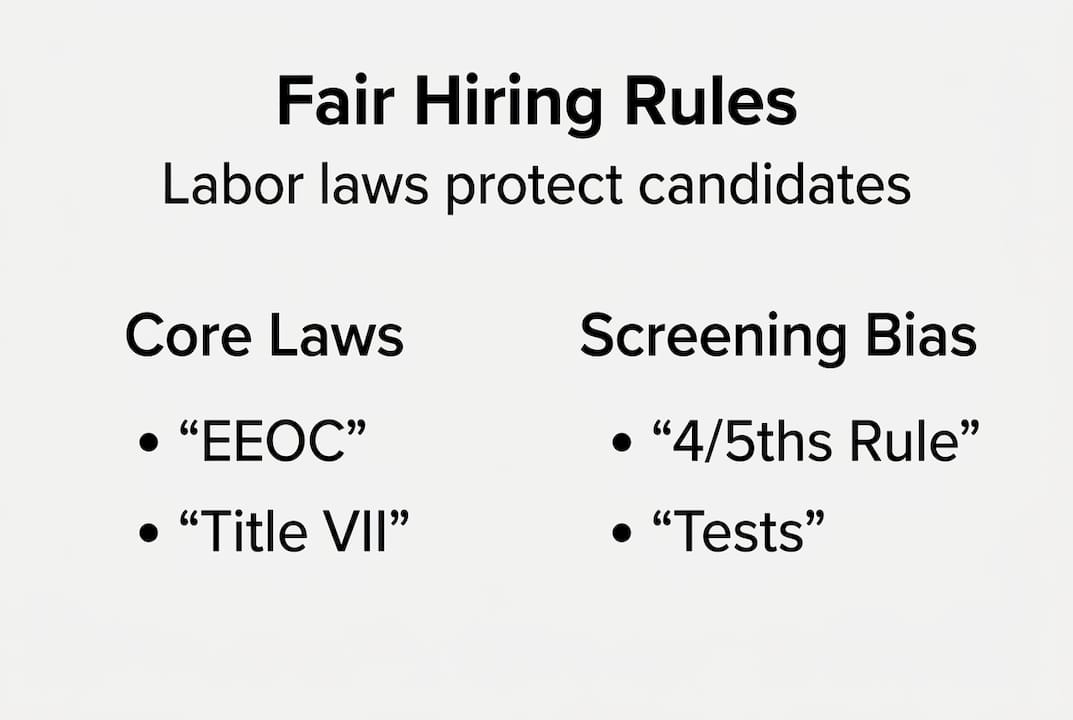
Let's be clear about what federal labor law actually prohibits. Employment laws ban discrimination based on protected characteristics throughout the entire hiring process, from the job posting to the final offer. These aren't vague suggestions. They are enforceable federal standards.
The four laws you need to know:
- Title VII of the Civil Rights Act (1964): Prohibits discrimination based on race, color, religion, sex, and national origin. Applies to employers with 15 or more employees.
- Age Discrimination in Employment Act (ADEA): Protects workers 40 and older from age-based bias. Particularly relevant in tech, where job postings sometimes use coded language like "digital native" or "recent grad."
- Americans with Disabilities Act (ADA): Requires employers to provide reasonable accommodations and prohibits disqualifying candidates based on disability status.
- Fair Labor Standards Act (FLSA): Governs minimum wage, overtime, and worker classification, which directly affects who qualifies for a posted role and what benefits come with it.
The key legal concept here is adverse employment action. A decision is legally problematic when a protected characteristic is a motivating factor, even if other reasons are also cited. A legal decision is one based entirely on job-related qualifications.
Real-world examples make this concrete. An employer who lists "5 to 7 years of experience" for an entry-level role may not be violating anti-discrimination law outright, but if that requirement disproportionately screens out women or people of color, it could trigger scrutiny under disparate impact doctrine.
Pro Tip: Scan job descriptions for phrases like "culture fit," "young and energetic," or "recent graduate." These can be coded signals for age or race bias. Screenshot them and document the posting date before applying.
Statistic to know: The EEOC receives over 67,000 workplace discrimination charges annually, yet enforcement actions represent only a fraction of actual violations.
Applicant screening: How rules shape interviews, tests, and evaluations
With basics covered, let's dig into how hiring actually happens and what the rules mean when you face interviews, tests, or automated screening.
When employers use any selection procedure, whether it's a written test, a structured interview, or an algorithm, EEOC guidelines require validation if that procedure produces adverse impact. "Validated" means the tool is proven to predict actual job performance. It's not enough to say a test feels relevant. The employer must demonstrate it.
The 4/5ths rule explained: If the selection rate for any protected group is less than 80% of the rate for the highest-selected group, that's a red flag for adverse impact. For example, if 50% of white applicants pass a screening test but only 30% of Black applicants do, that's a 60% ratio, well below the 80% threshold, and it triggers legal review.
| Screening method | Legal scrutiny level | Common bias risk |
|---|---|---|
| Structured interviews | Moderate | Accent, appearance bias |
| Written cognitive tests | High | Cultural knowledge gaps |
| AI resume screening | Very high | Historical data bias |
| Background checks | High | Racial disparate impact |
AI hiring tools require bias audits under emerging legal frameworks, yet most employers deploy these systems without meaningful oversight. An algorithm trained on historical hiring data will replicate historical biases. That's not a glitch. It's a design flaw with legal consequences.
What to do if you suspect bias in a hiring process:
- Request a copy of the job description and any written evaluation criteria.
- Note specific questions asked during interviews, especially those touching on personal life or background.
- Compare your qualifications against the stated requirements and document any gaps in how you were assessed.
- File a charge with the EEOC or your state's civil rights agency within 180 to 300 days of the discriminatory act.
- Connect with an employment attorney or advocacy organization for guidance before the deadline passes.
Wage and classification laws: Who gets hired and why it matters
Beyond anti-discrimination rules, a hidden layer shapes the jobs you see posted: wage, hour, and classification rules.
The FLSA doesn't just set minimum wage. FLSA classification rules determine whether a worker is an employee or an independent contractor, and that distinction changes everything about your rights, your benefits, and your legal protections.
The Department of Labor uses an "economic reality test" to make this determination. Key factors include:
- How much control the employer has over how work is done
- Whether the relationship is permanent or project-based
- Whether the work is integral to the employer's core business
- The worker's opportunity for profit or loss
Employee vs. contractor: What's actually at stake
| Protection | Employee | Independent contractor |
|---|---|---|
| Minimum wage | Yes | No |
| Overtime pay | Yes | No |
| Unemployment insurance | Yes | No |
| Workers' compensation | Yes | No |
| Anti-discrimination laws | Full coverage | Limited coverage |
| Benefits eligibility | Often included | Rarely included |
Common misclassification scenarios that job seekers encounter:
- Gig economy roles that require set hours but pay via 1099
- "Freelance" positions that come with a manager and a dress code
- Unpaid internships that produce real business value without academic credit
- Contract roles that last years with no path to full employment
Pro Tip: If a job posting offers "flexible contractor work" but the description reads like a full-time role with required hours and direct supervision, that's a misclassification red flag. You may be entitled to employee protections regardless of how the company labels the position.
State-specific laws and modern challenges
Labor law isn't just federal. State laws and new hiring trends create significant complexity, especially for remote workers and multi-state employers.

State legislatures have moved faster than Congress on several key issues. Pay transparency laws now require employers in states like Colorado, New York, and California to post salary ranges in job listings. Ban-the-box laws restrict when employers can ask about criminal history, often delaying that question until after a conditional offer. These protections vary dramatically by location.
State-specific hiring laws including pay transparency and ban-the-box rules affect how employers write postings and evaluate candidates, and roughly 50% of employers report rejecting out-of-state candidates specifically to avoid multi-state compliance obligations. That's a real barrier for remote job seekers.
States with significant hiring law differences:
- California: Strong ban-the-box protections, pay scale disclosure required, strict independent contractor tests under AB5
- New York: Salary range posting required, criminal history protections for most roles
- Colorado: Pay transparency law applies even to remote roles listed by out-of-state employers
- Illinois: AI video interview disclosure law requires employers to notify candidates when AI analyzes interviews
- Washington: Pay equity and salary history ban laws protect candidates from lowball offers
Pro Tip: If you're job searching remotely, look up the hiring laws of the state where the employer is headquartered, not just where you live. You may be entitled to salary transparency or criminal history protections that don't exist in your home state.
Limits and ongoing challenges: What the data shows
So how well do labor laws really work? Here's where the numbers and human experience show us their limits.
"Despite decades of civil rights legislation, racial callback gaps persist with white applicants receiving 36% more callbacks than Black applicants, with no statistically significant decline over time."
This is the uncomfortable core of the issue. Laws create a legal floor. They do not guarantee fairness. Discrimination has adapted. It moved from overt exclusion to subtle bias in language, evaluation criteria, and now algorithmic filtering.
Gender bias varies significantly by industry, with women facing stronger bias in male-dominated sectors like construction and finance, while men face bias in caregiving and education roles. The law treats these situations similarly, but the lived experience is not uniform.
What job seekers and advocates can do right now:
- Monitor job postings for coded language, unrealistic requirements, and missing salary information. Screenshot and document everything.
- Use state laws strategically. If you're in a pay transparency state, you have leverage to negotiate before an offer is made.
- Report suspected violations to the EEOC or your state civil rights agency. Even if your individual case doesn't proceed, reports build the data record that drives enforcement.
- Push for AI accountability. Ask employers directly whether their screening tools have been audited for bias. The question alone signals that you know your rights.
- Connect with advocacy organizations that track systemic patterns and can amplify individual experiences into policy pressure.
Why knowing your rights isn't enough: A realistic view
Here's the hard truth we don't say enough: labor laws are written to prevent the worst abuses, not to guarantee fair outcomes. Knowing Title VII exists doesn't stop a recruiter from unconsciously favoring a name that sounds familiar. Knowing the 4/5ths rule doesn't mean any employer is actually running those calculations on their screening software.
Discrimination has always been adaptive. When overt exclusion became illegal, it shifted to neutral-sounding requirements that produced the same results. Now it's shifting again into algorithmic systems that are harder to audit and easier to defend. The law is always one step behind.
Real progress in hiring fairness has come from people who didn't just know their rights but used them loudly. It came from advocates who documented patterns, from communities that named what they saw, and from job seekers who refused to accept "we went with another candidate" as a final answer. Legal knowledge is a tool. Advocacy is what makes that tool effective. At JobGatekeeping, we believe the two work together.
Learn, advocate, and protect your job search
If you've made it this far, you already know more about fair hiring law than most recruiters do. That knowledge is power, but only if you act on it.
At JobGatekeeping, we've built a space where job seekers and advocates can do exactly that. Browse real screenshots of gatekeeping job postings, share your own experiences, and connect with a community that takes hiring accountability seriously. Whether you're navigating a suspicious job offer or building a case for systemic change, you don't have to do it alone. Check out our Cookie Policy and start exploring the platform today.
Frequently asked questions
What are the main labor laws that affect hiring in the U.S.?
Title VII, ADA, ADEA, and FLSA are the core federal hiring laws, each targeting different forms of discrimination and setting baseline standards for fair employment practices.
How does the 4/5ths rule identify discrimination in hiring?
The 4/5ths rule flags adverse impact when any group's selection rate falls below 80% of the highest group's rate, which triggers a legal requirement to validate the selection procedure.
Do state labor laws change the hiring process?
Yes. State pay transparency and ban-the-box laws can require salary disclosures and restrict criminal history questions in ways that go well beyond federal minimums.
Why does discrimination in callbacks persist despite labor laws?
Racial callback gaps persist because bias has shifted from overt exclusion to subtle evaluation criteria and algorithmic screening that are harder to detect and challenge under current law.
What should I do if I suspect bias in a hiring process?
Document everything, compare your qualifications against stated requirements, and file a charge with the EEOC or your state civil rights agency within the applicable deadline for EEOC bias reporting.