

You send in a polished resume, get a fast reply, and feel a rush of excitement. The job looks real, the company sounds credible, and the offer seems almost too good. That feeling of "almost too good" is worth trusting. Exploitative job postings don't always look like obvious scams. Many are carefully crafted to appear legitimate, professional, and even flattering to applicants. They can drain your bank account, harvest your personal data, or simply waste weeks of your time and emotional energy. This guide breaks down exactly what makes a job posting exploitative, how to spot the warning signs, and what to do when you find one.
Table of Contents
- What is an exploitative job posting?
- Types and tactics: How exploitative job postings operate
- Warning signs and how to spot them
- What to do if you find an exploitative job posting
- The uncomfortable truth about the modern job search
- Find support and share your story
- Frequently asked questions
Key Takeaways
| Point | Details |
|---|---|
| Definition matters | Exploitative job postings use misleading or harmful tactics that go beyond ordinary hiring. |
| Scams have warning signs | Upfront payments, rapid offers, and requests for documents are classic red flags. |
| Even ‘real’ companies mislead | Ghost jobs and unreasonable demands can come from recognized employers, not just obvious scams. |
| Protect yourself | Always verify, never pay, and document suspicious behaviors to avoid exploitation. |
| Community and support matter | Sharing experiences helps expose exploitative hiring and supports other job seekers. |
What is an exploitative job posting?
Not every bad job posting is a scam, and not every scam looks obviously fake. That's what makes this topic so important. The line between a frustrating job ad and a genuinely exploitative one comes down to intent and impact.
According to research on digital recruitment fraud, an exploitative job posting is "a recruitment advertisement that uses misleading terms, unrealistic demands, or deceptive practices to extract value — money, sensitive data, unpaid labor, or candidate time — from job seekers rather than reflecting a genuine, fair hiring need." That definition is broader than most people expect. It includes outright scams, yes, but it also covers postings from real companies that are misleading, manipulative, or simply designed to benefit the employer at the applicant's expense.
The value being extracted can take several forms:
- Money: Fake employers ask for processing fees, background check payments, or training costs up front.
- Personal documents: Scammers request copies of passports, Social Security numbers, or bank details early in the process.
- Unpaid labor: Some postings lead to "working interviews," spec work, or trial periods with no compensation.
- Time and data: Ghost jobs collect resumes and contact information from applicants who never had a real chance at the role.
Studies on labor exploitation in the cleaning sector show that vulnerable workers are disproportionately targeted by deceptive job ads, particularly in industries with high turnover and informal hiring practices. The same patterns appear in teaching, caregiving, gig work, and remote roles.
Here's a quick comparison to help you tell the difference:
| Feature | Genuine job posting | Exploitative job posting |
|---|---|---|
| Job description | Clear, specific duties | Vague or inflated responsibilities |
| Compensation | Listed or discussed openly | Hidden, commission-only, or unpaid |
| Application process | Standard resume and interview | Requests fees or sensitive documents |
| Company information | Verifiable address and contacts | Generic, unverifiable, or copied |
| Timeline | Reasonable hiring process | Urgent pressure to accept quickly |
| Intent | Fill a real role | Extract money, data, or labor |
"The most dangerous job postings aren't the ones that look fake. They're the ones that look almost exactly like the real thing."
Genuine job postings treat applicants as people. Exploitative ones treat applicants as resources to extract value from. Once you see that distinction, you start reading job ads very differently. Resources like avoiding scam jobs in the TEFL industry show how even educated, experienced professionals get caught out by polished but deceptive listings.
Types and tactics: How exploitative job postings operate
With a clear definition in mind, it's important to know the specific forms these postings can take. Each type uses different tactics, but they all share the same goal: getting something from you without giving anything fair in return.
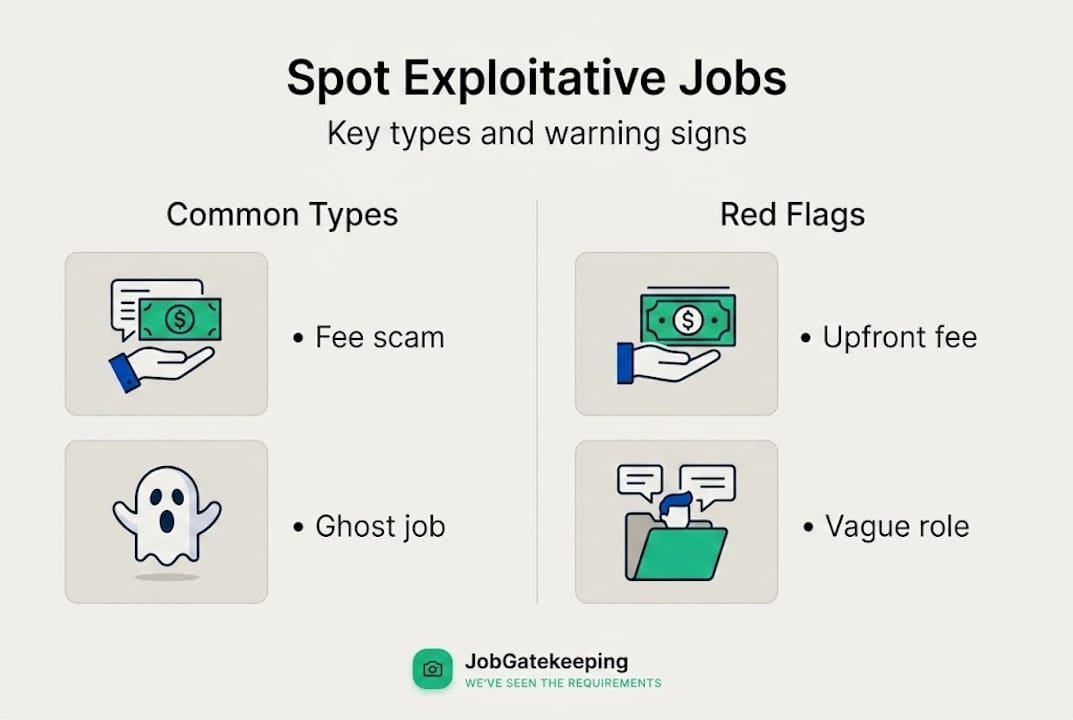
Fee scams are the most financially dangerous. These postings advertise attractive salaries, often for remote or travel-heavy roles, then ask applicants to pay for background checks, visa processing, equipment, or training before they can start. The fees are real. The job is not. Research confirms that exploitative practices "commonly include placing candidates under financial or personal-risk conditions via job scams, such as asking for fees, requesting sensitive documents, or issuing counterfeit or rapid offer materials."
Document and data harvesting operations look like legitimate applications. They ask for your resume, references, and then quickly escalate to requesting your ID, Social Security number, or banking details for "payroll setup." By the time you realize the job isn't real, your personal information is already circulating on the dark web.
Ghost jobs are a subtler but widespread problem. These are real postings from real companies, but the position was already filled internally, the budget was cut, or the listing was never tied to an actual opening. As ghost jobs reporting confirms, "companies publish listings with no intention of hiring; this is not always a direct financial scam, but it is still misleading to candidates and harms the labor market."
Unreasonable demands are another form of exploitation. Postings that require five years of experience for an entry-level role, expect candidates to complete extensive unpaid projects during the interview process, or offer "exposure" instead of pay are extracting real value from real people. Learning to avoid TEFL scams and bad employers gives a useful framework that applies across many industries.
Here's how a typical fee scam unfolds, step by step:
- You find a polished job posting on a major job board with a compelling salary and flexible hours.
- You apply and receive a fast, enthusiastic response within hours.
- The "hiring manager" conducts a brief interview via chat or email, never video or phone.
- You receive an official-looking offer letter with a start date and salary details.
- You're told to pay a fee for background screening, equipment, or visa processing.
- After payment, communication stops or the "company" disappears entirely.
Pro Tip: Legitimate employers never ask you to pay fees during the hiring process. If any cost is requested before you've started working, that's a scam. Full stop.
The comparison below shows how each type of exploitative posting targets a different vulnerability:
| Type | What they want | How they get it |
|---|---|---|
| Fee scam | Your money | Fake offer letters, urgent timelines |
| Data harvesting | Your personal info | Fake application forms |
| Ghost job | Your resume data | Real-looking but inactive listings |
| Unpaid labor scam | Your skills and time | Spec work, unpaid trials |
Warning signs and how to spot them
Knowing what to look for helps you avoid getting caught up in misleading or exploitative listings. The good news is that most exploitative postings leave clues if you know where to look.
Key red flags to watch for:
- Requests for payment at any stage before employment begins
- Pressure to accept an offer within 24 to 48 hours
- Job descriptions that are vague, copied from other postings, or inconsistent with the company's actual business
- Salary ranges that are dramatically above market rate for the role
- Communication only through personal email addresses rather than corporate domains
- Requests for sensitive documents like your passport or bank details before an official offer
- No verifiable company address, phone number, or LinkedIn presence
- Generic job titles with no specific duties listed
One important nuance: not all misleading job postings come from fake companies. As reporting on ghost job trends makes clear, "a posting can be exploitative even if it is from a legitimate company, such as ghost jobs with no intent to hire, or it can be outright fraudulent, such as scams requesting fees or sensitive documents."
A striking data point: surveys of active job seekers consistently find that a significant portion have applied to positions that turned out to be ghost jobs, with some estimates suggesting more than 40 percent of job seekers have encountered at least one ghost posting in a recent search cycle. That's not a fringe problem. It's a structural feature of how modern recruiting works.

Strong branding in recruitment from legitimate employers usually includes consistent messaging, a real careers page, and verifiable contact information. When those elements are missing or feel off, trust that instinct.
Quick checklist before you apply:
- Search the company name plus "scam" or "review" online
- Verify the company's address using Google Maps or LinkedIn
- Cross-reference the job posting on the company's official website
- Check whether the recruiter's email matches the company's domain
- Look up the hiring manager's name on LinkedIn
Pro Tip: Always verify company contact information independently. Don't use the phone number or email listed in the job posting itself. Search for the company's official website separately and use the contact details listed there.
What to do if you find an exploitative job posting
If you suspect or find yourself faced with an exploitative job offer, here's how to respond immediately and long-term. Acting quickly protects both you and other job seekers who might encounter the same posting.
Immediate steps to take:
- Stop all communication. Don't reply to further messages, and don't provide any additional information.
- Document everything. Take screenshots of the job posting, all messages, email addresses, and any documents you received. Save these in a secure location.
- Report the posting. Flag it on the job board where you found it. Most platforms have a "report this job" feature. Use it.
- Report to authorities. In the U.S., you can report job scams to the Federal Trade Commission at ftc.gov/complaint. The Internet Crime Complaint Center (IC3) also handles online fraud reports.
- Monitor your personal data. If you shared sensitive documents, place a fraud alert on your credit report through Equifax, Experian, or TransUnion.
- Notify your bank. If you shared financial information or made a payment, contact your bank immediately to flag the transaction.
From a fairness and compliance perspective, the EEOC guidance on hiring supports job seekers in pushing back: "job seekers can interpret exploitative patterns as signs the employer is not using objective, job-related criteria; job seekers can support fair practice by documenting discrepancies and refusing to provide sensitive info before verification."
"Refusing to share sensitive information before verification isn't paranoia. It's the professional standard that every legitimate employer already expects."
Beyond protecting yourself, there's a real ethical value in sharing what you find. When you report an exploitative posting or share your experience publicly, you protect every job seeker who comes after you.
Ways to share and support others:
- Post about your experience on job seeker forums and communities
- Leave a review on Glassdoor or Indeed with details about the deceptive posting
- Share screenshots with context on platforms that hold employers accountable
- Warn peers in your professional network, especially if the scam targets a specific industry
Resources like job search advice from experienced communities and guidance on how to avoid scam employers can help you rebuild confidence after a discouraging experience. The key is to keep moving, stay informed, and lean on your community.
The uncomfortable truth about the modern job search
Here's something most job search advice won't tell you: the conditions that allow exploitative job postings to thrive aren't accidents. They're byproducts of a system that has made it extremely cheap and easy to post a job listing, with almost no accountability for what happens next.
Digital recruiting platforms prioritize volume. The more listings, the more traffic, the more revenue. That incentive structure makes it easy for bad actors to blend in with legitimate employers. And even well-intentioned companies contribute to the problem through ghost jobs, which often exist because internal hiring processes are disorganized or because companies want to appear to be growing without actually committing to headcount.
The result is a job market where evidence-based hiring approaches are the exception rather than the rule. Most job seekers have no way to verify whether a posting reflects a real opening until they've already invested significant time and emotional energy. That asymmetry of information is exactly what exploitative postings rely on.
Individual vigilance matters, but it's not enough on its own. The job seekers who are most protected are the ones who combine personal caution with collective action. Reporting scams, sharing experiences, and building community knowledge creates a feedback loop that makes exploitation harder to sustain. When one person exposes a deceptive posting, hundreds of others benefit. That's not idealism. That's how accountability actually works in practice.
The uncomfortable reality is that systemic change requires pressure from job seekers, not just better individual choices. Every report filed, every screenshot shared, and every conversation started in a job seeker community chips away at the conditions that make exploitation possible.
Find support and share your story
As you navigate the job market, you're not alone and there's a community ready to help.

At JobGatekeeping, job seekers share screenshots of exploitative, unreasonable, and gatekeeping job postings every day. From entry-level roles demanding a decade of experience to unpaid "opportunities" dressed up as career development, the community calls it out openly and honestly. You can see exposed hiring practices from real postings that real people have encountered, and add your own voice to the conversation. Whether you're trying to identify a suspicious listing, looking for validation that a requirement is genuinely unreasonable, or just want to know you're not imagining the problem, this is where the conversation happens. Join the community and help make the job market more transparent for everyone.
Frequently asked questions
What counts as a red flag in a job posting?
Upfront payment requests, demands for sensitive documents, and unclear job roles are strong red flags, as exploitative practices typically involve placing candidates under financial or personal risk through fees, document requests, or counterfeit offer materials.
Is it legal for employers to ask for money during recruitment?
It is usually illegal or unethical for employers to charge candidates fees during the hiring process, since job scams frequently pressure applicants to pay processing fees or share personal documents as part of a fraudulent scheme.
What should I do if I realize I've responded to a scam job posting?
Stop communicating immediately, report the posting to the platform, and monitor your personal data for misuse. The EEOC confirms that job seekers support fair practice by documenting discrepancies and refusing to provide sensitive information before verification.
What are ghost jobs and why are they listed?
Ghost jobs are listings kept active with no real intent to hire, often used to gather resumes, make companies appear to be growing, or run data collection schemes. There are two types of ghost jobs: outright scams and legitimate company postings with no actual intent to fill the role.
Do reputable companies ever post exploitative jobs?
Yes, even legitimate companies may unintentionally post misleading or ghost jobs. A posting can be exploitative from a legitimate company when it's a ghost job kept active with no real hiring intent behind it.