

Nearly half of all job seekers will simply walk away from a job posting that doesn't list a pay range. That's not frustration talking. 44% of job seekers say they are unlikely to apply when salary information is missing. Recruiting transparency, which means openness about pay, process, criteria, and timelines, shapes whether job seekers trust a company before they ever step into an interview room. This article breaks down what real transparency looks like, where companies fall short, and exactly what you can do to protect yourself and make smarter application decisions.
Table of Contents
- Defining recruiting transparency: Clear standards and common gaps
- How lack of transparency impacts job seekers and employers
- Key elements of a transparent recruiting process
- What job seekers can do: Demand and apply transparency strategies
- The uncomfortable truth: What most insiders won't tell you about recruiting transparency
- Take control: JobGatekeeping resources for your next application
- Frequently asked questions
Key Takeaways
| Point | Details |
|---|---|
| Transparency attracts talent | Companies with clear pay ranges and processes enjoy higher offer acceptance rates and stronger candidate pools. |
| Job seekers demand clarity | 44% of candidates skip jobs without pay details, showing how crucial recruiting transparency is for engagement. |
| Openness supports fairness | Recruiting transparency helps prevent gatekeeping and ensures fairer outcomes for applicants and employers alike. |
| Use transparency as filter | Candidates can and should use missing information as a red flag to select more trustworthy employers. |
Defining recruiting transparency: Clear standards and common gaps
Recruiting transparency is the practice of openly sharing everything a candidate needs to make an informed decision about whether to pursue a job. That includes the pay range, the hiring process steps, the selection criteria, the expected timeline, and any feedback mechanisms. It sounds simple. In practice, most companies skip several of these elements entirely.
Think of it this way: if you walked into a store where nothing had a price tag, where the checkout process changed randomly, and where no one would tell you how long the line would be, you would leave. That is exactly what opaque recruiting feels like to job seekers every day.
What transparent recruiting should include:
- A clear salary or compensation range listed directly in the job posting
- A defined timeline from application to decision
- Specific, measurable job criteria (not vague language like "team player" or "dynamic go-getter")
- A commitment to provide feedback, or at least a status update, after key stages
- Disclosure if AI tools or automated screening are used in the review process
- Clear information about benefits, remote work options, and promotion pathways
Here is where the gap becomes most visible. Companies frequently post job descriptions with generic requirements, no salary data, and zero process information. Candidates submit applications into what feels like a black hole, hear nothing for weeks, and then receive a rejection with no explanation. That is not a broken pipeline. That is a design choice.
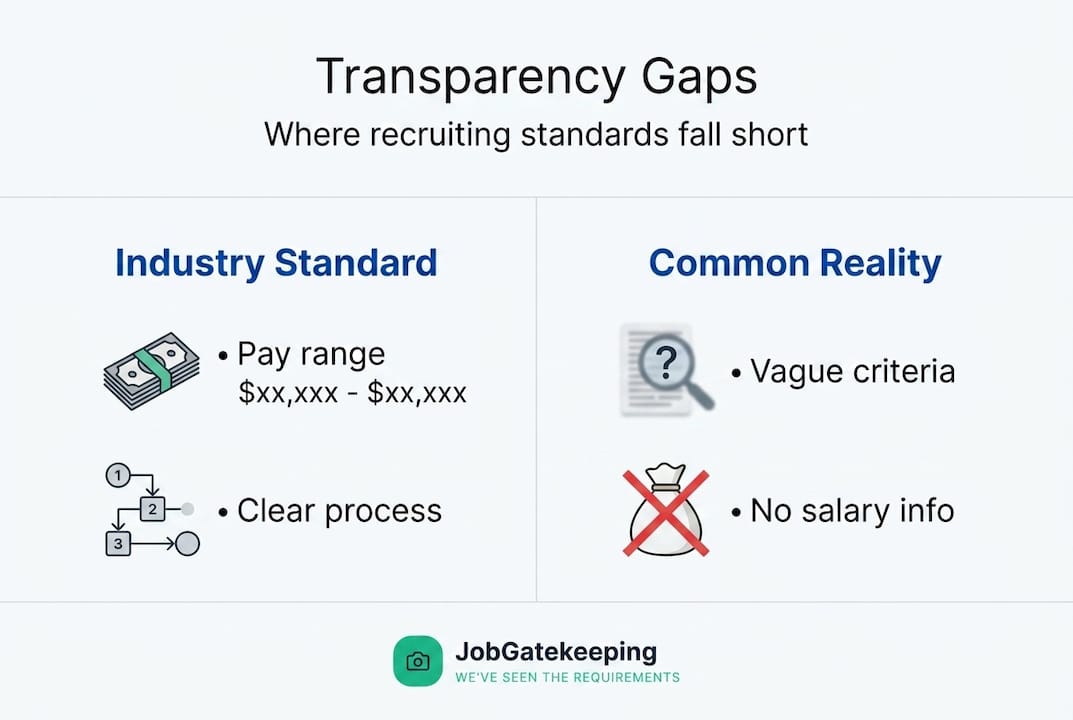
| Transparency element | Industry standard | What most companies actually do |
|---|---|---|
| Pay range | Listed in posting | Hidden or "competitive" |
| Process timeline | Shared upfront | Vague or never communicated |
| Selection criteria | Specific and measurable | Generic and subjective |
| Candidate feedback | Provided after interviews | Rarely given |
| AI/screening disclosure | Proactively disclosed | Almost never mentioned |
The statistics confirm what you already feel. 84% of job seekers believe companies hide pay specifically to reduce their negotiation power. This is not paranoia. It is a widely shared perception backed by real data, and it tells you something important: the information asymmetry in hiring is not an accident.
Pro Tip: When you see a job posting with no salary range and vague criteria, treat that as data about the company's culture, not just an oversight. Organizations that value transparency tend to start practicing it from the very first touchpoint with candidates.
Closing that gap between what transparent recruiting should look like and what actually happens requires both awareness and action. The next section covers exactly what is at stake when companies choose opacity over openness.
How lack of transparency impacts job seekers and employers
The real cost of opaque recruiting is almost always invisible until it stacks up. For job seekers, it shows up as wasted hours, anxiety, and the gut-punch of realizing a salary offer is 30% below what you needed. For employers, it shows up as extended searches, high candidate drop-off rates, and the slow erosion of their reputation on platforms where candidates share experiences.

For job seekers, the damage is both practical and psychological. When you apply without knowing the pay range, you're gambling your time. You might complete three rounds of interviews only to discover the offer doesn't meet your minimum. Beyond the wasted hours, it creates a feeling of being undervalued, like the company's time matters more than yours. Candidates who experience this frequently stop applying to companies with opaque practices entirely, shrinking their own opportunity pool out of self-protection.
For employers, the math is just as brutal. Companies that conceal recruiting information face longer hiring cycles, lower offer acceptance rates, and increased cost per hire. When a candidate declines an offer at the final stage because the pay wasn't what they expected, the company loses weeks or months of recruiter time, hiring manager time, and internal resources. That's a measurable business loss, not a soft HR problem.
"When candidates feel respected and informed throughout the hiring process, they are far more likely to accept offers and speak positively about the company, regardless of the outcome." This is the compounding benefit that transparent companies build over time.
Here's what the data shows about outcomes:
| Metric | Transparent recruiting | Opaque recruiting |
|---|---|---|
| Application rates | Higher, broader talent pool | Lower, candidates self-select out |
| Offer acceptance rate | Up to 88% | Significantly lower |
| Time to fill | Shorter | Extended by weeks |
| Candidate trust | Strong from first contact | Eroded before interview |
| Employer brand | Positive word of mouth | Negative reviews spread |
The 44% of applicants who won't apply without pay information are not a fringe group. They represent a massive slice of the qualified candidate pool that employers are voluntarily cutting themselves off from. Every opaque job posting is a self-inflicted recruiting wound.
The reality is that both sides lose when transparency is missing, but job seekers carry a disproportionate burden. They invest time, emotional energy, and hope into a process where the rules are unclear and the other side holds all the cards. Understanding this dynamic is the first step toward doing something about it.
Key elements of a transparent recruiting process
Knowing what transparency should look like gives you a checklist you can use to evaluate any company's hiring process before you invest your time. Here are the core elements, ranked by how directly they affect your ability to make an informed decision.
-
Pay range, listed and real. Not "competitive salary." Not "DOE" (depends on experience). An actual range. This is the single most important transparency signal because 83% of job seekers say they want full pay transparency, and companies that provide it are signaling respect for candidates' time and autonomy.
-
Process map with real timelines. A transparent company tells you upfront how many interview rounds to expect, who you will speak with, and approximately how long the process takes. This lets you plan, reduces anxiety, and shows organizational competence.
-
Specific job criteria. If the job description says "strong communication skills" with no further detail, that is a red flag. Transparent postings describe what good performance looks like. They tell you what success means in the role, not just a wish list of traits.
-
Feedback commitments. Will you get a reason if you're rejected? Will you hear back regardless of the decision? Companies that commit to this upfront are rare, but they exist, and they are worth seeking out.
-
AI and automated screening disclosure. Many companies now use AI to screen resumes before a human ever reads them. Transparent employers tell you this. If a company uses AI tools and hides that fact, you have no idea whether your application was actually reviewed or filtered out by an algorithm before a recruiter ever saw it.
-
Benefits and total compensation details. Salary is one line on a paycheck. Health insurance, retirement matching, remote work flexibility, vacation policies, and professional development budgets are all part of what you are actually earning. Transparent job postings address these.
Pro Tip: Use this checklist as a literal filter. Before you spend time tailoring your resume, run through these six elements. If a company is missing three or more, ask yourself whether you want to invest hours in an organization that doesn't respect your ability to make informed decisions.
These elements are not radical asks. They are basic professional courtesies that happen to also improve hiring outcomes for everyone involved. When you see them present, you are likely looking at a company that treats employees the way it treats candidates: with respect and clear communication.
What job seekers can do: Demand and apply transparency strategies
You do not have to wait for companies to get better at transparency. You can actively demand it, research it, and use its absence as a signal. Here is how to do that in practice.
-
Ask directly in your first interaction. When a recruiter reaches out or after you apply, send a brief, professional message asking for the salary range and process timeline. A simple question like "Could you share the budgeted range for this role so I can confirm alignment?" is professional, direct, and completely reasonable. How they respond tells you a lot.
-
Use market benchmarks before every conversation. Tools like the Bureau of Labor Statistics Occupational Outlook Handbook, industry salary surveys, and professional community forums give you real data on what roles pay. Walk into every conversation knowing your number, not guessing at it.
-
Think in total compensation, not just salary. Negotiate holistically, including total compensation: remote work flexibility, stock options, signing bonuses, health benefits, 401(k) match, and paid time off. Sometimes a lower base salary with strong benefits and remote flexibility is worth more than a higher base with rigid in-office requirements and minimal benefits.
-
Research the company's hiring reputation before applying. Check platforms where employees and candidates leave reviews. Look for patterns. If multiple people mention a chaotic interview process, weeks of silence, or offers that came in far below the listed range, that tells you something you cannot see in the job posting.
-
Set a transparency threshold and stick to it. Decide upfront what your minimum standards are. If a company won't share a pay range even when asked directly, that is useful information. You are not being difficult by expecting basic communication standards.
Practical steps checklist:
- Research salary benchmarks for the role before applying
- Ask for the pay range before scheduling interviews
- Clarify remote work, benefits, and process timeline in your first conversation
- Set a maximum number of interview rounds you are willing to complete without an offer discussion
- Keep notes on each company's responsiveness and communication quality
Pro Tip: Treating transparency as a filter rather than a hope is one of the most powerful shifts you can make in your job search. You are not just looking for a job. You are evaluating whether a company deserves your time and expertise.
The companies that respect your time at the recruitment stage are typically the same ones that respect it once you're hired. This is not always true, but it is a reliable enough signal to be worth tracking.
The uncomfortable truth: What most insiders won't tell you about recruiting transparency
Here is what the hiring industry does not advertise: a significant portion of recruiting opacity is entirely intentional. It is not a process failure or an oversight. Companies know that withholding salary information keeps candidates off-balance, which historically has led to lower opening offers and less assertive negotiation. The data confirms this. The 84% who believe companies hide pay to gain leverage are not cynical. They are accurate.
"Fake transparency" is also real. Some companies post salary ranges that are so wide they are functionally useless, like "$40,000 to $120,000," or list a range in the posting and then low-ball candidates with an offer at the very bottom. This is transparency as performance, not practice.
The only reliable test for real transparency is behavior under pressure. Ask tough questions. Ask them early. Ask them more than once if necessary. A company committed to genuine openness will not flinch. A company using transparency as marketing will become evasive when you get specific.
This is why collective accountability matters. When job seekers share their experiences and call out gatekeeping practices publicly, it changes the incentive structure for employers. Silence protects bad actors. Visibility creates pressure.
Take control: JobGatekeeping resources for your next application
The strategies in this article are most powerful when you have community and documentation behind you. At JobGatekeeping, we have built a platform specifically for job seekers who are done tolerating opaque and exploitative hiring practices.
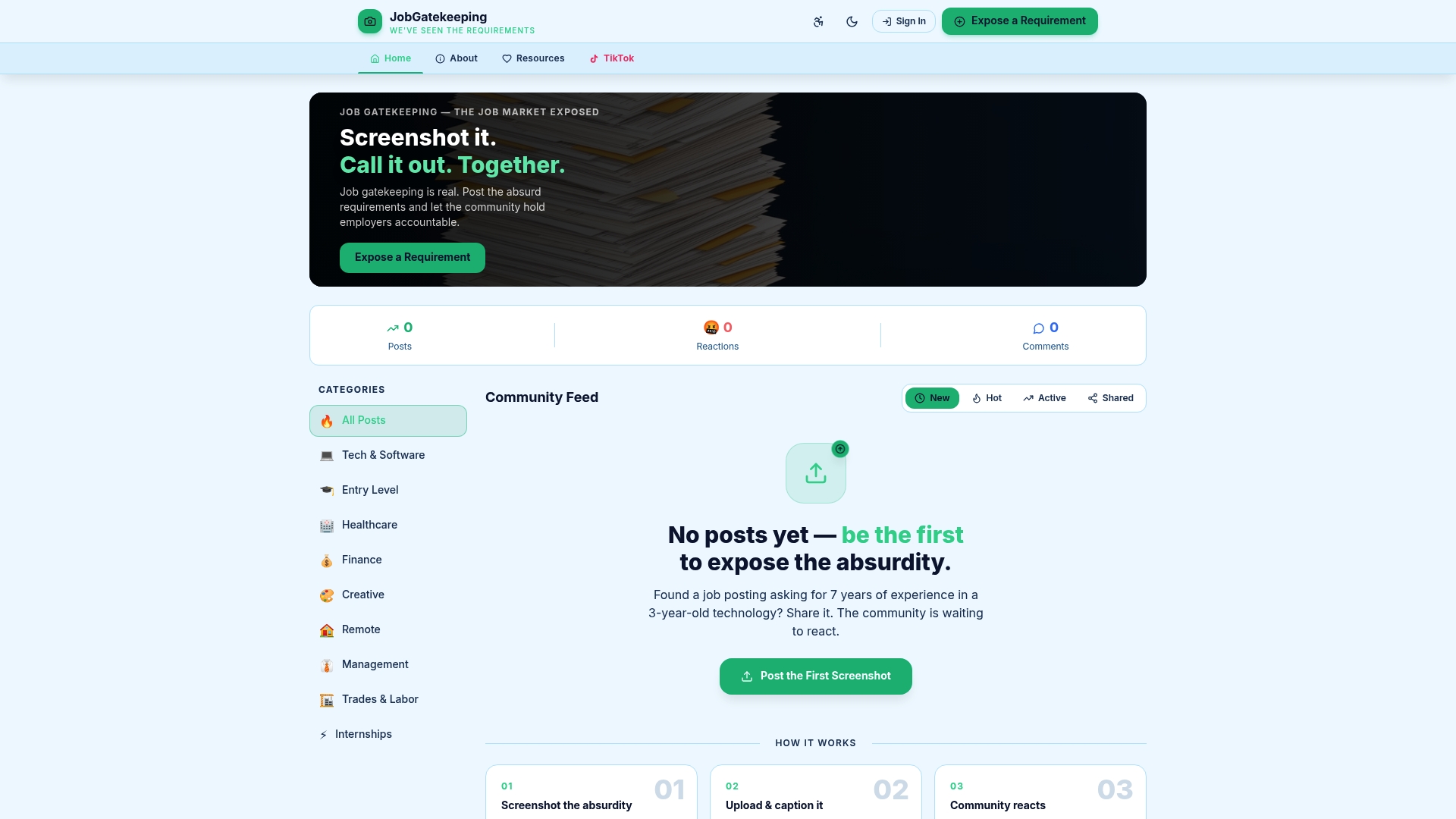
You can browse real examples of absurd job requirements that other job seekers have called out, from entry-level roles demanding a decade of experience to unpaid "internships" that are really full-time jobs. You can also upload screenshots of postings you have encountered, add context, and let the community react. Every submission contributes to a growing record of accountability that makes the job market a little more honest for everyone who comes after you.
Frequently asked questions
Why do companies hide pay ranges in job postings?
Most companies conceal pay ranges to retain negotiation leverage, with 84% of job seekers believing this is the primary motivation. Withholding the range keeps candidates uncertain, which tends to result in lower initial salary expectations.
How can I tell if a company is truly transparent in recruiting?
Look for a specific salary range, a clear process timeline, defined selection criteria, and upfront disclosure if automated screening tools are used. Companies that offer all four signals are genuinely committed to openness.
Does pay transparency actually lead to better job offers?
Yes. Transparent companies see offer acceptance rates rise to 88%, which reflects better candidate fit, fewer surprises at the offer stage, and stronger mutual trust throughout the process.
What should I ask a recruiter if pay isn't listed?
Ask directly for the budgeted salary range and follow up with questions about total compensation, remote work flexibility, and the number of interview rounds expected. This positions you as informed and sets a professional tone for the conversation.