

Nearly 17% of applicants skip applying to jobs simply because the language in the posting is too vague or confusing. That's not a small number. That's real opportunities lost because employers can't or won't write clearly. If you've ever stared at a job description wondering what "competitive compensation commensurate with experience" actually pays, or whether "fast-paced environment" is a warning sign, you're not imagining things. This guide is your decoder ring. We're breaking down the most common hiring jargon, calling out the red flags, and showing you exactly how to use this knowledge to your advantage.
Table of Contents
- Why job postings are full of jargon
- Decode common job posting jargon: What those terms really mean
- Red flags and traps: Jargon that should make you pause
- Turning jargon to your advantage: Research, ask, and respond
- Why jargon will outlast transparency laws—and what really works
- Take control of your job search with expert resources
- Frequently asked questions
Key Takeaways
| Point | Details |
|---|---|
| Jargon filters applicants | Employers use jargon to filter candidates but this can deter strong applicants. |
| Red flags reveal risks | Vague phrases like 'DOE' and buzzwords often hide crucial job info—dig deeper. |
| Decode to your advantage | Understanding posting language lets you ask better questions and negotiate smarter. |
| Proactive is powerful | Resumes tailored with actual, proven skills and questions turn jargon into hiring leverage. |
Why job postings are full of jargon
Let's be honest: most job postings are not written for you. They're written for algorithms, legal teams, and HR departments. Understanding that changes everything.
The biggest reason for all this vague language is ATS filtering, which stands for Applicant Tracking System. These are automated software tools that companies use to scan resumes and applications before a human ever sees them. When recruiting buzzwords appear in a posting, they're often designed to match the same words on incoming resumes. It's a keyword-matching game, not a genuine conversation with you.
Beyond the tech angle, jargon also helps employers stay vague on purpose. Phrases like "competitive salary" or "DOE" (Depends on Experience) are used to avoid committing to a real number. This gives employers the upper hand during negotiations, while leaving you guessing. It's frustrating, and it's intentional.
"Vague language in job postings doesn't just confuse applicants. It actively deters qualified people from applying, leading to worse hiring outcomes for everyone."
Here are a few other reasons jargon runs rampant in postings:
- Broad appeal: Employers want as many applicants as possible, so they use sweeping terms like "dynamic team player" or "self-starter" that sound positive but say nothing concrete.
- Legal cover: Phrases like "equal opportunity employer" or "EOE" are legally required signals, but when stuffed with other vague language, they blend into the noise.
- Unclear job design: Sometimes jargon is a mask for the fact that the employer hasn't fully figured out what they want. "Wear many hats" might mean the role is genuinely varied, but it often means "we'll keep adding responsibilities without adding pay."
- Resume padding norms: Employers mimic buzzwords they see elsewhere, creating a cycle that's hard to break.
Using a solid checklist for fair hiring can help you identify which postings actually meet a minimum standard of clarity. And if you're a job seeker who writes their own content, writing fair job captions offers a useful contrast for spotting the difference.
Decode common job posting jargon: What those terms really mean
Time to get into the real decoder stuff. Below is a breakdown of terms you'll see constantly, what they officially mean, and where they can mislead you.
| Term | Official meaning | Hidden risk |
|---|---|---|
| DOE | Depends on Experience | Salary is flexible but often hides the actual range entirely |
| PTO | Paid Time Off | Sounds great, but check if it's combined with sick leave and what accrual rules look like |
| UTO | Unpaid Time Off | You're not getting paid for that "flexibility" |
| CTC | Cost to Company | Includes benefits, bonuses, and extras that may inflate the apparent salary |
| EOE | Equal Opportunity Employer | A legal requirement, but not a guarantee of fair practices |
| Exempt | Not eligible for overtime pay | You can be worked past 40 hours with no extra compensation |
| Nonexempt | Eligible for overtime pay | Better protection, but sometimes used to justify lower base pay |
| Commensurate | Proportionate to your experience | Another way to say "we won't tell you the number" |
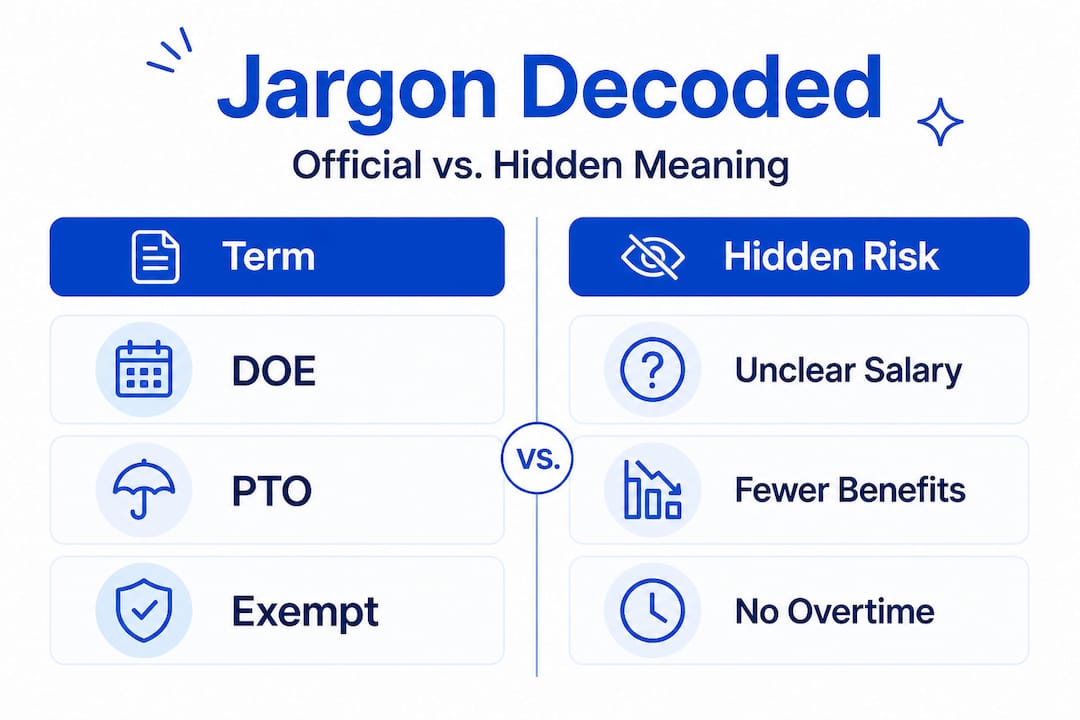
Let's go deeper on a few of these.
DOE is one of the sneakiest terms out there. On paper, it means the employer is open to negotiating based on what you bring to the table. In practice, it often signals that the employer wants to see what you'll accept before committing to anything. Employers in states with new pay transparency laws are increasingly required to post ranges, which is slowly reducing DOE-only listings. But you'll still see it everywhere.
PTO vs. UTO matters more than most people realize. PTO means you get paid while you're away, whether for vacation, illness, or personal matters. UTO means you don't. Some employers dress up "unlimited UTO" as a perk when it's really just unpaid leave. Always ask what the actual paid days count is.
Exempt vs. Nonexempt is huge for your quality of life. Exempt employees don't receive overtime pay under the Fair Labor Standards Act (FLSA). If a posting calls for an "exempt" salaried role, crunch the math: if you're expected to work 50+ hours weekly on a $45,000 salary, that hourly rate drops fast.
CTC shows up often in postings targeting candidates with international work experience. The total cost to the company includes your health benefits, retirement contributions, and other perks, which can make a $70,000 CTC look like more than it actually is in base take-home pay.
Pro Tip: Never assume you know what a term means in a specific company's context. Before your first interview, email the recruiter and ask for clarification on any undefined terms. It shows thoroughness and forces the employer to commit to specifics early. You can spot exploitative job postings much faster when you get answers in writing. Also check out how to evaluate job posts for traps before investing time in a full application.
Red flags and traps: Jargon that should make you pause
Some phrases seem harmless but are consistently used to mask bad working conditions, unfair pay, or unrealistic expectations. Here's a comparison table of the worst offenders.

| Jargon used | What it might mean | When it's a red flag 🚨 |
|---|---|---|
| "Fast-paced environment" | High workload, tight deadlines | Red flag if no specifics on team size or support |
| "Wear many hats" | Multiple roles bundled into one | Red flag if pay doesn't reflect the load |
| "Competitive salary" | Pay is roughly market rate | Red flag when combined with no stated range |
| "Unlimited earning potential" | Commission-only compensation | Almost always a red flag |
| "DOE" alone | Salary TBD based on you | Red flag when no range is given at all |
| "Self-starter needed" | Little to no onboarding or support | Red flag for new grads or career switchers |
| "Rockstar / ninja / guru" | Inflated expectation, casual culture branding | Red flag: often paired with low pay |
| "Must be comfortable with ambiguity" | No defined processes or structure | Red flag if you need clear direction |
That 17% of applicants who skip vague postings? They're making a rational choice. Applying to a role with zero pay transparency or a wall of buzzwords wastes your time and energy.
Here are five concrete steps to protect yourself when you spot suspicious jargon:
- Research average salaries first. Use tools like Glassdoor, Levels.fyi, or the Bureau of Labor Statistics to know what a fair range looks like for the role and your market. Don't walk in blind.
- Ask direct questions. In your first message to a recruiter, ask: "Can you share the salary range for this role?" Employers in many states are legally required to answer. If they dodge it, that tells you something.
- Compare benefit terms side by side. PTO days, health coverage quality, and retirement matching can be worth thousands of dollars. Don't just look at base pay.
- Check for specificity in listed duties. A good posting lists actual responsibilities. If every bullet says "collaborate with cross-functional teams" and nothing else, the job design is probably a mess.
- Avoid postings that are all buzzwords. If you can't find a single concrete deliverable or tool mentioned in the job description, it's often a sign the employer hasn't thought this through, or is hiding something.
Need help figuring out whether a specific posting is designed to trap you? Learn how to spot job post traps with a step-by-step framework, and find out how to protect against exploitative postings before it costs you time or dignity.
Turning jargon to your advantage: Research, ask, and respond
Here's the flip side. Once you understand what the jargon means, you can actually use it strategically. You stop being a passive applicant and start playing the game with a full deck.
The number one move: mirror the exact language from the job posting in your resume, but only when it's genuine. If a posting asks for "SQL proficiency," use the phrase "SQL" in your resume, not just "database management." ATS systems are literal keyword matchers, so precision matters. Generic buzzwords like "excellent communicator" won't help you pass the filter, but specific tools and skills will.
Here's a quick list of smart tactics to use right now:
- Clarify ambiguous terms before interviews. Email ahead. "I noticed the posting mentions 'flexible hours.' Could you describe what a typical workweek looks like?" This isn't annoying. It's professional.
- Research market salaries every time. Don't rely on a number you researched two years ago. Markets shift.
- Leverage pay transparency laws. States like California, Colorado, New York, and Washington now require salary ranges in job postings. If a company is headquartered there or lists remote work, you may be entitled to that range by law.
- Get specifics in writing. If a recruiter verbally mentions a signing bonus or a specific PTO policy, ask for it in the offer letter. Verbal promises don't pay your bills.
- Use trusted online resources. Sites like LinkedIn Salary, Payscale, and the Bureau of Labor Statistics give you real data to back up your asks.
For more on optimizing your resume for automated screening, check out these resume tips for ATS. And if you want to understand your rights around pay disclosures, learn how to demand hiring transparency in every stage of the process.
Pro Tip: In interviews, rephrase vague jargon from the posting back to the employer as a question. If the posting said "fast-paced environment," ask: "Can you describe what a typical week looks like in terms of workload and priority changes?" You force clarity and show you read the posting carefully. 🔥
Why jargon will outlast transparency laws—and what really works
Here's the uncomfortable truth: transparency laws are a step forward, but they won't save you. Jargon will outlast them. And here's why we believe that.
Hiring jargon isn't just laziness. It's often the product of legal strategy, corporate wordsmithing, and the simple fact that writing a clear job posting takes effort most hiring managers aren't incentivized to spend. Even with pay range mandates, employers will still write ranges like "$45,000 to $175,000" for a single role. Technically compliant. Totally useless.
We've seen it happen. States pass new rules, and within weeks, job postings just shift the vague language around. "Competitive compensation" becomes "range varies by location and experience." The opacity remains. The game continues.
What experienced job seekers do differently is treat jargon as the opening of a negotiation, not a finished statement. They read "DOE" and immediately start gathering data. They see "wear many hats" and ask follow-up questions. They don't wait for companies to get better. They get sharper.
Jargon literacy is a permanent skill. The job market will keep evolving, the laws will keep lagging, and employers will keep finding new ways to stay vague. Your best tool is understanding the system well enough to work around it. Explore how to use a transparent postings workflow to audit any posting you receive. And if you want to go further in holding employers accountable, learn how to demand recruiting transparency as part of your standard job search routine.
The job seekers who thrive aren't the ones waiting for the system to fix itself. They're the ones asking sharper questions, doing the research, and refusing to walk into an interview without knowing what they're worth.
Take control of your job search with expert resources
Navigating vague job postings alone is exhausting. But you don't have to do it alone.

JobGatekeeping is built for exactly this moment. Our platform gives you access to checklists, transparency guides, and a community of job seekers who call out absurd postings every single day. Whether you want to learn how to identify exploitative ads or sharpen your ability to read between the lines, we've got resources that meet you where you are. The more you understand how hiring language works, the more confidence you carry into every application and negotiation. Knowledge is leverage, and we're here to help you use it.
Frequently asked questions
What does 'DOE' mean in a job posting?
"DOE" stands for "Depends on Experience," meaning salary is flexible based on your background, but it's often used to avoid disclosing the actual pay range upfront.
Is PTO paid time off?
Yes, PTO covers vacation, sick leave, and personal days that are fully compensated, unlike UTO (Unpaid Time Off), which pays you nothing while you're away.
Why do companies use vague language in job ads?
Employers use jargon to filter applicants through ATS systems, attract a broad pool, and avoid stating pay ranges or specific responsibilities upfront.
How can I tell if a posting is hiding something?
Watch for excessive buzzwords, missing salary ranges, or unclear duties. Research shows 17% of applicants skip these postings entirely, and for good reason.
Should I use jargon from job postings in my resume?
Only mirror the relevant keywords that match your actual skills. Adding empty buzzwords you can't prove in an interview will only hurt you.