

60% of job seekers won't even apply to a job posting without a salary range listed. Let that sink in. Companies are actively shrinking their own applicant pools by staying silent about pay, and most of them know it. Yet opaque postings are everywhere. No salary. No range. Just "competitive compensation" and a wish list of requirements that reads like a ransom note. This article breaks down exactly why companies hide pay information, the legal loopholes they exploit, and what you can do to protect yourself and push for real change.
Table of Contents
- Structural and legal reasons job postings stay opaque
- Internal pay equity, compression, and management fears
- How pay transparency laws are shaping the landscape
- The impact on applicants: Trust, fairness, and applicant pools
- The uncomfortable truth about job posting transparency
- Take action for fair and transparent hiring
- Frequently asked questions
Key Takeaways
| Point | Details |
|---|---|
| Opaque postings reduce trust | When pay details are hidden, applicants lose confidence in employers and hiring practices. |
| Legal mandates face loopholes | Even laws requiring salary info are widely skirted through ignorance or deliberate omission. |
| Internal equity drives opacity | Fears of exposing pay disparities within organizations lead management to avoid disclosure. |
| Transparency attracts more applicants | Clear job postings boost applicant numbers and diversity by lowering barriers for candidates. |
| Advocacy makes a difference | Job seekers and community members can push for fair hiring by demanding more transparency. |
Structural and legal reasons job postings stay opaque
With the backdrop of applicant frustration front and center, let's explore the internal and legal causes of opaque job postings. Because the problem goes deeper than companies just being secretive. There are genuine structural reasons this keeps happening, and understanding them helps you spot the red flags faster.
One of the biggest culprits is outdated pay infrastructure. Many organizations have fragmented pay structures that haven't been updated in years. Titles like "Senior Analyst" might mean completely different things across different departments, making it nearly impossible to post a single accurate salary range without triggering internal confusion. So instead of fixing the problem, companies post nothing.
Legal compliance is another area where companies play games. Even in states with strict pay transparency laws, 25% of covered job postings still omit salary information entirely. That's not an accident. It's a pattern of deliberate noncompliance or willful ignorance, and it affects your ability to make informed decisions about where to apply.
Understanding labor laws and fair hiring is essential if you want to know when a company is genuinely breaking the rules versus just being vague. Here's how the compliance landscape breaks down:
| State requirement | Common employer response | What it actually means for you |
|---|---|---|
| Must post salary range | Posts a $40K–$200K range | Useless anchor, no real info |
| Good faith salary range required | Posts roles with "DOE" (depends on experience) | Likely noncompliant |
| No law in place | Posts nothing | You're flying blind |
| Active enforcement state | Still omits salary in 1 in 4 cases | Noncompliance is widespread |
The problems with recruiting transparency also stem from the fact that HR teams are often siloed. Compensation teams set pay bands, legal teams review compliance, and recruiters post jobs, sometimes without all three talking to each other properly. The result is postings that are legally questionable and practically useless.
Key structural issues driving opacity include:
- ✗ Salary grades tied to outdated job families that don't reflect modern roles
- ✗ Multiple business units with wildly different comp philosophies under one umbrella
- ✗ Legal teams that prioritize minimal disclosure over genuine transparency
- ✗ Job posting templates copied from years ago without updates for new transparency laws
- ✗ No internal accountability for verifying that posted ranges actually reflect reality
This is the system working against you. Not by accident, but by design.
Internal pay equity, compression, and management fears
Beyond structure and compliance, internal dynamics and management fears also drive posting opacity. And honestly? This is where it gets really frustrating.
Pay compression is a real issue inside most large organizations. It means that internal pay inequities get exposed the moment a company posts a salary range for a new hire that's higher than what current employees are making in similar roles. Suddenly, the person who's been at the company for three years is earning less than the person who just got hired. That triggers morale issues, turnover, and uncomfortable conversations that managers are simply not equipped to handle.

Here's what that looks like in practice:
| Scenario | Current employee salary | New hire posted range | Gap |
|---|---|---|---|
| Software engineer, 3 years tenure | $85,000 | $90,000–$110,000 | $5K–$25K below |
| Marketing manager, 5 years tenure | $72,000 | $80,000–$95,000 | $8K–$23K below |
| Data analyst, 2 years tenure | $65,000 | $70,000–$85,000 | $5K–$20K below |
These gaps aren't unusual. They're the norm. And companies know that the moment employees see posted ranges, they'll start asking questions. Those questions lead to renegotiations, which cost money. So instead, many companies choose silence.
Managers may not be trained to explain pay decisions either. This is a huge, underreported part of the problem. Even if a company wanted to be transparent, the people who would have to have those conversations with employees often lack the skills or authority to do so confidently. So the organization protects itself by just keeping everything vague.
Understanding fair hiring principles can help you recognize when a company's opacity is a symptom of a deeper cultural problem. And cultural problems don't fix themselves after you're hired. They follow you throughout your tenure.
Watch out for these internal fear signals in job postings:
- ✗ "Compensation commensurate with experience" with no range provided
- ✗ Job descriptions that avoid mentioning the team's existing pay structure
- ✗ Interview processes that heavily penalize candidates who ask about pay early
- ✗ Recruiters who dodge direct salary questions with "we'll discuss later"
A transparent workflow for job postings looks completely different. It includes clear ranges, honest descriptions of the compensation philosophy, and recruiters who can actually talk about money without flinching.
Pro Tip: If a recruiter cannot give you a ballpark salary in the first conversation, that's data. It tells you how this company handles uncomfortable conversations internally. Do you want to work somewhere that can't talk about money openly?
How pay transparency laws are shaping the landscape
Legal shifts are underway, and here's how new laws and employer tactics are changing the transparency landscape. It's progress, but it's slower and messier than advocates hoped.
Several states, including California, Colorado, New York, and Washington, now require employers to post salary ranges in good faith. The intent is clear: help workers know what they're walking into and close persistent pay gaps. But employers have found creative ways to comply on paper while undermining the spirit of the law.
"Good faith" means the range should reflect what the employer actually expects to pay. But posting a $50,000–$150,000 range for a mid-level marketing role is technically compliant while being practically useless.
Here's how employers narrow or evade transparency requirements:
- Post absurdly wide ranges to technically comply without revealing anything useful
- Post vague titles that make it impossible to compare across similar roles
- Exclude remote workers in states where remote work exceptions exist
- Quietly repost jobs after removing ranges that drew too much attention
- List roles as contract positions to sidestep full-time disclosure requirements
A job posting checklist can help you evaluate whether a company is actually complying with local law or gaming it. If you're in a covered state and see no salary info, that's a potential violation worth reporting.
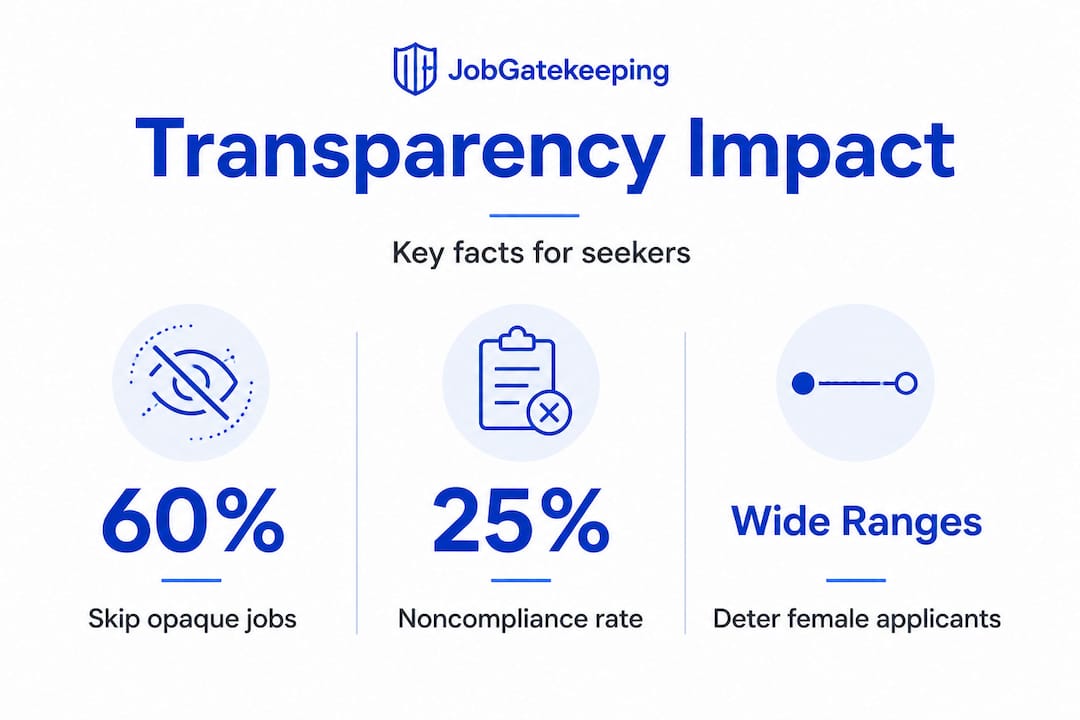
🚨 The noncompliance rate sits at about 25% even in states with active pay transparency enforcement. One in four covered postings still omits salary data. That's not a rounding error. That's a systemic failure.
There's also a subtler issue affecting fairness. According to research, wide salary ranges in job postings can actually harm female applicants more than male ones because of well-documented differences in how risk and negotiation are socialized. A $60K to $130K range doesn't level the playing field. It often just shifts where the inequality happens.
For hiring transparency tips that actually account for these nuances, you need resources that go beyond surface-level advice. Knowing the law is step one. Understanding how companies dodge it is step two.
The impact on applicants: Trust, fairness, and applicant pools
Transparency practices have measurable impact on applicants. Here's what happens when clarity is missing and how you can respond.
The numbers tell a stark story. 60% of job seekers will skip a posting entirely if it lacks salary information. That means companies hiding pay ranges are automatically cutting their applicant pool nearly in half. And they're not losing random applicants either. They're disproportionately losing experienced candidates who know their worth and aren't willing to waste time on a mystery paycheck.
Noncompliance risks a "trust tax" that compounds over time. When applicants feel deceived by vague postings, that sentiment spreads. Glassdoor reviews mention it. Reddit threads amplify it. And eventually, the company's employer brand takes a real hit that no amount of PR fixes quickly.
The impact on diverse talent is especially serious:
- ✗ Women and minority candidates are more likely to self-select out of roles without clear pay info
- ✗ First-generation professionals often lack the networks to find out what a role "really pays"
- ✗ Candidates with caregiving responsibilities can't risk a low-ball offer after a long process
- ✗ International applicants navigating visa considerations need pay clarity upfront to assess feasibility
Knowing how to spot exploitative job ads is a survival skill in this market. Opacity is often one of several red flags clustered together. Look for the combination: no salary range, vague title, unrealistic requirements, and buzzword-heavy descriptions.
When you're trying to evaluate entry-level postings, pay absence is especially telling. Entry-level roles are where exploitation is most common, and where candidates have the least leverage to push back in the interview process.
Pro Tip: Use transparent job boards as your starting point whenever possible. Platforms that require salary disclosure filter out a lot of the noise upfront. For winning job search tips in a difficult market, prioritizing transparency-first postings isn't just ethical, it's a smarter use of your time.
What can you do right now?
- ✓ Filter searches to include only postings with salary ranges on platforms that allow it
- ✓ Ask about compensation range directly in your first recruiter outreach message
- ✓ File a complaint with your state labor board when covered postings omit salary data
- ✓ Share problematic postings publicly to create accountability
- ✓ Research salary benchmarks on Levels.fyi, Glassdoor, and LinkedIn before any interview
The uncomfortable truth about job posting transparency
Here's what nobody in the HR world wants to say out loud: laws alone are not going to fix this. Not even close.
The assumption driving most pay transparency advocacy is that once companies are legally required to disclose salaries, the behavior will change and fairness will follow. But that's not how entrenched organizational fear works. Companies don't just change culture because a regulation tells them to. They adapt. They find workarounds. They post a $40K to $180K range and call it a day. Technically compliant. Practically meaningless.
The deeper issue is that pay secrecy isn't a policy choice. For most companies, it's a survival mechanism. Revealing what people earn forces organizations to reckon with years of inequitable decisions, rushed promotions, and inconsistent raises. That's a painful process. Most leadership teams would rather post a vague range and weather the occasional recruiter ghosting than crack open that can of worms internally.
There's also an uncomfortable truth about wide salary ranges. Research suggests that broad posted ranges may actually harm fair hiring for women applicants, who are statistically less likely to anchor to the top of a wide range during negotiation. So the range that looks progressive might just relocate the bias from the job post to the offer stage.
What job seekers often miss is that how a company writes its posting is itself a values signal. Clear, specific, honest postings reflect a culture that values directness. Vague, jargon-stuffed postings with no pay information signal an organization that is either confused about what it needs, or intentional about keeping you in the dark. Both are problems.
The companies getting this right aren't waiting for regulators. They're sharing ranges, explaining their pay philosophy, and training managers to have real compensation conversations. That gap between leaders and laggards tells you everything about where a company's values actually sit.
Take action for fair and transparent hiring
If you're ready to make your job search and your advocacy more effective, here's where to go next. 🔥
Frustration is valid. But frustration plus action is where real change happens. You don't have to accept opaque postings as the default. You can call them out, document them, and share them with a community that gets it.

JobGatekeeping is built exactly for this. It's a platform where you can anonymously upload screenshots of problematic job postings, whether it's a "junior role" requiring ten years of experience or an unpaid internship dressed up as a "learning opportunity." The community reacts, amplifies, and holds companies accountable in a way that one frustrated applicant alone simply can't. Use the exploitative job postings guide to sharpen your eye for what to flag. Together, every screenshot and every shared post adds pressure for fairer standards. Your voice matters here. Use it.
Frequently asked questions
Why do companies conceal salary information in job postings?
Companies hide salary details to avoid exposing internal pay inequities and triggering morale issues or renegotiation demands from current employees who may earn less than newly posted ranges.
Are employers breaking the law by omitting salaries in states with transparency laws?
Yes, in many cases. About 25% of postings in states with active pay transparency laws still omit salary information, reflecting deliberate noncompliance or failure to enforce internally.
How does salary opacity affect job applicants?
It drives away serious candidates fast. 60% of job seekers won't apply to postings without salary ranges, meaning opaque listings shrink applicant pools and reduce employer access to top talent.
Do wide salary ranges really help applicants?
Not always. Wide pay ranges may actually deter female applicants due to differences in how risk and salary negotiation are socially conditioned, meaning broad ranges can shift rather than eliminate unfairness.
What practical steps can job seekers take to demand more transparency?
Ask about pay range directly in your first recruiter touchpoint, filter for postings on transparent job boards, file state labor board complaints when covered postings omit salary info, and use platforms like JobGatekeeping to publicly call out noncompliant postings.