

The job market in 2026 is not just tough. It's a gauntlet. The applicant-to-opening ratio has dropped below 1.0 for the first time since 2017, applications per posting have doubled since 2022, and 80% of professionals report feeling completely unprepared for what they're facing. You're competing against hundreds of applicants for every role, many of which demand five years of experience for an "entry-level" position. Sound familiar? Good. Because we're here to cut through the noise and give you real, actionable strategies that actually work in this environment.
Table of Contents
- Understanding the 2026 job market realities
- How AI and ATS are changing hiring
- Targeted searches beat mass applications
- Comparison: What works and what wastes your time
- Skills-based hiring: How to prove you're a top candidate
- A hard truth: Navigating gatekeeping and redrawing the map
- Get more insights on modern hiring
- Frequently asked questions
Key Takeaways
| Point | Details |
|---|---|
| Focus on skills | Demonstrable abilities beat credentials in the 2026 job market. |
| Customize applications | Tailor each resume to job requirements and optimize for AI filters. |
| Network for success | Referrals increase your chances of being hired more than 9 times compared to mass applications. |
| Avoid time-wasters | Skip mass applying and invest your efforts in targeted roles and personal branding. |
| Advocate for fairness | Challenging unnecessary barriers helps change hiring for everyone. |
Understanding the 2026 job market realities
Let's be direct: the phrase "low-hire, low-fire" defines 2026 hiring. Companies aren't growing headcount aggressively, and existing employees aren't leaving. That means fewer openings, more applicants per role, and hiring managers who have the luxury of being absurdly picky. The result? Job listings stuffed with ridiculous requirements that would make even a veteran professional sweat.
Here's what the numbers tell us:
| Market Indicator | 2022 | 2026 |
|---|---|---|
| Applications per job posting | Average ~100 | Average ~200+ |
| Applicant-to-opening ratio | Above 1.0 | Below 1.0 |
| Professionals feeling prepared | ~50% | ~20% |
| Companies using AI in hiring | ~60% | 87%+ |
Applications per posting doubled since 2022, and that alone explains why your carefully crafted resume might be getting lost in a flood of submissions. It's not you. The system is broken.
🚨 "The job market in 2026 rewards precision and strategy, not volume. Shotgun approaches no longer work." That's the reality we're all navigating together.
Overqualification has become normalized. Entry-level roles now request three to five years of experience, specific software certifications, and industry-specific knowledge that would previously have been reserved for mid-level hires. Employers are piling on requirements because they can. And that gatekeeping is exactly what we at JobGatekeeping exist to call out. Understanding this context is your first weapon.
How AI and ATS are changing hiring
Once you understand the competitive market, it's critical to grasp how artificial intelligence shapes your job search from the first second your resume is submitted. Spoiler: most hiring managers never even see your application unless an algorithm approves it first.
87% of companies use AI in their hiring processes, with 50% using AI exclusively for initial rejections. That means half of your applications may be rejected before a single human reads them. Let that sink in.
Here's what you need to know about surviving the AI filter:
- Match keywords exactly. ATS systems (Applicant Tracking Systems) scan for specific terms from the job description. If the posting says "project management," don't write "project coordination." Mirror the language precisely.
- Avoid fancy formatting. Tables, graphics, and unusual fonts confuse ATS parsers. Stick to clean, simple resume layouts.
- Skills-based language wins. Instead of writing "responsible for team leadership," write "led a team of 8 engineers to deliver X project on time." Specific, measurable, skills-forward language is what both AI and humans reward.
- Quantify everything. Numbers cut through algorithmic noise. "Increased sales by 34%" is more scannable and impactful than "improved sales performance."
- Avoid keyword stuffing. AI has gotten smarter. Stuffing 50 keywords into white text won't help. Integrate them naturally throughout your resume and cover letter.
Pro Tip: Before submitting any application, paste the job description and your resume into a free ATS checker tool. You'll see instantly where your keyword gaps are and fix them before the algorithm does it for you.
⚠️ AI bias is real. Automated systems can disadvantage candidates based on gaps, non-traditional career paths, or unconventional school names. Always look for ways to request human review, such as applying via referrals or reaching out directly to hiring managers on LinkedIn after submitting.
The goal here is not to game the system cynically. It's to make sure your actual qualifications aren't buried under algorithmic gatekeeping. You deserve to be seen.
Targeted searches beat mass applications
Now that you know how to get seen by the AI, here's how to stand out and actually get called back. The "spray and pray" method, where you blast 50 applications a day with minimal customization, is officially dead. It doesn't just waste your time. It actively hurts your morale and dilutes the quality of every application you send.
Here's a step-by-step approach to targeted job searching:
01. Define your target clearly. Identify 10 to 15 companies you genuinely want to work for. Research their culture, recent news, products, and hiring patterns. You want to know them before you apply to them.
02. Match your skills to their needs. Read each job description carefully. Highlight the top five skills and requirements they emphasize. Then make sure those exact skills are visible in your resume, cover letter, and LinkedIn profile.
03. Customize every application. Yes, every single one. Change the opening line of your cover letter. Adjust your resume summary. Reference a specific company initiative or product you admire. It takes 20 extra minutes and multiplies your response rate significantly.
04. Activate your network before you apply. Find someone at the company on LinkedIn. Send a short, genuine message asking about the team or role. This is not begging. This is smart networking, and it creates a human connection that algorithms can't erase.

05. Follow up respectfully. One week after applying, a brief, polite follow-up email to the recruiter can keep you visible without being annoying.
The numbers on this are staggering. Referrals are 9x more likely to result in a hire than applying cold through a job board. Nine times. That's not a minor advantage. That's a fundamentally different playing field.
🔥 Referrals = 9x higher hire rate. Build your network before you need it, not when you're desperate.
Pro Tip: LinkedIn's "Alumni" tool is criminally underused. Search for people from your college or previous employer who now work at companies you're targeting. You already have a built-in conversation starter. Use it.
The investment of time upfront in research and network activation pays back with actual interviews. Fewer applications, better outcomes. That's the 2026 strategy that works.
Comparison: What works and what wastes your time
To make sense of these options, see how each stacks up in direct comparison under today's job market rules. Not all job search strategies are created equal, and some are genuinely eating your time with near-zero return.
| Strategy | Effort Level | Interview Rate | Time Cost | Best For |
|---|---|---|---|---|
| Mass cold applications | High volume | Very low (~1-2%) | Very high | Nobody, honestly |
| Tailored applications | Medium volume | Moderate (~10-15%) | Medium | Most job seekers |
| Building online presence | Ongoing | Passive but real | Low daily | Long-term visibility |
| Direct referrals | Low volume | High (~30-40%) | Low per application | Best results overall |
| Recruiter outreach | Medium | Variable | Medium | Specialized roles |
Tailored applications and networking consistently produce higher interview rates than mass-applying, and the data backs this up across every industry sector studied. The frustrating part? Most job seekers still default to mass applying because it feels productive. Clicking "Easy Apply" 40 times feels like progress. It rarely is.
Building your online presence deserves a special callout here. A polished LinkedIn profile with rich skills sections, project highlights, and active engagement in industry conversations is essentially a passive recruiter magnet. Hiring managers search for candidates. Make sure they can find you and like what they see. Post content. Comment thoughtfully. Get your name circulating in the right circles.
The real time-wasters are generic cover letters, unoptimized resumes, and mass applying without tailoring. Cut those habits now.
Skills-based hiring: How to prove you're a top candidate
Having tackled general approaches, the final key is showing the value you bring, even when requirements seem impossible. Employers love to pile on credentials in their job listings. But here's what's actually shifting underneath all that noise: skills-based hiring is rising while degree requirements are mattering less. Companies like Google, IBM, and Apple have already dropped degree requirements for many roles. The trend is spreading.
What employers actually want is demonstrable proof that you can do the work. Here's how to give it to them:
- Build a portfolio, no matter your field. Designers and developers have done this forever. But now, marketers, analysts, project managers, and even HR professionals can create case study portfolios that show real outcomes. A Google Doc with three strong case studies beats a resume bullet point every single time.
- Link to your work everywhere. Add portfolio links to your resume header, LinkedIn profile, and email signature. Make it impossible for a hiring manager not to see what you've built.
- Get skills endorsed and certified. LinkedIn endorsements from colleagues carry weight. Certifications from Google, HubSpot, Coursera, and similar platforms signal initiative. They also give AI filters keyword ammunition to work with.
- Do a small spec project. If you're applying to a role you really want, create a small piece of work tailored to that company. A sample marketing plan, a redesigned UX flow, a short data analysis. Attach it to your application or bring it to the interview. It's hard to ignore.
- Call out gatekeeping directly (professionally). If a job posting asks for 10 years of experience with a tool that only launched 3 years ago, that's absurd. You can still apply and directly address it: "I understand this role lists X requirement, but I want to show you why my skills make me the right candidate regardless."
Pro Tip: Search for roles one or two levels below where you're targeting and read their requirements carefully. Then build your portfolio to exceed those expectations. When you apply to the higher-level role, you'll have proof that you're already performing above that bar.
Skills-based hiring is the crack in the gatekeeping wall. Use it aggressively.
A hard truth: Navigating gatekeeping and redrawing the map
Here's what nobody wants to say out loud: the hiring system is not designed to find the best candidate. It's designed to filter and protect. When a company posts an entry-level job requiring five years of experience, it's not because they genuinely need it. It's often because they can demand it and because lazy requirement-writing has become standard practice.
The shift to skills-based hiring favors demonstrable abilities over credentials, and AI filters demand keyword optimization. But here's the uncomfortable truth about AI: pairing automated screening with human oversight is essential, and most companies aren't doing that well. Bias gets baked in. Algorithms reject good candidates for arbitrary reasons.
What does that mean for you? It means you cannot afford to play the game passively. You have to push back, strategically. Apply even when you meet 60% of the requirements. That's often enough. Use your network to get your application seen by a human. Highlight the skills you have, not the credentials you lack.
And beyond your individual job search, there's a collective role to play. When you see an absurd job listing demanding impossible qualifications, call it out. Share it. Document it. That's exactly what communities like JobGatekeeping are built for. The more we collectively shine a light on gatekeeping tactics, the harder it becomes for companies to keep using them. Individual advocates who refuse to stay quiet are genuinely changing what employers think they can get away with.
The candidates who thrive in 2026 aren't just the most qualified. They're the most strategic, the most vocal, and the most connected. That can be you.
Get more insights on modern hiring
If you're ready to keep fighting back against outlandish job requirements and biased hiring, you'll find even more support here. At JobGatekeeping, we're building a community that refuses to stay silent about broken hiring norms. You can share screenshots of ridiculous job postings, react to what others uncover, and access a growing library of JobGatekeeping tips designed to help you outsmart gatekeeping tactics at every stage of your search.
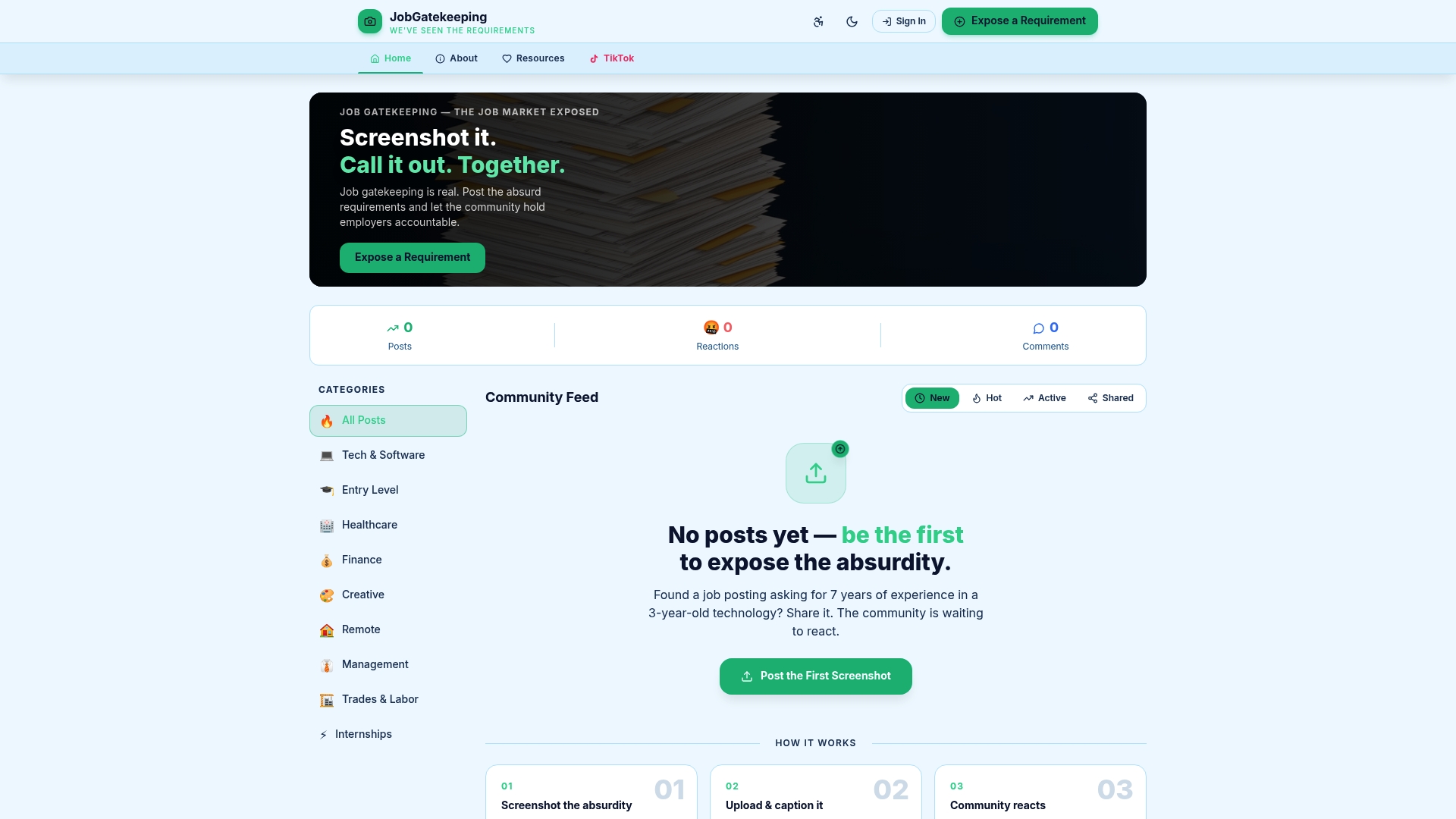
Together, we can hold employers accountable and make the hiring world a little fairer for everyone. Check out our cookie policy if you'd like to understand how we keep your experience safe and private. Join the conversation. Upload that screenshot. Make some noise. Because silence is what lets these absurd requirements keep multiplying. 🔥
Frequently asked questions
Why do job listings in 2026 have so many requirements?
Employers inflate requirements because AI tools and high applicant volumes let them filter aggressively, but skills matter more than credentials in practice. Apply anyway if you meet the core skills, not every line item.
How can I get noticed despite automated rejections?
Tailor your resume with exact keywords from the job description, and prioritize referrals for significantly better odds. A referral makes you nine times more likely to land the hire compared to cold applying.
Is having a degree still important for getting hired in 2026?
Skills-based hiring is rising and degrees matter less than they did even five years ago. Demonstrable, proven skills through portfolios and certifications now carry more weight with forward-thinking employers.
What is the most effective job search strategy in 2026?
A targeted, relationship-driven approach consistently wins, with referrals producing 9x higher hire rates than cold applications. Fewer, highly optimized applications combined with active networking beats mass applying every time.