

You open a job board, search "entry-level," and find a posting that wants three to five years of experience, a bachelor's degree, AWS certification, and proficiency in four programming languages. Sound familiar? 🚨 It's not just annoying — it's a pattern that's making the job search harder for millions of new grads and early-career professionals every year. Knowing how to quickly evaluate a job post before you invest time writing a cover letter or crafting your resume can save you hours of frustration and help you focus your energy on the opportunities that are actually worth pursuing.
Table of Contents
- Why evaluating entry-level job posts matters
- What to look for in a fair entry-level job posting
- Spotting red flags: Unreasonable demands and vague language
- Step-by-step: How to quickly evaluate any entry-level job post
- Our take: Why "entry-level" rarely means what it says — and what to do
- Next steps: Get support for your job search journey
- Frequently asked questions
Key Takeaways
| Point | Details |
|---|---|
| Red flags matter | Spotting unrealistic requirements helps you avoid exploitative 'entry-level' positions. |
| Fair posts are clear | Look for transparent requirements, pay details, and growth information in good job postings. |
| Follow a workflow | A repeated checklist streamlines your search and boosts your odds of finding a fair job. |
| Learn to adapt | 'Entry-level' often means more than it says, so advocate for fair treatment and stay alert. |
Why evaluating entry-level job posts matters
Let's be real: the job market isn't exactly designed to help you out. Entry-level roles have become a minefield of misleading language, inflated requirements, and vague expectations. If you don't know what you're looking at, it's easy to waste days chasing roles that were never truly accessible to newcomers in the first place.
Here's why this skill matters so much right now:
- Wasted time is your biggest enemy. Applying to the wrong roles eats into time you could spend targeting realistic opportunities.
- Unreasonable requirements create self-doubt. When you see a posting asking for five years of experience in an "entry-level" role, it's easy to think you're just not qualified enough. You're not the problem. The post is.
- Spotting bad posts early keeps your energy focused. The faster you can screen out garbage, the faster you find the good stuff.
As entry-level postings often ask for excessive experience, misleading applicants about what's actually accessible, understanding the structure of these postings isn't optional — it's a survival skill.
🔥 "The problem isn't that you're underqualified. The problem is that too many companies are mislabeling roles to attract overqualified candidates at entry-level pay."
Learning to recognize exploitative postings early in the process is one of the most powerful things you can do for your job search. It shifts your mindset from "why don't I qualify?" to "why is this posting unreasonable?" That mental shift is everything.
What to look for in a fair entry-level job posting
So what does a legitimate entry-level post actually look like? Knowing the hallmarks of a fair posting helps you quickly identify which jobs are worth your time and effort.
Defining reasonable job requirements is the foundation of fair hiring. It means asking for skills and competencies relevant to the role, not stacking requirements that even mid-level professionals would struggle to meet.
Here's a quick breakdown of what fair vs. unreasonable looks like:
| Element | Fair posting ✓ | Unreasonable posting ✗ |
|---|---|---|
| Experience requirement | 0-1 years or "internship experience welcome" | 3-5 years for an entry-level title |
| Education | Degree preferred OR equivalent experience accepted | Mandatory advanced degree for a junior role |
| Compensation | Clear salary range listed | "Competitive pay" with no figures given |
| Responsibilities | Specific and realistic tasks listed | Vague language like "wear many hats" |
| Growth path | Mentions mentorship, training, or advancement | No mention of development opportunities |
| Job title | Clear and accurate (e.g., "Junior Marketing Coordinator") | Inflated title like "Marketing Ninja" |
A fair post also includes clear responsibilities, a manageable number of required skills, and a realistic picture of what the first 90 days look like. If a posting reads like they need a senior employee but they're posting for "entry-level" pay, that's not a coincidence.
Signs of a genuinely fair entry-level posting include:
- Skills-based requirements rather than arbitrary years of experience
- A listed salary range or at least a pay band
- Named benefits, even at a basic level (health insurance, PTO, remote options)
- A clear job title that matches the actual industry standard
- A description that mentions onboarding, training, or learning expectations
Pro Tip: Use a structured job posting checklist every time you evaluate a new role. It keeps your evaluation consistent and prevents you from getting swept up in exciting-sounding language that hides a terrible opportunity.
Hiring process transparency is another key marker. A fair employer will typically tell you what the interview process looks like, how many rounds there are, and a rough timeline. If a posting has zero information about what comes after applying, that's already a yellow flag.
Spotting red flags: Unreasonable demands and vague language
Understanding what makes a post fair, it's equally important to know the signs of a problematic one. And there are a lot of them. Many entry-level postings use vague criteria or inflate qualifications to filter out candidates, shift unpaid labor onto applicants, or simply attract overqualified workers at low pay.

Here's how the most common red flags break down:
| Red flag | What it looks like | What it usually means |
|---|---|---|
| Experience inflation | "Entry-level: requires 3+ years" | Underpaying for a mid-level role |
| Commission-only pay | "Unlimited earning potential!" | No base salary, high risk for worker |
| Unpaid training | "1-month unpaid onboarding required" | Exploitative labor practice |
| Vague responsibilities | "Assist with various tasks as needed" | Undefined scope that expands without pay |
| Missing company name | Posting under "Confidential employer" | Often MLM or high-turnover operation |
| Excessive skill stack | Requires 8+ technical tools for junior role | Unrealistic or copy-paste job description |
The numbered list of immediate red flags to watch for:
- "Entry-level" in the title with 3+ years experience required. This is the most common bait-and-switch in the industry. Check why jobs ask for experience before assuming it's your fault.
- Commission-only or unpaid trial periods. Real entry-level jobs pay you from day one. Period.
- Vague phrases like "self-starter" or "fast-paced environment" with no concrete detail. These often signal high burnout, unclear expectations, and potential exploitation.
- No mention of salary or benefits. Transparency in pay is a basic standard. If it's missing, it's usually not good news.
- Overstuffed skill requirements. A posting that needs you to know Python, Salesforce, HubSpot, Tableau, and three design tools for an "entry-level analyst" role is padding, not reality.
- Generic or unverifiable company info. If you can't find the company on LinkedIn, Glassdoor, or their own website, proceed with real caution.
Pro Tip: Copy and paste suspicious job descriptions into a document and highlight every vague phrase. If more than 30% of the post is ambiguous or uses buzzwords without concrete meaning, treat it as a red flag. You want specifics, not vibes.
When you spot exploitative job posting warning signs, don't second-guess yourself. Trust the pattern. These postings aren't rare exceptions. They're a known, widespread problem in the hiring landscape, and recognizing them is the first step to protecting your time and your career.
Step-by-step: How to quickly evaluate any entry-level job post
Now that you've learned what to look for and what to avoid, here's a proven system you can follow on any job board or company site. A job posting checklist ensures fair hiring and helps candidates assess posts efficiently, so every step here is designed to be fast and repeatable.
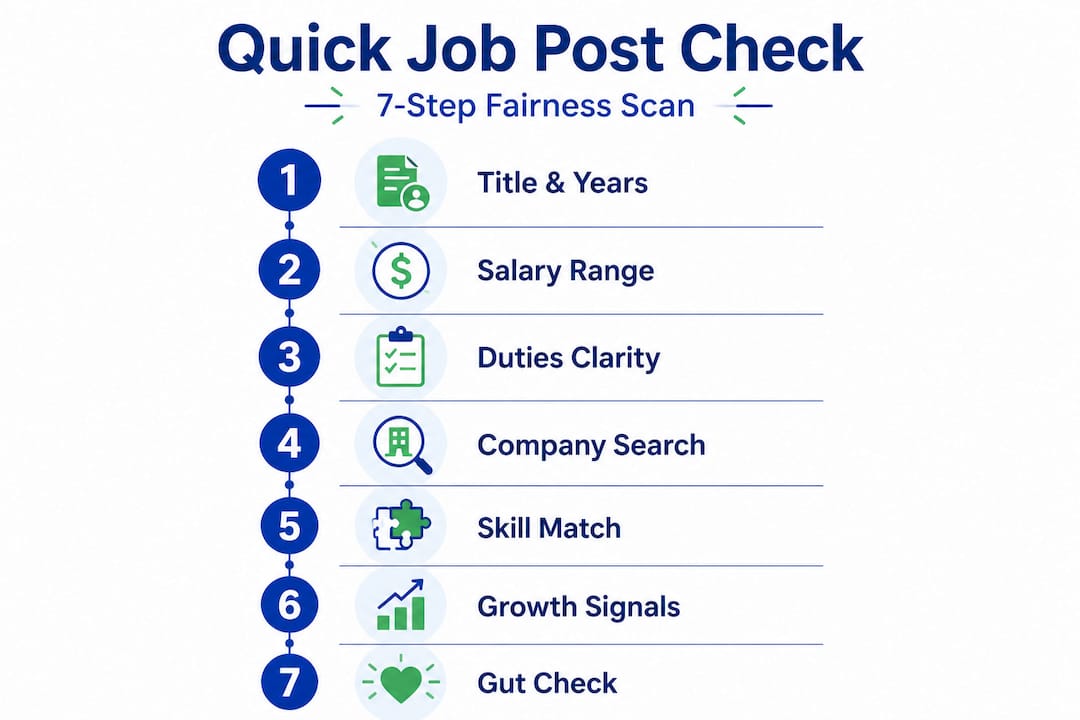
01. Scan the title and experience requirements first. Before reading a single bullet point, check the title and the "requirements" section. Does the title say "entry-level" but list 3+ years of experience? Stop there. Move on. Don't rationalize it.
02. Check the salary or compensation section. Is there a salary range? A clear pay band? If it says "competitive salary" or "based on experience" with no numbers attached, that's a flag. Bookmark it and research the company's Glassdoor reviews before going further.
03. Read the responsibilities for specificity. Are the listed duties specific and realistic for someone starting out? Or is it a wall of vague tasks like "support team operations" and "contribute to company goals"? Real postings tell you what you'll actually do.
04. Verify the company. Search the company name on LinkedIn, Glassdoor, Indeed reviews, and their own website. How long have they been operating? What do employees say about work-life balance and management? This takes five minutes and can save you five weeks.
05. Cross-check the required skills. Compare the listed skills to other entry-level job posts in the same field. If most similar roles ask for one or two tools and this one asks for eight, something's off. Use sites like LinkedIn or Indeed to benchmark the skills for that specific role type.
06. Look for growth signals. Does the post mention training, onboarding, mentorship, or career advancement? A company investing in your growth is a better bet than one that describes you as a "plug-and-play" resource.
07. Apply a final gut check. Ask yourself: "Would a reasonable person with 0-1 years of experience realistically succeed here?" If the answer is no, or if the answer requires a lot of convincing, that's your answer.
Pro Tip: Create a simple tracking spreadsheet with columns for the job title, company, red flags spotted, salary range, and a "worth applying" rating. Staying organized means you stop second-guessing yourself mid-application and waste far less time. Combine this with winning job search strategies to stack every advantage in your favor.
You can also filter by companies that openly practice increase hiring transparency. Companies that show their process upfront tend to be fairer across the board.
Our take: Why "entry-level" rarely means what it says — and what to do
Here's the honest truth: the phrase "entry-level" has been so watered down that it barely means anything anymore. And that's not an accident.
Companies have learned that labeling a role as entry-level attracts a wider applicant pool, including mid-level candidates who are desperate enough to accept lower pay. It keeps wages down. It keeps applicants anxious. And it keeps the power firmly on the employer's side.
The disconnect between the label and the actual requirements is industry-wide now. We see it in tech, marketing, finance, healthcare admin, and beyond. It's not limited to one sector or one type of employer. The reasonable requirements for hiring are being stretched and broken across the board.
So what do you do? You adapt your strategy and you push back.
Adapting means you apply anyway when you're close to 60-70% of the listed requirements. Studies consistently show that many job requirements are aspirational, not mandatory. If you wait until you check every single box, you'll wait forever.
Pushing back means demanding clarity when you get to the interview stage. Ask directly: "What does success look like in the first 90 days?" and "What's the typical growth path from this role?" If they can't answer, that tells you something important.
And collectively, we can push for more. Recruiting transparency is essential for fair hiring, but most candidates must learn to demand it. Share what you see. Call it out. When job seekers name these patterns publicly, it creates pressure for employers to do better. That's how change actually happens.
The goal isn't to be perfect at evaluation. The goal is to be fast enough at spotting the bad ones so you can spend your limited energy on the real ones.
Next steps: Get support for your job search journey
You now have a real framework for cutting through the noise and identifying job postings that are actually worth your time. But staying sharp in a market this messy means having ongoing support and trustworthy resources.

That's exactly what JobGatekeeping is built for. Whether you're trying to stay ahead of guarding against exploitative jobs, find community with others who've faced the same absurd postings, or access tools that help you navigate the hiring process with confidence, we've got your back. Browse our blog for deep-dive guides, share your own experiences anonymously, and connect with a community that gets it. You're not alone in this, and together, we can make the job market a fairer place for everyone starting out. 💪
Frequently asked questions
How much experience is really needed for an entry-level job?
Entry-level roles should require only basic or foundational skills, not years of professional experience. Any posting asking for more than one year of direct experience in an entry-level role is likely inflating requirements.
Should entry-level jobs require a degree?
A degree is sometimes listed but not always essential, depending on the field and alternative qualifications. Many employers are shifting toward skills-based hiring, especially in tech, marketing, and creative roles.
How can I check if a job post is a scam or exploitative?
Look for vague responsibilities, unrealistic pay promises, missing company information, and ambiguous job titles. Excessive experience demands for entry-level pay are also a major warning sign.
What if an entry-level post asks for skills I don't have?
Focus on applying if you meet the majority of requirements and communicate your willingness to learn. Most listed skills are aspirational rather than absolute, especially for entry-level and junior roles.
Are unpaid internships a fair entry point?
Genuine entry-level roles should offer fair compensation; unpaid work can signal exploitative practices that take advantage of newcomers who feel they have no leverage. Always research whether the role complies with labor laws in your region.