

You open a job posting that looks promising. Then you read it. The role is "entry level," but it demands five years of experience, proficiency in six software platforms, and a master's degree preferred. Sound familiar? You're not alone. 57% of applicants abandon applications because of time-consuming and confusing requirements. But here's the thing: many of those requirements aren't as firm as they look. Knowing the right questions to ask can mean the difference between walking away from a great opportunity and actually landing it.
Table of Contents
- Why job requirements can be confusing or excessive
- The must-ask questions about job requirements
- Comparison: What probing questions reveal about real requirements
- How to use answers to make smart application decisions
- A new way to approach job postings: Bridge the gap, don't just check boxes
- Get advocacy, guidance, and tools for your job search
- Frequently asked questions
Key Takeaways
| Point | Details |
|---|---|
| Clarify must-haves | Always ask which requirements are truly essential and which can be learned on the job. |
| Probe for real priorities | Inquire about success metrics and problems the role is meant to solve to uncover core needs. |
| Apply strategically | Don't let long requirements lists deter you—applying at 60-70% fit is often enough. |
| Spot red flags | Use reverse questions to reveal hidden deal-breakers and assess transparency. |
| Advocate for fair hiring | Job seekers and advocates can drive industry change by challenging unclear or excessive postings. |
Why job requirements can be confusing or excessive
Job postings have a frustrating reputation for being walls of text that list every possible skill a fantasy employee might have. It's not always malicious. Sometimes it's just lazy. Sometimes it's a hiring manager copy-pasting from an old posting or brainstorming every tool they've ever touched. Either way, you end up staring at a list that feels impossible.
Here's what's really going on behind those long, intimidating requirement lists:
- ✗ Wishlist culture: Many hiring teams build their postings around the ideal candidate rather than the actual job. That means requirements that sound essential are actually aspirational. Nobody expects every box to be checked.
- ✗ Filter mode: Some companies use long requirement lists to reduce the volume of applicants. Throw in enough buzzwords, and only the boldest people apply. That's not good practice. That's gatekeeping.
- ✗ Outdated postings: Roles evolve, but job postings often don't. A posting recycled from 2021 might still ask for skills the team no longer even uses.
- ✗ No clear ownership: When multiple people have input on a job description but nobody owns the final version, you get bloated, contradictory requirements that don't reflect the actual day-to-day role.
"Unrealistic requirements like entry-level roles demanding 5+ years of experience are common. If you match 60-70% of the requirements, you should still apply and clarify in interviews which are truly non-negotiable."
This matters because those entry-level experience hurdles filter out candidates who could absolutely do the job. Fair hiring advocates are clear on this: the best job postings distinguish essential vs. optional requirements to avoid turning away qualified people before they even get through the door.
The experience inflation trends we see across industries make this worse every year. And until companies are held accountable for posting reasonable job requirements, it's on us to know what questions to ask.
The must-ask questions about job requirements
Okay, so you've found a posting that excites you but makes your head spin. What do you actually say? Asking the right questions is not aggressive or pushy. It's smart. It shows initiative and signals that you're thinking about whether you'll succeed in the role, not just whether you can land it.
Here are the questions that matter most, broken into stages of the hiring process:
Before you apply (via email or recruiter screen):
- "Can you help me understand which requirements are must-haves versus nice-to-haves?" This single question can save you hours of tailoring a cover letter for a role you're actually well-suited for.
- "What are the top three priorities for this role in the first 90 days?" Key clarifying questions like this reveal what the company actually cares about, not what they threw on the posting.
- "What does success look like at the six-month mark?" The answer tells you more about the real job than the entire posting will.
- "Is there flexibility in the experience requirement, or is it a hard cutoff?" Recruiters often have more leeway than the posting implies. Ask directly and you might be surprised.
During the interview (ask the hiring manager directly):
- "What problems are you hiring this role to solve?" Questions like this cut through the noise and force a real conversation about what matters.
- "What skills are most important for long-term success in this position?" You'll find out fast what the team actually values day-to-day versus what the HR template included.
- "What does a typical day look like for this role?" This reveals the actual work, not the aspirational job description.
- "What qualities do your top performers in this role share?" Listen carefully. The answer often exposes unspoken, real requirements.
Pro Tip: Ask recruiters about logistics and process. Ask direct managers about the actual work and success criteria. Recruiters often don't know what the hiring manager really needs. You get better intel when you talk to the right person at the right stage.
One more thing: if you're applying for a role where you might be considered overqualified, ask directly, "Are there concerns that my background might be more than what this role requires?" Bringing it up yourself removes the awkward elephant from the room and gives you a chance to reframe the conversation.
Decoding entry-level roles takes practice, but these questions give you a structured approach to evaluate job posts before committing your time and energy.
Comparison: What probing questions reveal about real requirements
Knowing the questions is step one. Understanding what the answers tell you is where the real power is. Let's look at how different answers reveal whether you're dealing with a flexible, collaborative employer or a rigid, red-flag situation.
| Question asked | Helpful answer 🟢 | Red flag answer 🔴 |
|---|---|---|
| "Which requirements are truly must-have?" | "The SQL skills are firm. Python is a plus." | "All of them are required." |
| "What does success look like at 90 days?" | "You'll have onboarded and shipped one feature." | "We'll evaluate as we go." |
| "What does a typical day look like?" | Specific, detailed, realistic description | Vague or evasive non-answer |
| "What are the top priorities for this role?" | Clear, ranked list of outcomes | "We're still figuring that out." |
| "What causes failure in this role?" | Thoughtful reflection on past challenges | Defensive reaction or blame-shifting |
That last question is a powerful one. Asking "what causes failure here?" is what's called a reverse interview question. It flips the dynamic. Instead of you proving you're good enough, you're evaluating whether the role is designed for success. Employers who have thought seriously about what makes people struggle are usually more self-aware and better to work for.
Here's what to watch for when you get the answers:
- Ambiguous success criteria are a major red flag 🚨. If they can't define what winning looks like, how will you know if you're succeeding?
- Extra-long wishlists defended as non-negotiable signal a company that hasn't thought critically about the role. That rigidity usually shows up in the culture too.
- Quick, specific, confident answers suggest the hiring manager knows their team and their needs. That's where you want to be.
Asking transparent questions about the hiring process is how you find employers worth your time. And it's how advocates can document which companies actually have their act together.
How to use answers to make smart application decisions
So you've asked the questions. You have the answers. Now what? Here's how to read between the lines and make a call you feel confident about.

Interpreting vague or rigid answers:
If the recruiter can't tell you which requirements are firm, that's not necessarily a dealbreaker. It might just mean they're operating off a template and the hiring manager has more flexibility. Push the conversation to the decision-maker. If the hiring manager is also vague, that's a different story.
Interpreting long, defensive answers:
When someone spends ten minutes defending every single requirement on the posting, take note. That level of rigidity in the conversation often mirrors how the team operates. You'll be expected to check every box, always, with no gray area.
Interpreting specific, collaborative answers:
This is what you want. An interviewer who says, "Look, the five-year experience thing is aspirational. We need someone who can hit these three outcomes fast," is showing you they're reasonable. That's a team worth your effort.
Here's a simple decision framework based on what you learn:
| What you found out | Recommended action |
|---|---|
| Clear must-haves, flexible on extras | Apply and tailor to the firm requirements |
| Vague success criteria, long wishlist | Proceed with caution, ask follow-up questions |
| Rigid on everything, no clarity | Seriously consider moving on |
| Matches 60-70% of requirements | Apply and clarify during the process |
| Obvious red flags in tone or answers | Document it and move on |
Pro Tip: When a job posting lists 15 requirements but the interviewer tells you only three actually matter, screenshot that posting. That disconnect is worth documenting. It helps the whole community understand what patterns to look for.
For advocates, the process goes further. When you identify excessive requirements, note the company, the role, and the specific language. This kind of documentation builds the case for systemic change. These modern job search tips are about more than individual wins. They're about holding the system accountable.
A new way to approach job postings: Bridge the gap, don't just check boxes
Here's the honest, uncomfortable truth that most career advice skips: asking clarifying questions feels scary because we've been conditioned to believe job applications are a test we either pass or fail. You see the requirement list, you measure yourself against it, and if you come up short, you give up. That's the checklist mindset. And it's exactly what excessive job requirements are designed to trigger.
But employers and job seekers are often talking past each other. Employers see requirements as filters or aspirational targets. Job seekers read them as barriers. That gap creates a lose-lose situation. Companies miss out on great candidates. Candidates miss out on jobs they'd actually thrive in.
The shift we're advocating for isn't just about individual strategy. It's about changing the culture of hiring conversations. When you ask, "Which of these requirements are truly non-negotiable?", you're not being difficult. You're modeling what good hiring looks like. You're pushing back against the lazy, copy-paste job description culture, one conversation at a time.
The best employers we've seen celebrated on our platform and in fair hiring strategies are the ones who welcome these questions. They know a candidate who asks smart questions is a candidate who gives a damn about doing good work. Companies that get defensive about their requirements are often hiding something, usually the fact that they haven't thought them through.
So stop approaching postings as pass/fail tests. Start approaching them as the beginning of a dialogue. Your questions shape that dialogue. And collectively, when enough of us push back on absurd requirements by asking smart questions and exposing gatekeeping, companies start to change how they post. Better conversations lead to better postings. Better postings lead to better matches. That's the goal. 🔥
Get advocacy, guidance, and tools for your job search
When you're ready to put these strategies into action, don't go it alone.
Job seekers who ask the right questions and share what they find are fueling real change in how companies hire. At JobGatekeeping, we've built a community where you can expose the absurd, connect with advocates who've been there, and access resources that help you navigate even the most gatekeeping-heavy hiring process.
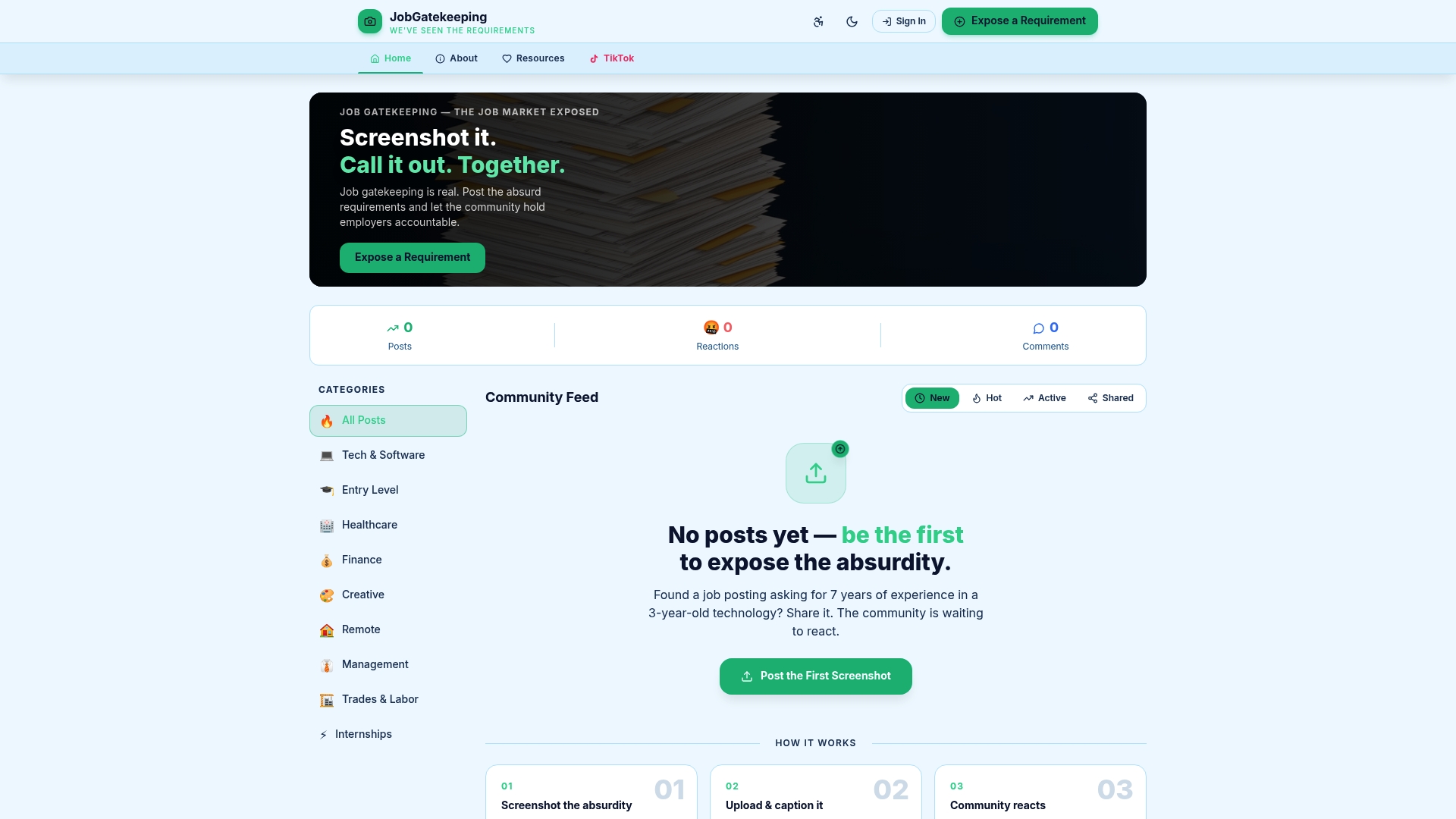
Upload a screenshot of that ridiculous posting. Add a caption calling out the gatekeeping. Let the community react, share, and pile on. Together, we track patterns, name the tactics, and help each other make smarter decisions. Whether you're a job seeker trying to decode a confusing posting or an advocate pushing for systemic change, we have the tools and the community to back you up. Come find your people. 🚨
Frequently asked questions
What should I do if I don't meet all the job requirements?
Apply if you meet about 60-70% of the requirements and use the interview to ask which ones are truly non-negotiable. Many listed requirements are aspirational, not firm cutoffs.
How can I tell which job requirements are must-haves?
Ask the employer directly: "Which requirements are truly must-have vs. ramp-friendly?" Most hiring managers will tell you exactly which skills they're firm on and which are a bonus.
Why do employers list so many requirements?
Employers often use requirements as filters or aspirational wishlists, not as firm deal-breakers. Not every item on that list is something you must have on day one.
What is a reverse interview question and when should I use it?
A reverse interview question like "What causes failure here?" flips the power dynamic so you're evaluating the employer, not just proving yourself. Use them mid-interview to spot hidden red flags before you commit.
Can job seekers influence hiring practices for more fair postings?
Yes, absolutely. By asking clarifying questions, giving feedback, and calling out gatekeeping publicly, candidates and advocates push companies toward distinguishing essential vs. optional requirements, which creates fairer, more honest job postings for everyone.