

Nearly half of all "entry-level" job postings now demand 5 or more years of experience, and that number keeps climbing. The share of postings requiring 5+ years jumped from 37% in mid-2022 to 42% by mid-2025. For recent graduates already navigating student debt, a competitive market, and a shifting economy, this trend feels like a locked door with no key. This article breaks down why experience inflation happens, what it costs you, and exactly how to compete anyway. You deserve a fair shot, and understanding this system is the first step to beating it.
Table of Contents
- What is entry-level experience inflation?
- What causes entry-level experience inflation?
- How does experience inflation affect job seekers?
- Strategies to overcome entry-level experience inflation
- The hidden cost of experience inflation
- Explore more tips and expose absurd job requirements
- Frequently asked questions
Key Takeaways
| Point | Details |
|---|---|
| Inflated requirements are common | Nearly half of entry-level jobs now demand 5+ years of experience. |
| Market shifts are driving inflation | AI automation and layoffs have caused companies to push higher requirements onto junior roles. |
| Grads face tough odds | Underemployment rates for recent grads are the highest since 2020 due to these shifts. |
| Strategies can help you compete | Building tangible experience and networking are essential to bypass inflated filters. |
| Employers risk future talent shortages | Hiring only experienced workers for entry roles undermines long-term leadership pipelines. |
What is entry-level experience inflation?
Entry-level experience inflation is when employers attach years of professional experience to roles that are supposed to be accessible to new workers. Think about that for a second. A job labeled "entry-level" is, by definition, designed for someone just starting out. Requiring five years of experience for that role is a contradiction, plain and simple.
This shift didn't happen overnight. The job market has been tightening and transforming for years, and companies have slowly moved the goalposts. What once required a degree and basic skills now demands a proven track record. Employers justify this by pointing to a more competitive applicant pool or higher performance standards, but the real picture is more complicated than that.
The data makes the damage visible. The underemployment rate for recent grads sits at a staggering 42.5%, with unemployment at 5.6%. That means nearly half of college graduates who do find work are stuck in jobs that don't even use their degrees.
"Recent college graduates face a 42.5% underemployment rate and a 5.6% unemployment rate, signaling a structural mismatch between what employers demand and what new workers can offer."
Here's why this matters beyond the numbers:
- You spend 4+ years earning credentials that employers then dismiss in favor of experience you couldn't have gotten without a job in the first place.
- Internships and part-time roles don't always count the way full-time employment does in ATS systems.
- Your competition isn't just other new grads anymore. Layoffs have pushed experienced workers into the same applicant pool.
- The expectation gap creates a cycle where you can't get experience without the job, and can't get the job without experience.
Understanding what you're up against is not defeatist. It's strategic. Knowing the rules of a broken system helps you find the workarounds.
What causes entry-level experience inflation?
Understanding what entry-level experience inflation actually means sets the stage for exploring the root causes. This isn't one single trend. It's a convergence of forces that all point in the same direction: fewer opportunities for workers just starting out.
The main drivers behind experience creep include AI automation, applicant tracking system filtering, supply and demand imbalances, and companies hiring experienced workers at entry-level pay. Let's unpack each one.
AI automation has eliminated many of the routine tasks that junior roles were built around. Filing, data entry, basic research, and formatting work have all been partially or fully automated. As a result, companies expect the humans they do hire to operate at a higher level from day one. The floor for "entry-level" just got raised.

Applicant tracking systems, or ATS, are software tools that screen resumes before a human ever sees them. These systems are programmed to filter for specific keywords and experience thresholds. If a posting says "3 to 5 years required" and your resume shows 1 year, the algorithm rejects you automatically. The hiring manager never knows you existed.
Supply and demand is brutally simple. More people are applying for fewer junior roles, so companies can afford to be selective. When 500 people apply for one opening, raising the bar feels like a rational shortcut, even if it screens out perfectly capable candidates.
Layoffs created a surplus of experienced workers willing to accept lower pay just to stay employed. Companies spotted this and quietly began filling roles that used to go to new graduates with mid-career professionals instead. Entry-level pay, senior-level expectations.
Here's what this looks like on a practical level:
- Roles that once required a bachelor's degree now require 3 to 5 years of experience on top of it.
- Soft-skill requirements have ballooned to include things like "proven stakeholder management" for coordinator roles.
- Job descriptions often reflect a wish list rather than actual role requirements.
- ATS filters mean even qualified applicants go unseen.
Pro Tip: Customize your resume for each application by mirroring the exact language from the job description. ATS systems rank resumes by keyword match, so even rephrasing a skill differently can cost you a callback.
How does experience inflation affect job seekers?
Once we recognize the drivers behind experience inflation, it's important to see how these changes affect people in the job market. The numbers tell one story. The lived experience tells another.
The underemployment and unemployment rates for recent graduates vary significantly by field. Nursing and education graduates face more accessible job markets with clearer entry paths. Tech and data roles, however, have seen job postings drop by 30% to 38%, making competition brutal for people entering those fields right now.
| Field | Unemployment rate | Entry-level posting trend |
|---|---|---|
| Nursing | Low | Stable or increasing |
| Education | Low to moderate | Stable |
| Technology | High | Down 30-38% |
| Data science | High | Down 30-38% |
| General business | Moderate | Slightly down |
This table matters because it tells you where to focus your energy. If you're in tech or data, you need a different strategy than someone entering healthcare. Context is everything.
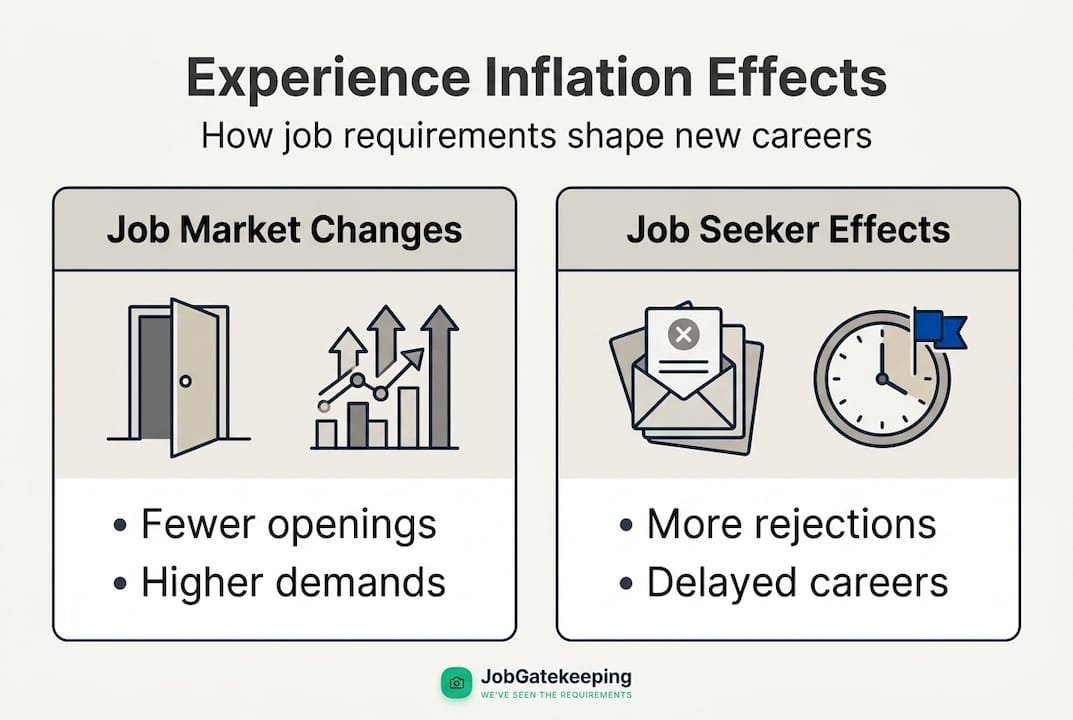
Beyond the field-level data, the personal cost of experience inflation is real. Job seekers spend more time applying, face more rejection, and often accept roles well below their skill level just to build the resume employers want. This delays financial independence, career growth, and professional confidence.
Here are four steps you can take right now to adapt:
- Audit your target field. Research current posting volumes and experience requirements in your specific area to set realistic expectations before you apply.
- Reframe your experience. Internships, class projects, freelance work, and volunteer roles all count. Present them using professional language and measurable results.
- Apply to more roles than feels comfortable. The rejection rate is high right now. Treat applications like a volume game while you refine your approach.
- Target smaller companies. Startups and small businesses are far less likely to use rigid ATS systems and are more open to potential over credentials.
The market is hard. That's not your fault. But there are moves you can make.
Strategies to overcome entry-level experience inflation
The impact is clear, but the good news is there are effective ways to respond, even if requirements seem overwhelming. The difference between candidates who break through and those who don't often comes down to strategy, not credentials.
One of the biggest shifts you can make is moving from a traditional job search to an adaptive one. Here's how they compare:
| Approach | Traditional job search | Adaptive strategy |
|---|---|---|
| Application method | Apply to postings as-is | Customize every resume and cover letter |
| Network use | Minimal | Central to your strategy |
| Experience building | Wait for a job offer | Build portfolio projects now |
| Targeting | Broad and general | Niche skills and companies |
| Mindset | Qualification-focused | Value-focused |
The adaptive approach asks you to stop waiting for permission. You don't need a company to hand you experience. You can build it.
Here's how to create your own experience before you land the job:
- Build portfolio projects. If you're in tech, design, writing, or data, create real work samples. GitHub repos, published articles, and Behance portfolios speak louder than empty resume lines.
- Freelance or consult. Even one paid project gives you legitimate professional experience. Platforms like Upwork and Fiverr make this accessible.
- Volunteer your skills. Nonprofits and community organizations often need skilled help they can't afford to pay for. You get real-world application and references.
- Take on internships, even late. A targeted internship at the right company can open doors faster than 50 generic applications.
Pro Tip: Identify two or three niche skills that are in demand in your target field but underrepresented in the applicant pool. Specializing in something specific like prompt engineering, data visualization, or grant writing makes you harder to filter out and easier to remember.
The long-term risk for employers is that blocking new talent from entry points eventually starves their senior pipeline. Your job is to stay in the game long enough to benefit when companies wake up to that reality.
The hidden cost of experience inflation
Here's the perspective most hiring managers won't say out loud: experience inflation doesn't just hurt job seekers. It quietly dismantles the companies practicing it.
When you block junior talent from entering the workforce pipeline, you eliminate the people who would eventually grow into your senior roles. Companies celebrating their ability to hire overqualified candidates at entry pay are taking out a loan against their own future. In five years, they will look for mid-level managers and find an empty bench.
Innovation also suffers. New perspectives, fresh questions, and unconventional approaches are almost always introduced by people who are new to an industry. When you filter out everyone without five years of experience, you filter out the people most likely to challenge outdated assumptions.
The broader social cost is equally serious. A generation of educated workers stuck in mismatched roles or long-term unemployment creates ripple effects across consumer spending, mental health, and public trust in institutions. This is not a story about individual career struggles. It's a structural failure with wide consequences.
Companies need to ask themselves: Are we actually getting better hires by inflating requirements, or are we just creating the illusion of selectivity while burning through their own futures?
Explore more tips and expose absurd job requirements
If reading this made your blood boil just a little, you're not alone. Thousands of job seekers are documenting the exact same patterns you've experienced, and they're doing something about it.

At JobGatekeeping, we track and call out absurd job requirements every single day. Our community uploads screenshots of the most egregious postings, adds context, and reacts together, because naming the problem out loud is the first step toward changing it. You'll also find practical resources to help you identify gatekeeping tactics, sharpen your applications, and avoid wasting time on postings designed to fail you. Come join the conversation and turn frustration into action.
Frequently asked questions
Why do entry-level jobs require so much experience now?
AI automation and layoffs allow companies to hire experienced workers at entry pay, and ATS systems make it easy to filter by experience thresholds with no human review.
Which fields are least affected by entry-level experience inflation?
Nursing and education have lower unemployment rates and more accessible entry-level positions. Tech and data roles are the hardest hit, with job postings down 30% to 38%.
How can I stand out for entry-level jobs with inflated requirements?
Build real portfolio projects, target niche skills that are underrepresented in the applicant pool, and use networking to bypass ATS filters entirely by getting referred directly.
What risks do employers face by inflating entry-level requirements?
Companies that block junior talent from entry-level roles eventually face senior talent shortages because they never built the pipeline to develop mid-level leaders from within.