

You graduate, polish your resume, and start applying for entry-level jobs. Then you see it: "Entry-level position, 3 to 5 years of experience required." The contradiction is almost funny until you realize it's everywhere. US graduates face 42.5% underemployment in a market where the jobs designed to give them a start are quietly raising the bar. This article breaks down why this is happening, who it hurts most, and what you can actually do about it, both as a job seeker and as someone who believes the hiring system needs to change.
Table of Contents
- Understanding the entry-level job paradox
- How we got here: The market forces driving experience creep
- Consequences: Who loses and who adapts?
- Action steps: Advocating for fairer hiring and standing out anyway
- What most advice misses about entry-level hiring
- Next steps: Explore more on unfair job requirements
- Frequently asked questions
Key Takeaways
| Point | Details |
|---|---|
| Entry-level paradox | Many entry-level jobs now require previous experience, creating a barrier for new job seekers. |
| Market forces | Oversupply of applicants allows employers to set high experience requirements, even for beginners. |
| Lasting impact | These practices can cause long-term talent gaps and fewer opportunities for advancement. |
| Paths forward | Advocating for skills-based hiring, pursuing internships, and showcasing practical experience can help you break in. |
Understanding the entry-level job paradox
The phrase "entry-level" is supposed to mean a job for someone starting out. No deep prior experience needed. Just basic qualifications, eagerness, and a willingness to learn. That promise has been quietly broken over the last decade.
Today, entry-level ads routinely require 3 to 5 years of professional experience for roles that were once open to fresh graduates. This is not a minor discrepancy or a copy-paste error from HR. It is a widespread, systemic pattern that has quietly redefined what "beginner" means in the eyes of employers.
"Entry-level is no longer a starting point. It has become a filter that removes most people before they even have a chance to prove themselves."
The data tells a grim story. Consider what recent research shows about the US graduate workforce:
| Metric | Figure |
|---|---|
| Graduate underemployment rate | 42.5% |
| Graduate unemployment rate | ~6% |
| Entry-level jobs requiring 3+ years experience | Majority of postings |
| Graduates working jobs not requiring a degree | Tens of thousands |
These numbers mean that almost half of all college graduates are working jobs that do not use their degree, and many of those graduates tried and failed to break into their field because the entry door was locked behind a requirement they could not physically meet at that stage of their career.
The emotional and financial impact of this reality hits hard. Here is what job seekers in this position regularly experience:
- Chronic self-doubt: When every application feels like you are automatically disqualified, it erodes your confidence even if the requirement is objectively unreasonable.
- Financial stress: Waiting months to land a role that matches your qualifications forces many graduates into lower-paying survival jobs.
- Resume shame: Applicants start to hide gaps or inflate experience, which creates its own set of risks during interviews.
- Delayed career milestones: Starting your career two or three years late has compounding effects on salary growth, retirement savings, and skill development.
- Disproportionate harm to first-generation graduates: Those without alumni networks or family connections in professional industries feel this barrier more acutely than anyone.
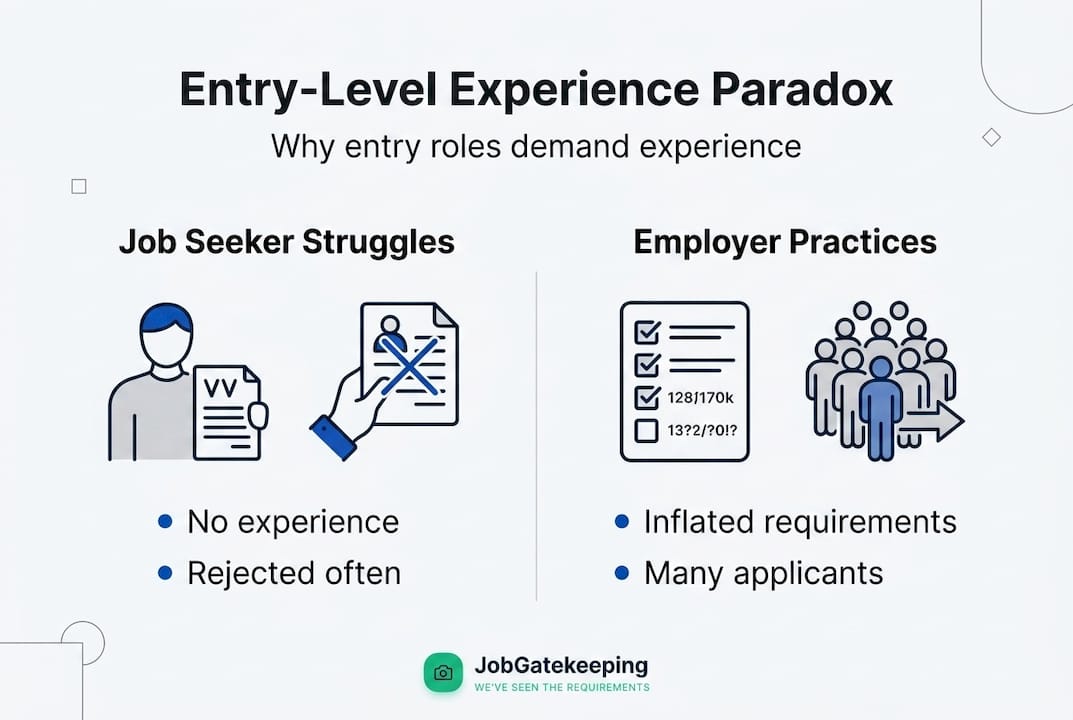
The paradox is not just frustrating on a personal level. It is structurally irrational. If no one can get entry-level experience without first having entry-level experience, the whole system stalls. And yet companies keep posting these jobs, and the cycle keeps spinning.
How we got here: The market forces driving experience creep
Understanding why this happens requires looking at the economic conditions that allow it. When there are far more candidates than jobs, employers get comfortable. They can afford to ask for more.
During periods of economic uncertainty or high graduate output, the oversupply of applicants gives employers the leverage to raise their expectations without losing candidates entirely. They know someone will apply regardless of the requirements listed. This is not a conspiracy. It is basic supply and demand logic applied to labor, and it puts job seekers in a deeply unfair position.

The term "experience creep" describes this gradual inflation of requirements in job listings. A role that once asked for one year of experience becomes two. Then three. Each update seems minor in isolation, but across an industry and over several years, the cumulative effect is enormous. Many job seekers applying today are being screened against benchmarks that did not exist when their older peers were entering the same roles.
Here is how companies that inflate requirements compare to those that still prioritize training:
| Company type | Approach to experience | Likely to hire new grads |
|---|---|---|
| Large enterprise with grad programs | Structured onboarding and mentoring | Yes |
| Mid-size companies (50 to 200 employees) | Expect immediate contributors | Rarely |
| Startups with specific skill gaps | Skills-based, less formal | Sometimes |
| Companies that invest in training | Realistic requirements, grow talent | Yes |
| Cost-cutting organizations | Offload training to candidates | Almost never |
How does experience creep actually happen in practice? Here is the step-by-step process that turns a genuine entry-level role into something that excludes beginners:
- A hiring manager drafts a job description based on the departing employee's profile, who had five years in the role.
- HR adds "preferred qualifications" that were never formally required but seem safe to include.
- The company receives 400 applications. Recruiters use experience thresholds to reduce the pile to 40.
- The threshold that started as a soft preference becomes a hard filter in applicant tracking systems.
- The next time the role opens, the inflated requirements are copy-pasted without question.
- Industry peers see the posting and assume that experience threshold is standard, and they adopt it too.
That six-step process, repeated across thousands of companies and dozens of industries, is how entry-level became a misleading label rather than a meaningful category.
Pro Tip: When you see a job posting that asks for 3 years of experience for an entry-level role, look at the listed responsibilities, not the requirements. If the actual day-to-day tasks sound genuinely learnable, apply anyway. Many of those experience figures are aspirational, not mandatory. Some companies that train realistically still exist and are worth targeting specifically.
Consequences: Who loses and who adapts?
The effects of this broken system are not evenly distributed. Some people are better positioned to absorb the impact, and others are left out entirely.
New graduates are the most obvious casualties. They enter a market where their degree is both expected and insufficient, where theoretical knowledge counts for little unless paired with work history. But career changers face an equally frustrating situation. Someone leaving retail management to move into marketing, for example, has genuine transferable skills but may still get filtered out by a system that counts years of industry-specific titles rather than actual competence.
"When entry points shrink, the entire workforce pipeline runs dry. Today's hiring shortcuts become tomorrow's leadership vacuum."
Marginalized groups feel this most sharply. First-generation college students often lack the unpaid internship opportunities, alumni connections, or parental financial support needed to build a resume before entering the job market. The experience paradox systematically narrows the workforce pipeline, and it does so in ways that reinforce existing inequalities rather than reducing them.
The long-term damage to employers is less discussed but equally real. If fewer people gain genuine entry-level experience today, there will be fewer qualified mid-level and senior candidates available in five to eight years. Companies that refuse to train anyone are essentially borrowing talent from a pool that is slowly emptying. At some point, the bill comes due.
Smaller and mid-size companies with 50 to 200 employees are statistically the least likely to invest in training new hires. They prefer immediate contributors who can step in without a ramp-up period. This makes a certain kind of short-term financial sense but creates a structural problem when those same companies try to hire for senior roles three years later and find that no one was being groomed in the entry-level tier.
Who adapts? A few categories of people manage to navigate this system despite its absurdity:
- Candidates who built parallel credentials: Freelance projects, open-source contributions, side businesses, and volunteer coordination can fill the gap when formal employment history is thin.
- People who targeted the right companies: Large firms with rotational graduate programs or structured mentorship tracks still exist. Finding and targeting these specifically makes a real difference.
- Candidates who applied despite the requirements: Studies consistently show that men apply to jobs when they meet 60% of the listed qualifications, while women wait until they meet nearly 100%. Closing that gap is a survival skill in this market.
- Employers who adapted their thinking: Some forward-thinking companies have moved toward skills-based assessments and portfolio reviews rather than year-counting. These employers tend to attract more motivated, diverse candidates.
The people and companies that succeed are not necessarily the most qualified or the most deserving. They are the ones who learned to work around a flawed system. That is the uncomfortable reality.
Action steps: Advocating for fairer hiring and standing out anyway
Frustration is valid. Anger is justified. But you still need a job, and waiting for systemic change to arrive before applying is not a realistic strategy. The good news is there are concrete ways to improve your position right now while also contributing to the broader push for better hiring standards.
Here is a practical action plan:
- Reformat your resume around skills, not timelines. A skills-based resume leads with what you can do rather than a chronological list of titles. Cluster your competencies into categories like "data analysis," "client communication," or "project coordination" and provide concrete examples from any context: class projects, volunteer roles, personal initiatives.
- Treat internships and freelance work as real credentials. Three months managing social media for a nonprofit teaches real skills. A freelance web project for a local business is portfolio material. Do not hide or minimize these; lead with them. Skills-based hiring and internships are increasingly recognized as valid entry points by progressive employers.
- Create a public portfolio of work. In most fields, you can produce and publish relevant work without being employed: write industry analysis, build a data visualization, design a sample campaign, or code a small app. Employers who care about what you can do will notice.
- Apply to companies with known training cultures. Research companies that have structured graduate programs, publicly commit to developing internal talent, or regularly post about promotions from within. These are signals worth tracking.
- Call out inflated requirements directly and collectively. Screenshot job postings that use "entry-level" dishonestly. Share them. Discuss them with peers. Collective visibility is what creates accountability pressure on employers.
- Engage with networks of people experiencing the same barriers. Shared experience is both emotionally valuable and strategically useful. Communities that document and expose gatekeeping practices help you identify which companies to avoid and which to target.
- Write to legislators and policymakers. Workforce development policy can create incentives for employers who genuinely train new workers. This sounds distant, but local advocacy adds up.
Pro Tip: When you apply to a role with inflated requirements, address it briefly in your cover letter. Acknowledge the gap and immediately pivot to specific examples that demonstrate you can deliver the actual outcomes the role requires. Hiring managers who screen resumes manually often respond better to confident, direct candidates than to technically perfect ones who say nothing.
The most powerful move is to do both at once: pursue every practical advantage available to you while refusing to accept that the current system is legitimate or permanent.
What most advice misses about entry-level hiring
Most career advice tells you to "just get experience somehow," as though the problem is your resourcefulness rather than the system you are navigating. That framing quietly places the blame on job seekers instead of the employers who created and maintain these barriers. It is worth naming that clearly.
Individual workarounds like freelancing and portfolio building are genuinely useful. We are not dismissing them. But treating them as the full solution lets employers off the hook for inflating requirements they never needed. The real problem is not that graduates lack cleverness. It is that a market flush with applicants gives companies zero financial reason to moderate their demands voluntarily.
True change requires collective action: job seekers publicly documenting and rejecting unreasonable requirements, advocacy groups pressuring companies to publish transparent hiring criteria, and policymakers creating accountability structures around workforce development. Individual adaptation is a survival strategy. Collective advocacy is the actual fix.
See yourself as both an applicant trying to get hired and an advocate helping to change the conditions that make this so hard. Those roles are not in conflict. They reinforce each other.
Next steps: Explore more on unfair job requirements
If this article put a name to something you have been feeling for months, you are not alone and you do not have to figure it out in isolation.

At JobGatekeeping, we track exactly these kinds of absurd hiring practices. Our community of job seekers, advocates, and transparency enthusiasts exposes job postings that gatekeep unfairly, from entry-level roles demanding five years of experience to unpaid internships dressed up as opportunities. You can browse real examples, submit your own screenshots, and react alongside thousands of others who are done pretending these requirements are normal. When more people document and discuss these postings, employers face real pressure to do better. Join the conversation and help make the evidence visible.
Frequently asked questions
Why do entry-level jobs require experience now?
Because there are many more applicants than jobs, employers raise requirements to filter the volume, even when those requirements are not genuinely necessary for the role.
Is it possible to get hired without experience?
Yes. By building a skills-based resume, completing internships, and showcasing real projects, some candidates do get considered, especially when skills-based hiring is part of the employer's approach.
Which employers are most likely to hire true entry-level workers?
Large companies with formal graduate or rotational programs are your best bet. Smaller companies with 50 to 200 employees are statistically the least likely to invest in training new hires.
What can I do if all job ads want experience?
Build practical credentials through volunteer work, side projects, freelance gigs, and online courses, then highlight transferable skills on a resume that leads with competencies rather than job titles.