

Most candidates don't lose trust when they get rejected. They lose trust when they have no idea why. That moment when a hiring decision feels random, secretive, or contradictory — that's when the whole process falls apart. And honestly? It happens constantly. Hiring opacity isn't a minor inconvenience. It's a systemic problem that discourages qualified people from applying, pushes advocates into exhausting battles, and lets discriminatory patterns hide in plain sight. This guide breaks down why publicizing hiring practices is a powerful tool, not just for fairness, but for real, measurable accountability.
Table of Contents
- Why transparency in hiring matters
- What should be publicized: Key elements of hiring practice transparency
- How transparency supports fairness and legal compliance
- Accountability and avoiding performative transparency
- The uncomfortable truth about hiring transparency
- Take action for fair hiring practices
- Frequently asked questions
Key Takeaways
| Point | Details |
|---|---|
| Transparency builds trust | When hiring practices are public, candidates are more confident and can self-assess fit. |
| Supports fairness and compliance | Published standards help prevent discrimination and align with legal requirements. |
| Promotes pay equity | Pay transparency reduces gaps and attracts talent while complying with laws. |
| Facilitates accountability | Publicized hiring criteria allow advocates and job seekers to challenge unfair practices. |
| Avoid performative signals | Push for real transparency, not just published policies, to ensure genuine change. |
Why transparency in hiring matters
Here's a misconception worth calling out right away: transparency in hiring isn't some gift employers hand to candidates out of the goodness of their hearts. It's a structural safeguard that benefits everyone involved. When you can see how decisions are made, you can actually evaluate whether a role is worth pursuing. You can prepare effectively. You can self-screen honestly instead of wasting three rounds of interviews on a job that was never the right fit.
When processes feel subjective or unexplained, candidates disengage fast. It's not just frustrating — it's psychologically draining. Research consistently shows that hiring process transparency helps job seekers assess fit, reduce uncertainty, and understand how decisions are made, improving trust even when the outcome is a rejection. That's remarkable. Even a "no" feels more acceptable when candidates understand the reasoning behind it.
"Transparency isn't just about fairness — it's about building a process that candidates can trust, even when things don't work out in their favor."
For job seekers and advocates, the psychological benefits are real and concrete:
- Trust: Knowing the criteria upfront creates confidence that the process isn't arbitrary
- Self-assessment: Published standards let you measure your actual fit before investing time and energy
- Reduced anxiety: Clear timelines take away the agonizing silence that follows a first-round interview
- Accountability: Transparent processes give advocates concrete data points to challenge unfair patterns
We've talked a lot about transparency tips that job seekers can use in the field, and recruiting transparency remains one of the most demanded changes in modern hiring. The reason? It levels the playing field in a way that no other single reform can.
What should be publicized: Key elements of hiring practice transparency
Okay, so transparency is important — but what does it actually look like in practice? "Be more transparent" is meaningless advice unless there are specific, actionable elements that employers publish and advocates demand. Let's break it down into real components.
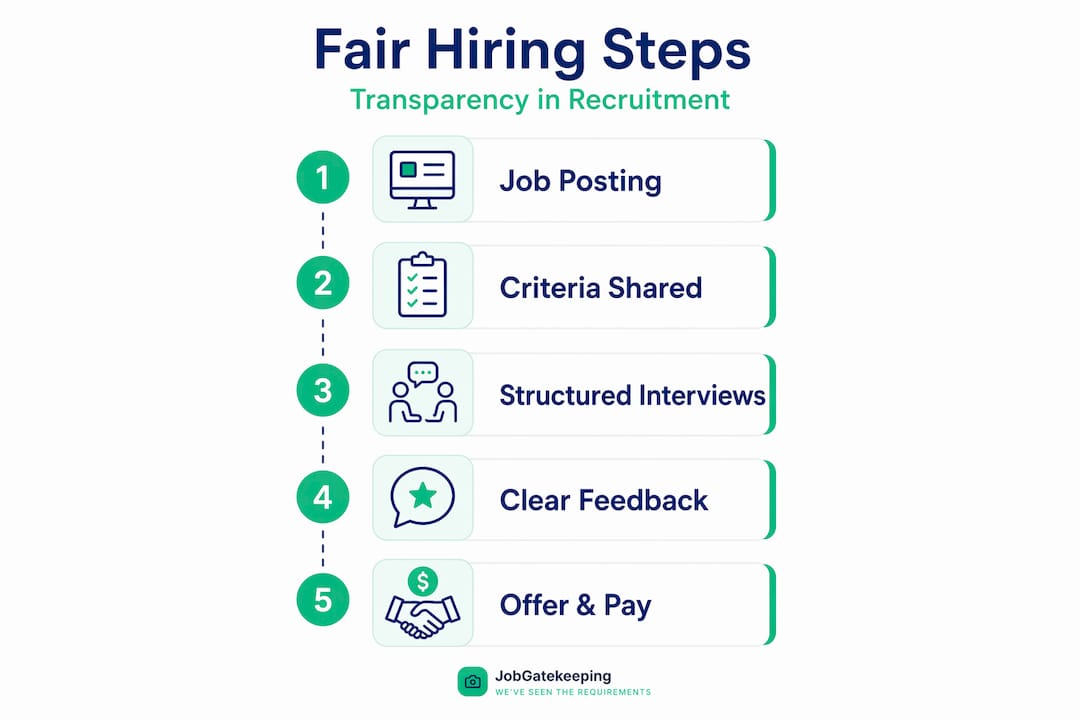
The methodology is clear: employers should publish hiring stages, how success is defined, and the job-related evaluation criteria. These three things form the backbone of a transparent process. Without them, everything else is decoration.
Here's what a truly transparent hiring process includes:
- Hiring stages and timeline — How many rounds? What format? When will candidates hear back? These aren't proprietary secrets. They're basic information every applicant deserves.
- Success criteria — What does "a great candidate" actually look like for this specific role? Not vague buzzwords like "team player," but measurable, job-related attributes.
- Evaluation rubrics — How are interviewers scoring responses? Is there a structured framework, or are they going on gut feel?
- Pay ranges — This one is increasingly becoming a legal requirement in many U.S. states, and for good reason.
- Feedback mechanisms — Will candidates receive any explanation of why they weren't selected?
Pay transparency deserves special attention here. Pay transparency can support pay equity and help with talent attraction and retention. It's not just a fairness issue. It's a business strategy issue. Organizations that publish salary ranges attract candidates who are genuinely aligned with compensation expectations, which reduces drop-off rates later in the process.
| Hiring element | Opaque process | Transparent process |
|---|---|---|
| Salary range | "Competitive compensation" | Specific range published in job posting |
| Interview stages | Revealed one at a time | Full process outlined upfront |
| Evaluation criteria | Based on "cultural fit" | Structured rubric shared with candidates |
| Timeline | "We'll be in touch" | Specific dates communicated |
| Feedback | Silence after rejection | Brief explanation of decision provided |
The transparent job postings workflow approach gives both employers and job seekers a clearer picture of what's expected. And using a detailed job posting checklist is one of the simplest ways to start holding organizations accountable from the very first touchpoint.
Pro Tip: When evaluating a potential employer, ask directly for a written outline of the hiring stages and what criteria will be used at each step. If they hesitate or give vague answers, that's information too. 🚨
How transparency supports fairness and legal compliance
This is where the stakes get really serious. Hiring transparency isn't just nice to have. It's closely tied to legal compliance and discrimination prevention. And if you're an advocate pushing for systemic change, this is the lever you pull.

Inclusive hiring standards operationalized in job descriptions help prevent discrimination and support compliance with equal employment law. Translation: when you write vague job requirements or evaluate candidates using undefined "culture fit" criteria, you're not just being sloppy. You may be violating the law.
The EEOC employer guidelines make it clear that hiring and recruiting must comply with legal requirements. Making processes and standards transparent supports lawful, accountable hiring. The connection between documentation and defensibility is tight. Organizations that publish their hiring criteria have a paper trail when challenged. Those that don't? They're vulnerable.
Publishing hiring practices can reduce discrimination risk and provide a defensible record when combined with job-related documentation. This is particularly important for federal employers and contractors, but the principle applies broadly.
Here's how transparency actively supports fairness and compliance:
- Removes subjective criteria that can mask bias (like "culture fit" or "executive presence")
- Creates audit trails that HR teams and legal departments can reference if decisions are challenged
- Reduces disparate impact by ensuring all candidates are evaluated against the same published standards
- Empowers marginalized candidates to identify when they've been evaluated unfairly and take action
For advocates, this means you have actual tools. When a company's stated criteria don't align with their hiring patterns, that's a documented inconsistency you can challenge. Understanding fair hiring principles gives you the language to make those challenges effectively. And knowing how labor laws shape fair hiring means you're not just frustrated — you're informed.
The question of reasonable job requirements also comes into play here. Demanding "10 years of experience for an entry-level role" isn't just absurd — it can have a discriminatory impact on younger candidates and career changers. Transparency forces these requirements into the open where they can be scrutinized.
Accountability and avoiding performative transparency
Here's where we need to get real. Publishing a process document doesn't automatically mean a company is actually following it. 🔥
Publicizing hiring practices creates accountability pressure for organizations to align their stated criteria with real practices, pushing beyond so-called "performative" transparency. But the pressure only works when candidates and advocates actually apply it.
Performative transparency is everywhere. It's the company that posts a lengthy "our hiring process" blog entry but never gives feedback. It's the job posting with a detailed rubric that nobody in the interview room has actually read. It's the "diverse and inclusive employer" badge plastered on a website while the leadership team is homogeneous.
How do you spot the difference between real transparency and the performative kind? Watch for these red flags:
- Vague language in published policies — phrases like "holistic review" or "variety of factors" without specifics
- No feedback loop — genuine transparency includes a mechanism for candidates to receive or request feedback
- Criteria that shift mid-process — a signal that published standards aren't actually being used
- Inconsistency between the job posting and what interviewers discuss — a major warning sign
- No named contact for process questions — opaque processes hide behind anonymity
The lack of transparency in job postings is a documented problem, not just an occasional oversight. And exploitative job postings often hide behind the language of professionalism while actually delivering nothing of value to applicants.
Pro Tip: Before your first interview, email the recruiter and ask for a written description of the evaluation criteria and the expected timeline for each stage. Their response — or non-response — tells you a lot about whether their transparency is real. 📋
If organizations can't back up their stated process with actual documentation, that's a story worth telling. That's a screenshot worth sharing.
The uncomfortable truth about hiring transparency
Here's our honest take, and it might not be what you expect to hear.
Most organizations that talk about hiring transparency are still fundamentally prioritizing their own convenience over candidate experience. Publishing a five-step process overview is easy. Actually training every interviewer to follow a structured rubric, collect consistent data, and deliver timely feedback — that's hard. It requires internal accountability, manager buy-in, and cultural shift. Most companies aren't doing that work.
And here's the uncomfortable part: candidates know it. They can sense the difference between a company that has genuinely built a fair, documented process and one that slapped a transparency statement on its careers page to look good. The superficial signals — the generic "we'll be in touch" emails, the interviewers who clearly haven't read your resume, the sudden silence after a promising second round — these don't disappear because a policy document exists.
Real transparency requires internal incentives to change. Recruiters need to be rewarded for giving feedback, not just for filling seats quickly. Hiring managers need accountability for following the criteria they helped create. Executives need to see diversity and fairness metrics as real performance indicators, not PR talking points.
Advocates shouldn't let organizations off the hook with policies alone. Push for ongoing candidate surveys, milestone feedback checkpoints, and published aggregate data on hiring outcomes. That's what real demanding recruiting transparency looks like in practice. It's ongoing, measurable, and tied to actual decisions — not just good documentation.
Together, we can push for the standard to be higher. Not "we published our process" but "here's how our process performed and what we changed based on candidate feedback."
Take action for fair hiring practices
You've seen the full picture now. Transparency matters. Accountability matters. And the gap between what companies publish and what they actually do is real and wide.

JobGatekeeping exists because that gap is too important to ignore. We're a community of job seekers and advocates who are done accepting vague job postings, arbitrary requirements, and zero accountability. At JobGatekeeping, you'll find fair hiring resources, checklists, and a growing community of people calling out the practices that keep deserving candidates locked out. Upload a screenshot. Share your experience. React to what others have found. Together, we build the pressure that drives real change. One absurd job posting at a time.
Frequently asked questions
What information should employers disclose in hiring processes?
Employers should disclose hiring stages, success criteria, evaluation methods, timelines, and pay ranges so candidates can assess fit and make informed decisions.
How does pay transparency impact job seekers and organizations?
Pay transparency addresses pay equity, builds candidate trust, reduces negotiation friction, and helps both sides comply with emerging legal requirements in many U.S. states.
Can publicizing hiring practices reduce discrimination?
Yes. Publishing job-related standards and structured processes reduces discrimination risk by creating a documented, defensible record that replaces subjective decision-making.
What are signs of performative transparency in hiring?
Performative transparency shows up as vague policy language, no candidate feedback, criteria that shift mid-process, and a complete disconnect between what's published and what interviewers actually discuss.
How can job seekers advocate for real hiring transparency?
Job seekers can request written process outlines and evaluation criteria before interviews, and push for post-process feedback surveys that hold organizations to their published hiring standards.