

You've seen them. Job postings asking for five years of experience for an "entry-level" role. Requirements for three certifications when the job is basically data entry. No pay range anywhere in sight. It's maddening, and it's not accidental. These postings are often the product of lazy, biased, or deliberately exclusionary hiring practices. But here's the thing: job posting scrutiny gives you a real framework to push back. When you know what to look for and how to challenge it, you stop being a passive applicant and start being an advocate for fairness.
Table of Contents
- What is job posting scrutiny?
- Where scrutiny happens: Types and triggers
- How to spot gatekeeping and unfair requirements
- Ghost jobs and misleading postings: Inside a hidden problem
- Action steps: Applying job posting scrutiny for fair outcomes
- Why job seekers need scrutiny skills, and what most guides miss
- Build advocacy with jobgatekeeping.com
- Frequently asked questions
Key Takeaways
| Point | Details |
|---|---|
| Scrutiny exposes unfair practices | Careful review of job ads helps reveal gatekeeping and discriminatory tactics that may not be obvious at first glance. |
| Red flags are actionable | Job seekers can spot and respond to problematic requirements by applying structured scrutiny techniques. |
| Ghost jobs waste time | Misleading postings with no hiring intent harm job seekers and distort job market data, prompting regulatory action. |
| Transparency is legally required | Many states mandate pay-range disclosure in job ads, and non-compliant postings can be challenged or penalized. |
| Advocacy builds change | Documenting and reporting unfair job ads empowers job seekers and advocates to push for fair hiring across industries. |
What is job posting scrutiny?
Now that we've set the stage, let's clarify what scrutiny means and why every job seeker should care.
At its core, scrutiny means careful, critical examination. Applied to job postings, "job posting scrutiny" means examining requirements, wording, and compensation disclosures for compliance and fairness risks. It's about reading a job ad not just as a list of tasks but as a document that can include, exclude, mislead, or even discriminate.
🚨 Job gatekeeping is real. Every vague requirement, missing pay range, or impossible qualification is a choice someone made. Scrutiny is how we hold those choices accountable.
Why does this matter for you as a job seeker? Because job postings are the first filter. Before your resume even gets looked at, the ad itself decides who feels qualified enough to apply. Ads loaded with unnecessary credentials, jargon-heavy language, or discriminatory phrasing quietly push people out before the process even begins.
Understanding fair hiring principles is foundational here. Scrutiny isn't about being cynical about every employer. It's about building the skill to read between the lines and know when something is genuinely unfair versus just poorly written. Both are worth flagging, by the way.
Key things scrutiny looks for:
- Requirements inflation: Asking for credentials or years of experience that don't match the actual role
- Vague language: "Self-starter" and "fast-paced environment" as substitutes for actual job descriptions
- Missing compensation: No salary range, no hourly rate, just "competitive pay"
- Exclusionary phrasing: Language that signals preference for specific demographics under the guise of culture fit
- Duplicate or zombie postings: Ads that have been live for months with no response
Each of these is a flag worth examining. And together, they paint a picture of an employer's real attitude toward fairness.
Where scrutiny happens: Types and triggers
Having defined scrutiny, it's time to explore where and how it shows up in real hiring scenarios.
Scrutiny isn't just something job seekers do informally. Federal laws prohibiting job discrimination mean that regulators and advocates actively scrutinize postings for discriminatory content, wage disclosures, and signs of ghost jobs. This is a formal, legally grounded process, not just community venting.
At the same time, pay-range disclosure requirements exist in many jurisdictions, where employers must include compensation ranges accurately in job ads. States like Washington, Colorado, and New York have passed laws requiring this, and violations can trigger penalties.
Here's a quick breakdown of who applies scrutiny and why:
| Type of scrutiny | Who applies it | What they look for |
|---|---|---|
| Legal compliance (EEO) | Government regulators, legal counsel | Discriminatory language, protected class exclusion |
| Wage transparency | State agencies, advocates | Missing or misleading pay ranges |
| Ghost job detection | Job seekers, workforce advocates | Postings with no hiring intent |
| Credential integrity | HR professionals, job seekers | Inflated or irrelevant requirements |
Triggers for scrutiny usually fall into a few categories:
- Discriminatory language — Phrases that code for age, gender, race, or disability status
- Vague or deceptive pay ranges — "$30,000 to $120,000" for a single role tells you nothing
- Suspicious posting behavior — The same job reposted weekly for six months
- Impossible requirements — Entry-level roles demanding AWS Certified status and 7 years of React experience
Pro Tip: Set up a simple tracking system. When you apply to a job, log the posting date, requirements, and pay range. If a company rejects you but keeps reposting, that's data worth sharing with the community.
For practical guidance on reading between the lines, check out these transparency tips for fair hiring and learn how to protect against exploitative postings before they waste your time.
How to spot gatekeeping and unfair requirements
Once you know where scrutiny happens, you'll need clear tools to recognize gatekeeping tactics in job ads.
Let's get specific. Gatekeeping in job postings is often subtle. It doesn't always look like outright discrimination. Sometimes it's a list of fifteen requirements when the job could be done by someone with five. Sometimes it's a certification that nobody actually uses on the job but filters out people who can't afford the training course.
EEO laws explicitly prohibit discrimination in job advertisements, and certain requirements can legally qualify as illegal gatekeeping if they have a disparate impact on protected classes without a legitimate business reason.
🔥 Common gatekeeping red flags to watch for:
- ✗ "Recent graduate preferred" — Can signal age discrimination against older workers
- ✗ "Must be able to lift 50 lbs" for a desk job — Disability-based exclusion with no job-related basis
- ✗ "Native English speaker" — This can function as national origin discrimination
- ✗ "5 years experience with [tool released 3 years ago]" — Pure credential inflation
- ✗ No salary listed, but lists luxury perks — A classic deflection tactic
- ✗ "Culture fit is everything" with no explanation — Often code for demographic preferences
Pro Tip: When reviewing a job ad, ask yourself one question for every requirement: "Does this directly relate to doing the job well?" If the answer is no or unclear, it might be gatekeeping. Document it. Share it. These are the kinds of postings that deserve to be called out.
When checking reasonable job requirements, think about whether the requirement is testable, relevant, and proportional. A good job posting checklist can help you go through this systematically rather than relying on gut instinct alone.
The numbers back this up. Research consistently shows that women are less likely to apply to jobs when they don't meet 100% of listed requirements, while men typically apply at 60% qualification match. Inflated requirements don't just exclude, they self-select in ways that reinforce existing inequality.
Ghost jobs and misleading postings: Inside a hidden problem
Beyond traditional gatekeeping, misleading job postings, especially ghost jobs, pose new risks for honest job seekers.

Ghost jobs are postings with no real intent to hire. The company might be "pipelining" candidates for future roles, satisfying a legal requirement to post before promoting internally, or just forgetting to take down old listings. Whatever the reason, the impact on job seekers is real and frustrating.
Ghost jobs waste applicants' time and distort labor market information. New York's State Senate passed legislation specifically targeting this practice, recognizing it as unethical and harmful. That's how serious this problem has gotten.
| Ghost job behavior | What it signals | Your move |
|---|---|---|
| Job reposted every 2 weeks for 6+ months | No real open role, or very high turnover | Research employee reviews before applying |
| "Immediate hire" with no follow-up | Pipeline collection or automated posting | Apply but set a two-week response deadline |
| Zero reviews on Glassdoor or LinkedIn | New or evasive employer | Proceed with caution, verify the company exists |
| Identical posting on 10+ job boards | Mass net casting with no real urgency | Don't tailor heavily, keep it general |
Here's what ghost job scrutiny looks like in practice:
- Check the posting date. A "new" job posted four months ago is a red flag.
- Cross-reference LinkedIn. Does the company have real employees in the roles adjacent to this one?
- Look for specificity. Real job postings have real managers, real teams, real context. Vague ones often don't.
- Search the job title plus the company name. Sometimes you'll find the exact posting from a year ago, still live.
😤 Nothing wastes your energy like perfecting a cover letter for a job that doesn't exist. Ghost jobs aren't just annoying. They're a form of disrespect toward job seekers.
When you learn how to avoid entry-level job traps, ghost jobs become easier to spot early. The same instincts that help you identify inflated requirements will help you sniff out postings that were never meant to lead anywhere.
Action steps: Applying job posting scrutiny for fair outcomes
Understanding the risks is only half the battle. Here's how to apply scrutiny in your job search and help create fairer outcomes.
This is where it gets actionable. Treating job postings like testable claims means challenging requirements, checking for legal compliance, and pushing for transparency as a default habit, not a last resort.
Here's a practical step-by-step process:
01. Review every requirement critically. Read each bullet point and ask if it's job-related, proportional, and legally defensible. Flag anything that feels inflated, vague, or exclusionary.
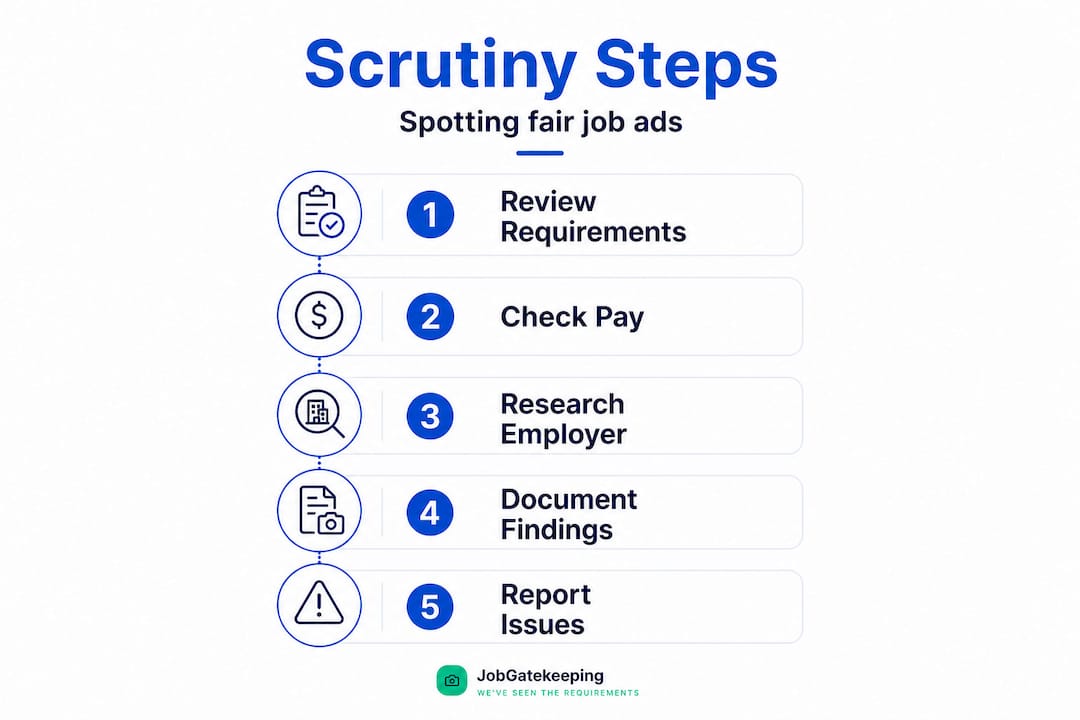
02. Check the wage disclosure. Is there a pay range? Is it specific or absurdly broad? In states with wage transparency laws, missing pay ranges may be a legal violation worth reporting.
03. Research the employer. Look at employee reviews on Glassdoor and Blind. Check LinkedIn to see how long similar roles have been filled or vacant. A pattern of rapid turnover or never-filled roles is worth noting.
04. Document what you find. Take a screenshot. Note the posting date, the platform, and the specific issues. This documentation is powerful if you decide to report the posting or share it publicly.
05. Challenge and report if needed. You can report discriminatory postings to the EEOC. You can share ghost jobs and inflated requirements with communities like ours. Collective visibility creates accountability that individual complaints alone can't achieve.
06. Build a network of scrutiny-minded peers. Share what you learn. When one person spots a pattern, it's an anecdote. When a hundred people share screenshots of the same company doing the same thing, it's a movement.
Pro Tip: Use a transparent postings workflow to systematize your review process. This way, scrutiny becomes a habit rather than a reaction. You can also learn how to demand recruiting transparency directly during the hiring process itself.
Why job seekers need scrutiny skills, and what most guides miss
After all these practical steps, it's important to reflect on the bigger picture: what makes scrutiny truly game-changing for job seekers and advocates.
Most job search guides focus on the wrong end of the problem. They tell you to tailor your resume, optimize your LinkedIn headline, and write compelling cover letters. All useful advice. But none of it addresses the upstream issue: the job posting itself might be rigged against you before you even open the application.
The conventional wisdom assumes job postings are neutral documents. They're not. They're written by humans with biases, time pressures, and sometimes deliberate gatekeeping intent. Treating them as objective lists of requirements is a mistake that costs job seekers time, confidence, and opportunity.
Here's the uncomfortable truth: many job seekers internalize rejection from gatekeeping-heavy postings as personal failure. They think, "I just need one more certification" or "I'll apply when I have more experience." But if the requirement was inflated to begin with, no amount of additional qualification will actually make you feel ready. That's by design.
Scrutiny skills flip this dynamic. When you recognize that a posting is asking for things that don't match the role, you stop chasing artificial standards and start evaluating employers on their merits. You apply anyway. You ask questions in interviews. You share what you found with others.
There are platforms built specifically to surface these patterns. Job ad analysis tools and community platforms let you see if others have flagged the same employer or the same type of posting. That collective intelligence is genuinely powerful.
Individually, you might just feel frustrated. Together, you create a record. And that record pushes employers to do better.
Build advocacy with jobgatekeeping.com
If reading this got your blood pressure up even a little, good. That frustration is valid, and it's exactly the fuel that drives change. You now have the tools to read job postings critically, spot gatekeeping in real time, and take meaningful action when you find something wrong.

JobGatekeeping.com is built for exactly this. Upload screenshots of absurd job postings, add a caption explaining the issue, and let the community react with outrage, laughter, or pure relatability. We've got checklists, guides, and a growing library of flagged postings that show hiring gatekeeping patterns across industries. Whether you want to share your own experience or just browse what others have called out, you'll find a community that takes this seriously and refuses to stay quiet about it. Together, we make the invisible visible.
Frequently asked questions
What does job posting scrutiny look like in practice?
It involves checking job ads for legal compliance, wage transparency, and signs of gatekeeping using frameworks like checklists and expert guidance. Scrutiny means studying job postings for compliance and gatekeeping risks in a systematic, documented way.
How can I tell if a job ad is discriminatory?
Look for language that excludes protected classes or imposes requirements unrelated to the job. EEO laws prohibit discrimination in job advertisements and recruitment practices, so what you're seeing may be legally actionable.
Why are pay ranges a focus of job posting scrutiny?
Many states require accurate pay-range disclosure in postings, and vague or excessively broad ranges may trigger legal review or penalties. Employers must include pay ranges under wage transparency rules in jurisdictions like Washington State.
What are "ghost jobs" and why are they harmful?
Ghost jobs are postings with no intent to hire, wasting applicants' time and distorting job market data. Ghost jobs are unethical and impact both job seekers and reliable labor market information, which is why states are now passing laws to regulate them.
Can job seekers actually challenge unfair job postings?
Yes, by documenting concerns and reporting to regulators or advocacy groups, job seekers can hold employers accountable. Regulatory scrutiny of postings is triggered by violations and advocacy, so your report can start a real investigation.