

Most people assume that looser, more flexible hiring criteria help more candidates get through the door. The reality is the opposite. When hiring standards are vague or inconsistently applied, bias fills the gap. Qualified candidates get screened out for the wrong reasons, and employers end up defending decisions they cannot justify. Understanding why hiring standards matter gives you real power. Whether you are a job seeker tired of absurd requirements or an advocate pushing for systemic change, knowing how standards work, where they fail, and what the law actually says is where accountability starts.
Table of Contents
- Key Takeaways
- Why hiring standards matter legally
- How clear standards reduce bias in hiring
- Employer trade-offs that still affect you
- What you can actually do about it
- My take on hiring standards and why they are the real fight
- Fight back with Jobgatekeeping 🔥
- FAQ
Key Takeaways
| Point | Details |
|---|---|
| Vague standards create bias | Without clear criteria, hiring decisions rely on subjective judgment, which opens the door to discrimination. |
| Federal law sets the baseline | The UGESP and Title VII require that hiring criteria be job-related, validated, and documented. |
| Structured processes reduce bias | Skill-based hiring and structured interviews produce fairer, more defensible outcomes for all candidates. |
| Transparency is a tool you can use | Job seekers and advocates can ask for criteria, flag vague postings, and push for accountability. |
| No system is perfect yet | Employers still struggle to balance predictive accuracy with equitable outcomes, which means advocacy work is far from over. |
Why hiring standards matter legally
Here is something that surprises a lot of people: employers do not get to make up hiring criteria however they want. Federal law places real limits on what standards can look like and how they must be applied. The foundation is Title VII of the Civil Rights Act, which prohibits employment discrimination based on race, color, religion, sex, and national origin. But the legal muscle behind day-to-day hiring practices comes from the Uniform Guidelines on Employee Selection Procedures, or UGESP, which mandate that any selection procedure be validated, documented, and monitored for discriminatory impact.
The UGESP introduced what is known as the Four-Fifths Rule. It works like this: if the selection rate for a protected group is less than 80% of the rate for the highest-scoring group, adverse impact exists. That is not just a warning signal. It is a legal trigger. Employers then have to prove that the criteria causing that disparity are job-related and represent a legitimate business necessity.
This matters enormously for job seekers. When an employer uses a blanket requirement like a four-year degree for a role that does not need one, or a credit check for a position with no financial responsibility, they may be creating adverse impact without realizing it. Protected characteristics like race, national origin, disability, and gender can all be indirectly affected by requirements that look neutral on paper.
Key legal protections you should know about:
- Title VII of the Civil Rights Act prohibits discrimination in all stages of hiring.
- The Americans with Disabilities Act requires reasonable accommodation in selection processes.
- The Age Discrimination in Employment Act protects applicants 40 and older from criteria that unfairly screen them out.
- Executive Order 11246 requires federal contractors to take affirmative action in hiring.
Pro Tip: If a job posting you applied to has criteria that seem unrelated to the actual work, you have grounds to ask the employer how those requirements were validated. It is a legitimate question, and their answer tells you a lot.
Job-related hiring criteria are not just good practice. They are a legal obligation. And when employers skip that step, it is usually job seekers from marginalized groups who pay the price.
| Requirement type | Potential protected group impacted | Legal defense required |
|---|---|---|
| Degree requirement | Race, first-generation students | Must prove job-relatedness |
| Credit history check | Race, national origin | Must show business necessity |
| Criminal background screen | Race, gender | Must be narrowly tailored |
| Physical test | Gender, disability | Must reflect actual job demands |
How clear standards reduce bias in hiring
Bias does not always show up in a hiring manager muttering something offensive. It shows up in a gut feeling. It shows up in an unstructured interview where two candidates get completely different questions. It shows up when "culture fit" becomes the deciding factor with no definition behind it.
Clear, objective hiring standards cut through that. Structured interviews reduce interviewer bias by asking every candidate the same questions and scoring answers against predetermined criteria. That consistency makes decisions defensible. It also makes them fairer, because the same bar applies to everyone.

Skill-based hiring takes it a step further. Rather than using a degree or years of experience as a proxy for ability, it evaluates what a candidate can actually do. Companies like Tesla and IBM have removed degree requirements entirely for many roles, and they did it specifically to reach more qualified candidates who were being filtered out unnecessarily.
Common hiring practices that quietly harm fairness:
- ✗ Requiring a four-year degree for roles where skills clearly matter more
- ✗ Using "culture fit" as a selection criterion without any defined, measurable meaning
- ✗ Relying on unstructured interviews where questions vary by candidate
- ✗ Posting vague job requirements that make it impossible for applicants to assess their own fit
- ✗ Running credit or background checks without a clear, documented connection to the role
Transparency matters too. When employers publish their evaluation criteria upfront, candidates can prepare meaningfully and self-assess honestly. That reduces the flood of mismatched applications and gives qualified people from nontraditional backgrounds a real shot. Learn more about what this looks like in practice on Jobgatekeeping's guide to fair hiring principles.
Pro Tip: Before applying, look at whether a job posting lists specific, measurable skills or just vague phrases like "strong communicator" and "team player." Postings with no concrete criteria are a red flag for inconsistent evaluation. You can learn how to spot unfair job ads before they waste your time.
Employer trade-offs that still affect you
🚨 Here is the uncomfortable truth: even well-intentioned employers struggle to get hiring standards right. And those struggles have real consequences for job seekers.
Running a proper validation study to confirm that a hiring criterion actually predicts job performance is expensive and time-consuming. Smaller organizations often skip it entirely, which means they rely on criteria that have never been tested for bias or accuracy. That is not a technical HR problem. That is a fairness problem you walk into every time you apply.
| Approach | Strength | Weakness |
|---|---|---|
| Structured interviews | Reduces bias, defensible in court | Time-intensive to design and score |
| Skills assessments | Directly measures ability | Can still carry bias if poorly designed |
| Degree requirements | Easy to screen at volume | Often excludes qualified candidates |
| Unstructured interviews | Feels natural to interviewers | Introduces bias, legally risky |
| Work sample tests | High predictive validity | Demanding to administer fairly |
There is also a documented tension between predictive accuracy and equitable outcomes. No selection procedure currently achieves both perfect predictive accuracy and zero adverse impact at the same time. That is not an excuse for employers to stop trying. It is a reason why ongoing monitoring, data collection, and willingness to adjust standards are all critical parts of doing this responsibly.
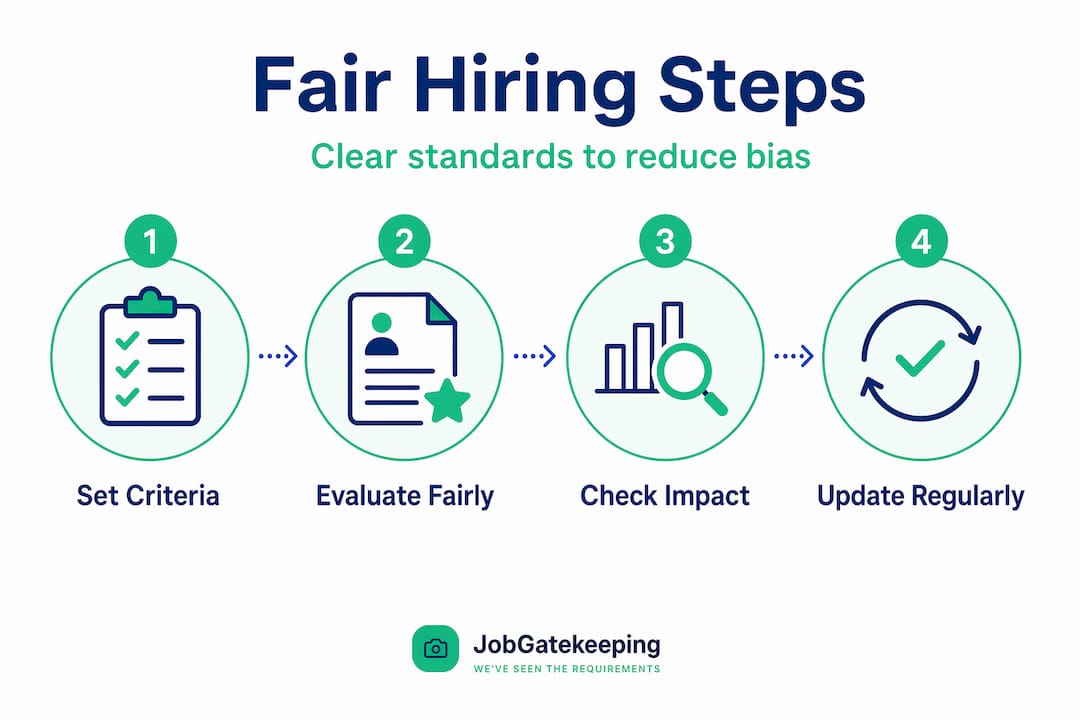
The employers who take the importance of hiring standards seriously are the ones doing regular adverse impact analyses, updating their criteria as job roles change, and publishing what they are looking for in plain language. The ones who do not? They often generate the exact kind of postings you see called out on Jobgatekeeping every single day.
What you can actually do about it
You are not powerless here. Whether you are a job seeker or an advocate, there are concrete ways to assess hiring standards and push back when they are unfair.
-
Read the posting critically. Ask yourself whether each listed requirement connects to something the job actually requires. A posting asking for "5 years of experience with a technology that is only 3 years old" is a signal that standards were not thought through. That kind of requirement is worth calling out publicly.
-
Ask direct questions in interviews. You have the right to ask how candidates are evaluated. Questions like "What does your interview scoring process look like?" or "How do you assess fit for this role?" reveal a lot about whether an employer has real standards or is winging it.
-
Use transparency as a filter. Employers committed to fair hiring should be able to tell you what criteria they use and why. If they cannot or will not, that is information. Jobgatekeeping's hiring process transparency tips walks you through exactly what to look for and what to ask.
-
Document and share what you find. When a posting is blatantly discriminatory or absurdly overloaded with requirements for an entry-level role, screenshot it. Share it. Publicizing hiring practices creates accountability that a single complaint rarely does. Collective visibility is pressure.
-
Push for skill-based evaluation. Advocate for employers in your network or industry to move away from degree and experience requirements toward demonstrated ability. 75% of Gen Z candidates consider an employer's commitment to diversity and equity when applying. That is leverage, and it is growing.
The impact of hiring quality improves across the board when standards are clear, documented, and enforced. That is good for employers, yes. But it is better for everyone who has ever been screened out of a job they were more than qualified for.
My take on hiring standards and why they are the real fight
I have watched job seekers spend months tailoring applications to postings that were never going to give them a fair shot. Not because they lacked skills. Because the hiring criteria were vague enough to let bias run the room.
What I have learned from years of advocacy in this space is that the conversation about fair hiring almost always stays at the surface level. People talk about bias training and diverse hiring panels, but they skip the harder question: what standards are being used, and can anyone defend them? In my experience, the employers making the most progress are the ones willing to put their criteria in writing, share them with candidates upfront, and actually analyze whether those criteria are doing what they claim. That is rare. It should not be.
I also believe that legal frameworks alone will not fix this. The UGESP has existed since 1978. Adverse impact is still well documented across industries. What moves the needle is public pressure. It is job seekers calling out absurd requirements by name. It is advocates collecting data and sharing it loudly. The law gives you a foundation, but the community gives you force.
If you take one thing away from this: do not accept vague hiring criteria as a neutral fact of the job market. They are a choice. And choices can be challenged.
— Steggy
Fight back with Jobgatekeeping 🔥
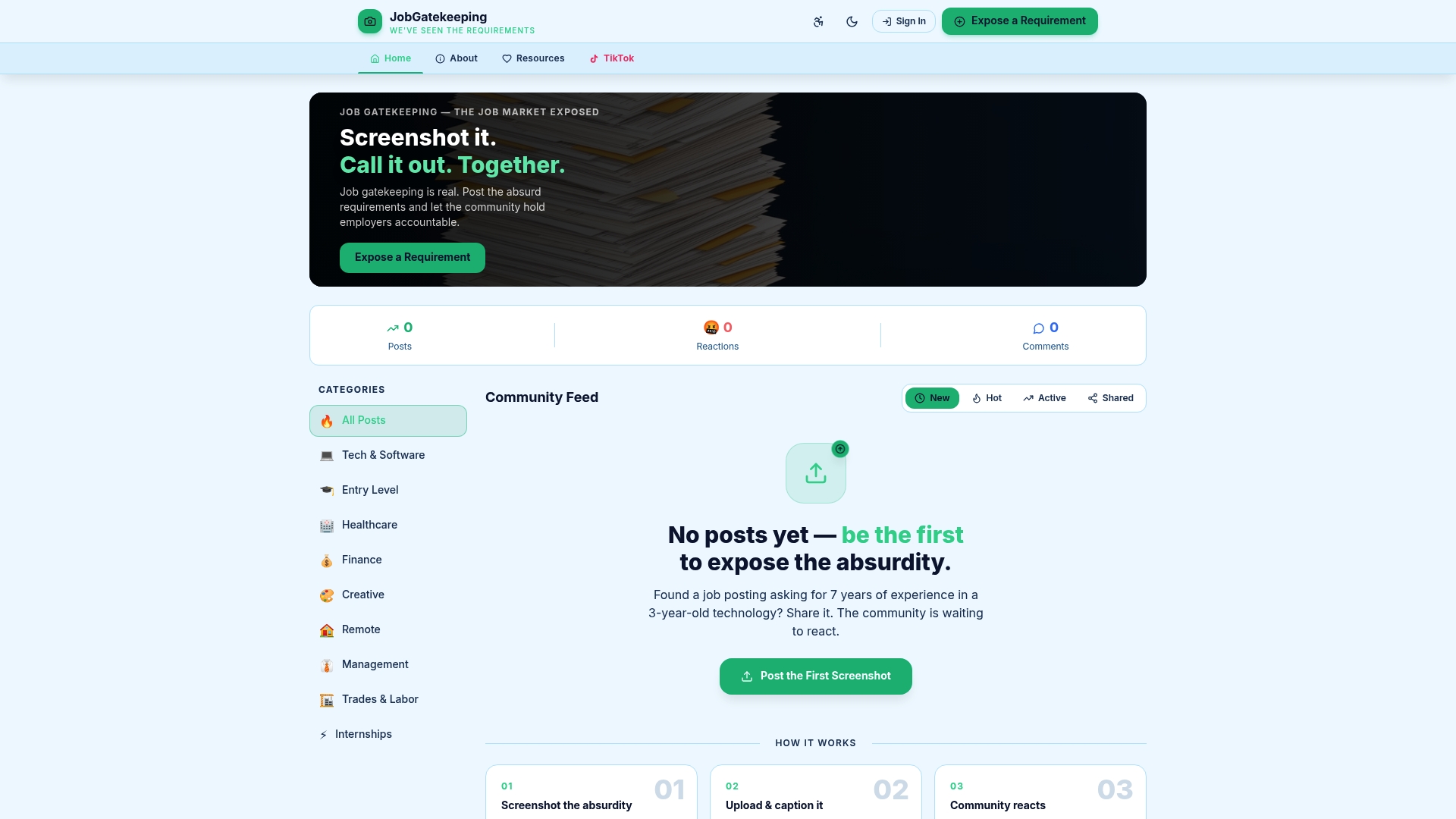
You have seen how much hiring standards shape who gets hired and who gets passed over. Jobgatekeeping was built for exactly this moment. When you come across a job posting demanding 8 years of experience for a junior role, or requiring a master's degree to send emails, do not just sigh and move on. Upload it. Caption it. Let the community pile on.
Jobgatekeeping gives job seekers and advocates a place to expose gatekeeping practices in real time, with community reactions that turn individual frustration into collective accountability. You can also explore resources on defining reasonable job requirements to understand exactly where the line is between legitimate criteria and gatekeeping. Your screenshot is evidence. Use it.
FAQ
Why do hiring standards matter for job seekers?
Clear hiring standards protect job seekers from arbitrary or biased decisions by requiring employers to use job-related, documented criteria. Without standards, subjective judgment fills the gap and often disadvantages candidates from underrepresented groups.
What is the Four-Fifths Rule in hiring?
The Four-Fifths Rule states that if a protected group's selection rate falls below 80% of the highest-scoring group's rate, adverse impact exists and the employer must prove the criteria are job-related and necessary.
How can I tell if a job posting uses unfair criteria?
Look for requirements with no clear connection to the actual role, like degree mandates for hands-on technical work or excessive years of experience for entry-level positions. Vague language like "culture fit" with no definition is another common signal of inconsistent standards.
Does skill-based hiring actually reduce bias?
Yes. Replacing degree and experience proxies with assessed skills removes barriers that disproportionately screen out qualified candidates. Companies that have made this shift, including IBM and Tesla, report broader and more diverse talent pools.
What can advocates do to improve hiring standards?
Advocates can document and publicize problematic job postings, push employers to share their evaluation criteria, and promote skill-based assessment models. Collective visibility and data are the most effective tools for holding employers accountable.