

You send in your application for an "entry-level" role, then hit the requirements section and see it: 3 to 5 years of experience required. For an entry-level job. You are not imagining things, and you are not underqualified for the world. What is entry-level experience creep? It is the growing trend where jobs officially labeled "entry-level" demand years of prior work experience that new graduates simply cannot have. 35% of entry-level jobs already require 3 or more years of experience. This article breaks down why it happens, how it hurts you, and exactly what to do about it. 🚨
Table of Contents
- What is entry-level experience creep and why does it happen?
- The impact of entry-level experience creep on job seekers and the labor market
- How to decode entry-level job postings with inflated experience requirements
- Proven strategies to overcome entry-level experience creep and win job offers
- Comparing true entry-level roles with mislabeled experience creep jobs
- Why the notion of "entry-level" is broken and what job seekers can do about it
- Find support and resources to navigate entry-level experience challenges
- Frequently asked questions
Key Takeaways
| Point | Details |
|---|---|
| Experience creep defined | Many jobs labeled 'entry-level' require several years of prior experience, complicating job searches for new graduates. |
| Root causes | Inflated experience requirements stem from ATS filters, risk-avoidance hiring, and understaffed teams needing quick productivity. |
| Not all experience counts equally | Internships, projects, and volunteer work can substitute formal experience if presented with clear outcomes and relevant skills. |
| Strategic applications win | Focus on job tasks, tailor resumes with keywords, and apply when you meet the majority of core responsibilities. |
| Long-term market impact | Experience creep risks shrinking training opportunities, potentially leading to talent shortages down the line. |
What is entry-level experience creep and why does it happen?
Entry-level experience creep is when a job posting carries the "entry-level" label but lists experience requirements that belong on a mid-level or even senior role. We are talking about postings that ask for "2 to 4 years of experience with Salesforce" or "3 years minimum in project coordination" for a role that pays $40,000 a year and comes with no training structure. The label says entry-level. The requirements say otherwise.
So how does this happen? It is not usually one villain sitting in HR cackling over a keyboard. It is a system problem. Experience creep is driven by ATS filters, inherited job templates, and understaffed teams that prioritize speed-to-productivity over training. Here is what that looks like in practice:
- Inherited templates: A manager copies an old job description from a previous hire who had five years of experience, tweaks a few bullet points, and hits publish. Nobody questions the experience ask.
- ATS over-filtering: Recruiters handling 500 applications use "years of experience" as a blunt screening tool. It is faster than reading every resume. The result is that qualified candidates without the magic number get filtered out before a human ever sees their application.
- Understaffed teams: When a team is stretched thin, they cannot afford to train someone from scratch. They want someone who can contribute on day one, even if the budget only supports a junior salary.
- Pay band confusion: "Entry-level" in many organizations simply means the lowest pay band. It does not mean the role comes with a training program or that hiring managers expect zero experience.
Understanding why entry-level jobs ask for experience is the first step toward not taking it personally. This is a systemic issue, not a reflection of your worth.
The impact of entry-level experience creep on job seekers and the labor market
With causes understood, let's look at what this trend actually does to people and to the broader job market. Because the effects of experience creep go further than one frustrating job application.
For you as a job seeker or recent graduate, the most immediate impact is a narrowed door. Employers prefer experienced candidates, shrinking true entry-level opportunities and making it harder to train junior talent at all. If every "entry-level" posting requires three years of experience, new graduates face a wall before they even begin.
"The entry-level job used to be where you learned the job. Now it is where you prove you already know it." That shift is the core problem. It assumes access to internships, unpaid work, and network opportunities that not everyone has.
Technology is making this worse. AI tools are automating many of the repetitive, task-based functions that once gave junior employees a starting point. Data entry, basic customer support scripting, simple content formatting. Those tasks built foundational skills. As they disappear, so do the natural on-ramps for new workers.
Here is what the experience inflation landscape looks like right now compared to a decade ago:
| Factor | 10 years ago | 2026 |
|---|---|---|
| Typical experience ask for entry-level | 0 to 1 year | 2 to 4 years |
| On-the-job training offered | Common | Rare |
| ATS usage in screening | Limited | Near-universal |
| AI replacing junior tasks | Minimal | Accelerating |
| New grad hiring as % of workforce | Higher | Declining |

The long-term employer risk is real too. If companies stop training junior talent now, they face a senior talent shortage in five to ten years. You cannot promote people who were never hired. That is not your problem to solve today, but it is worth knowing that experience creep is bad for everyone, including the companies doing it.
How to decode entry-level job postings with inflated experience requirements
Now that you know what experience creep looks like, let's get practical. You can learn to read a job posting the way a hiring manager wrote it, not the way a first-time applicant reads it.
The most important reframe: most "requirements" in entry-level postings are risk-reduction signals, not hard barriers. When a company lists "2 years of experience with Google Analytics," they are often signaling that they do not want to explain what Google Analytics is. If you already know it, you can address that directly in your application.
Here is how to read a posting strategically:
- Separate must-haves from wish lists. Any requirement that appears once in the middle of a long bullet list is probably a nice-to-have. Requirements that appear in the title, the intro paragraph, or are listed first are the ones that matter most.
- Look at the actual tasks, not just the title. If the day-to-day responsibilities match things you have done in a capstone project, internship, or volunteer role, you have relevant experience. The job title on your resume does not have to match theirs.
- Count the responsibilities you can actually do. If you can honestly speak to 60 to 70% of what is listed under "what you will do," apply. Do not self-reject based on the requirements section alone.
- Learn how to evaluate entry-level job posts carefully and you will quickly spot which postings are realistic targets versus which ones are mid-level roles in disguise.
Pro Tip: Use the actual language from the job posting in your cover letter and resume. If they say "cross-functional collaboration," use that phrase to describe the group project you led in your senior year. You are not fabricating experience. You are translating it into employer language. Learning to decipher job posting jargon will save you hours of wasted applications.
Proven strategies to overcome entry-level experience creep and win job offers
With decoding skills in hand, let's talk about what actually works when you are up against inflated requirements.
01. Reframe your resume around outcomes, not duties. Do not just list what you did. List what changed because of what you did. "Managed social media" becomes "Grew Instagram engagement by 34% over one semester by testing post timing and format." Scope and results speak louder than job titles.
02. Use keywords from the posting to pass ATS filters. Pull the exact phrases the posting uses and mirror them in your resume where truthful. ATS systems scan for keyword matches before a human ever reads your file. One-size-fits-all resumes do not pass these filters consistently.
03. Apply to roles where you meet at least 60% of core responsibilities. The core responsibilities section (not the requirements section) is your real checklist. If you can speak credibly to the majority of those tasks, you are a viable candidate.
04. Explicitly translate internships, projects, and student leadership into competency language that aligns with job descriptions. "Led a team of four students" is leadership. "Managed timeline and deliverables for a semester-long research project" is project management.
05. Build experience through short cycles. Contract gigs, nonprofit volunteering, apprenticeships, and roles adjacent to your target field all count. A three-month freelance content project is real experience. Put it on your resume and describe it like a professional engagement.
06. Network with intention. Not to beg for jobs, but to learn which companies actually train junior employees and which ones are genuinely inflating their requirements. Insiders know things job postings do not say. Check out job search tips for 2026 for current tactics that work in this market.
Pro Tip: For handling entry-level experience requirements in interviews, prepare a story for each core skill the role demands. Even if your proof comes from a class or volunteer project, a specific, results-oriented story is more convincing than a vague claim about being "a fast learner."
Comparing true entry-level roles with mislabeled experience creep jobs
To further clarify, let's look at what separates a genuine entry-level role from one that has been inflated by experience creep. Organizations should distinguish true entry-level from early-career roles, because even requiring one year post-graduation can cut out a large portion of new grads entirely.
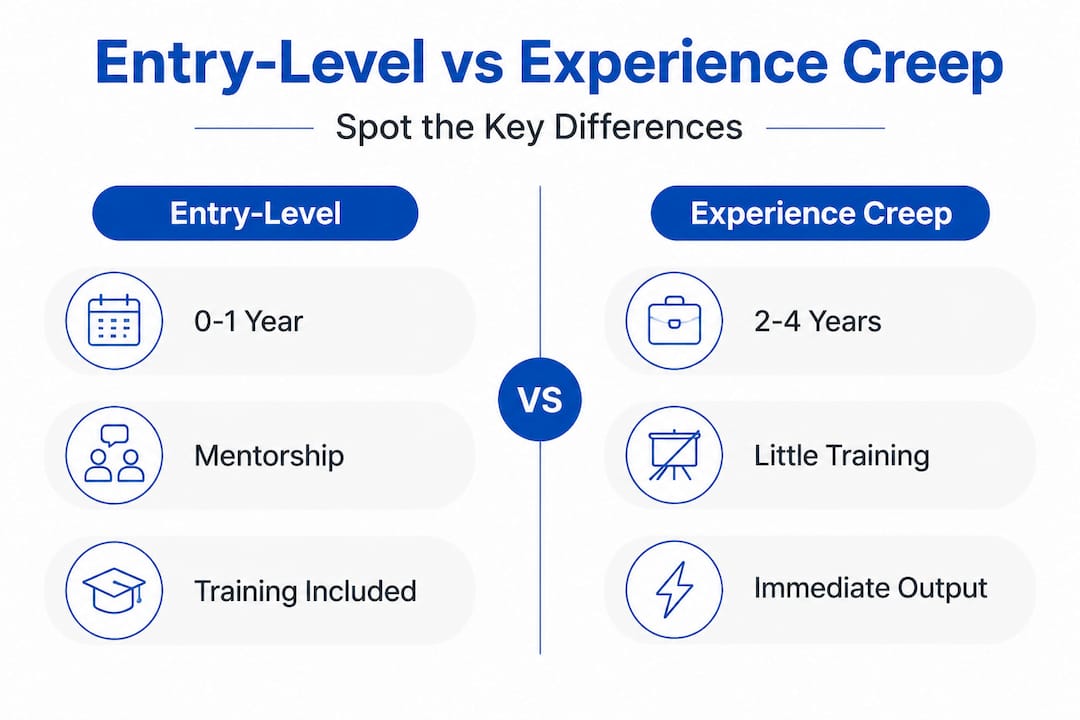
Here is a side-by-side look at what you should expect from each:
| Feature | True entry-level role | Experience creep role |
|---|---|---|
| Experience required | 0 to 1 year or none | 2 to 5 years |
| Training provided | Structured onboarding | Expected to self-manage |
| Pay band | Junior level | Junior to mid level pay, mid-level expectations |
| Mentorship | Often included | Rarely mentioned |
| Typical source | Rotational programs, apprenticeships | Standard job boards |
| Interview focus | Potential and attitude | Proven track record |
This comparison matters for your entry-level roles guide strategy. True entry-level roles are concentrated in structured programs at larger companies, government agencies, and nonprofits. If you want training, target those explicitly. If you are applying to a standard job board posting that says "entry-level" but demands experience, treat it as an early-career or junior role and position yourself accordingly.
Why the notion of "entry-level" is broken and what job seekers can do about it
Here is the uncomfortable truth: experience creep is not irrational from an employer's perspective. It is just deeply unfair in its downstream effects. Employers prefer experienced hires to avoid training costs, which feels like smart risk management until you realize it is quietly destroying the talent pipelines that produce tomorrow's senior employees. The logic is circular and self-defeating. Every senior developer, seasoned marketer, and experienced project manager was once a new graduate who someone took a chance on.
The inequality angle is one we feel strongly about. Experience creep does not hit everyone equally. Students who could afford unpaid internships, who went to schools with strong alumni networks, or who had parents who could pull a favor have a head start. Students who worked part-time jobs to pay tuition and had no time for unpaid roles are left behind. Calling a role "entry-level" while requiring three years of experience is not just a mislabeling issue. It is a class and access issue.
As a job seeker, understanding this dynamic shifts your approach. It stops you from internalizing rejection as personal failure and helps you apply more strategically. But there is also a bigger play here: advocacy. Push back by supporting reasonable job requirements in public conversations. Share the absurd postings you find. Call out the gatekeeping. When enough of us name the problem loudly, employers notice.
Pro Tip: If you receive a rejection from a role where you met the stated requirements, ask for feedback. You will rarely get it, but the ask signals confidence and occasionally opens a door to a future role or referral.
Find support and resources to navigate entry-level experience challenges
You should not have to decode broken job postings alone. At JobGatekeeping, we built a space specifically for this moment in your job search. A place where you can call out the absurd, find solidarity, and get sharper about how to navigate a hiring system that is often stacked against you.
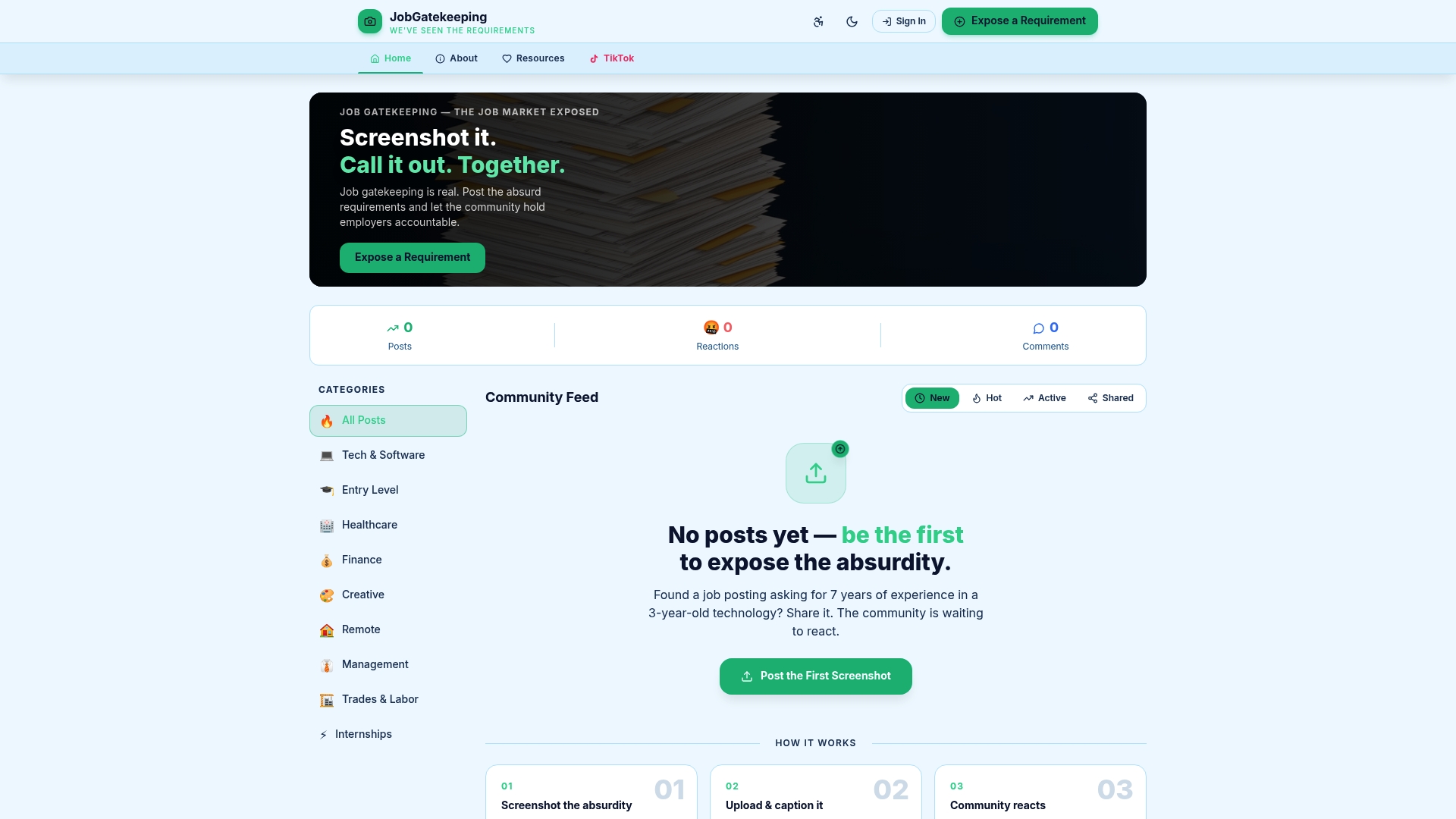
Upload a screenshot of that ridiculous posting asking for five years of experience for an "entry-level" coordinator role paying $35,000. Let the community react. 🔥 Then use our resources to understand what those inflated requirements actually mean and how to respond to them strategically. Visit JobGatekeeping to expose bad job postings, connect with others navigating the same mess, and find practical guidance on turning gatekeeping moments into application wins. Together, we hold the hiring world accountable.
Frequently asked questions
Why does every entry-level job require 1 to 3 years of experience?
Job posts are often wish lists built on inherited templates, and recruiters use years of experience as a crude filter when applicant volume is high. The "entry-level" label usually reflects pay band, not the actual training level the role provides.
Should I apply to entry-level jobs if I don't meet the experience requirement?
Yes, if you can demonstrate 60 to 70% of the core responsibilities and show proof through projects, internships, or volunteering. Tailor your application carefully and use the posting's own language to connect your experience to their needs.
What counts as experience for entry-level roles if I'm a new graduate?
Internships, co-ops, capstone projects, open-source work, freelancing, and relevant part-time jobs all count. Describe them in employer language with scope and measurable impact and they read as genuine professional experience.
How can I gain experience if I can't get hired?
Create it through short cycles: a portfolio project, a three-month contract gig, nonprofit volunteering, or an apprenticeship. Targeted, documented work in your field beats waiting for the perfect hire.
Are all entry-level jobs mislabeled with experience creep?
Not all. True entry-level roles still exist, concentrated in rotational programs, apprenticeships, and contract positions. But many listings inflate requirements due to systemic organizational pressures, so knowing how to spot the difference matters.