

Job boards were never designed to protect you. They were built to connect employers with applicants, full stop. But somewhere along the way, job seekers got tired of submitting into the void, decoding impossible requirements, and getting ghosted after three rounds of interviews. So they did what frustrated people always do: they found each other. Online job forums have quietly transformed from simple listing aggregators into something far more powerful, a collective defense system against opaque hiring, absurd requirements, and the gatekeeping tactics that cost real people real opportunities every single day.
Table of Contents
- How online forums changed the job search landscape
- Decoding employer requirements and ATS: Forums as survival guides
- Challenging unfairness: Forums as transparency engines
- Beyond jobs: Support for complex employment realities
- What most guides ignore: The double-edged sword of online job forums
- Resources for transparent, empowered job searching
- Frequently asked questions
Key Takeaways
| Point | Details |
|---|---|
| Forums drive transparency | Online job forums expose hidden steps and demystify employer requirements for applicants. |
| Community spotlights fairness | Peer insights help reveal unfair or excessive demands, especially in digital hiring. |
| Practical support beyond job leads | Forums offer guidance on legal, visa, and employment conditions, not just job listings. |
| Advice is powerful but not infinite | Crowdsourced tips work best when combined with your own research and context. |
How online forums changed the job search landscape
For years, job seekers were expected to figure it all out alone. Read the posting. Submit the resume. Wait. The process was always tilted in the employer's favor, and applicants had almost no reliable way to compare notes or verify whether a posting was even legitimate. That changed when online forums started aggregating real applicant experiences.
Today, forums and community-driven platforms pull together timelines, salary data, interview format disclosures, and honest gut-checks from people who just went through the same process you're about to enter. That shift from "broadcast job listing" to "peer-reviewed hiring intelligence" is massive. It fundamentally changes the power dynamic.
Here's what that shift actually looks like in practice:
| Old model | Forum-powered model |
|---|---|
| Employer posts requirements, no context | Community shares decoded expectations |
| Applicants wait in silence | Timelines are tracked and shared publicly |
| Salary hidden until offer stage | Ranges discussed openly in threads |
| No feedback after rejection | Community compares notes on red flags |
| ATS acts as invisible barrier | Forum guides surface ATS keyword strategies |
The data backs this up. Online job-search advice can improve outcomes for individuals when not everyone has identical exposure to that advice. Peer-shared insight creates real, measurable advantages for those in the know. And the demand for that insight is driven by a deeply frustrating reality: six in ten candidates quit applications due to friction in the process itself.
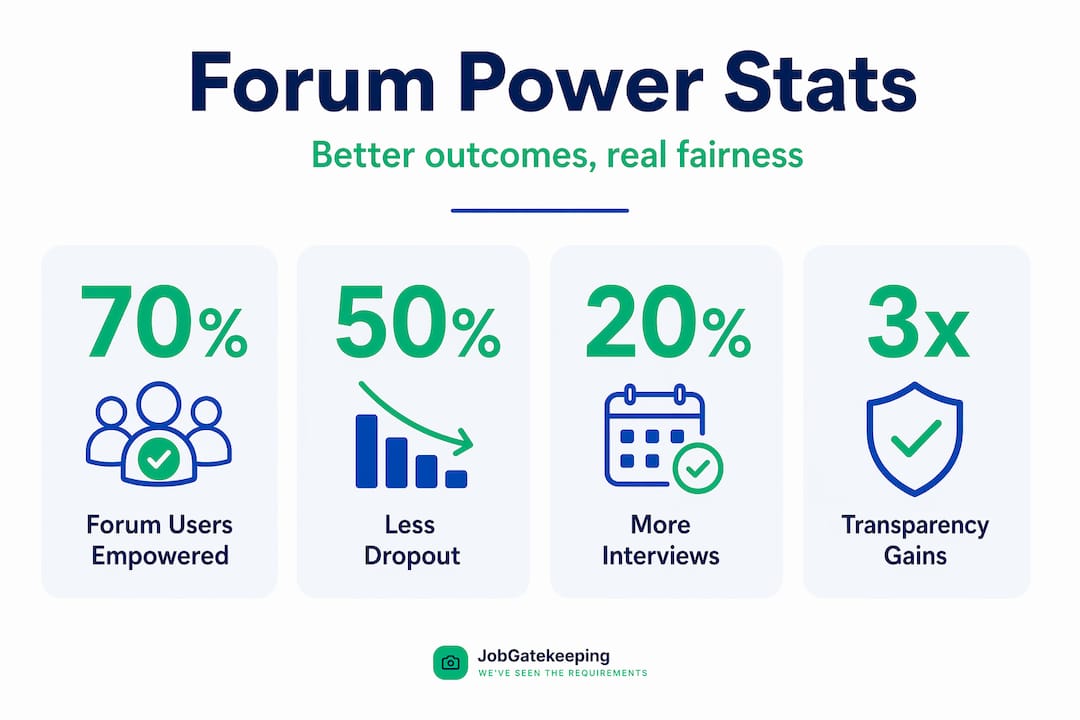
That's not a small number. That's the majority of applicants abandoning ship before they even get a shot, often because the process is confusing, opaque, or just exhausting. Forums emerged as a direct response to that friction. They don't just share job leads. They share survival strategies.
Of course, forums aren't perfect. There's an oversaturation problem we'll get to. And not all advice is created equal. But the core function, helping applicants understand why job postings lack transparency and equipping them with real expectations before they apply, is genuinely valuable. It's the kind of resource that should have existed from the beginning.
The key benefits forums deliver:
- ✓ Real application timelines from actual candidates
- ✓ Decoded employer requirements and unstated expectations
- ✓ Red flag patterns that signal sketchy or misleading postings
- ✓ Emotional support and motivation from community solidarity
- ✓ Early warnings about companies with poor hiring practices
Decoding employer requirements and ATS: Forums as survival guides
Let's be honest: most job postings are written in a language that only benefits the employer. "5+ years of experience with a 3-year-old technology." "Entry-level role requiring senior-level expertise." "Competitive salary" with zero numbers attached. These aren't accidents. They're filters, and not always fair ones.
This is where job forums flip the script. They act as grassroots translators, turning confusing or algorithm-driven hurdles into actionable steps that regular applicants can actually use.

Here's a numbered breakdown of how forum communities typically decode a confusing hiring process:
01. Identify the ATS keywords. Forum members share which terms consistently appear in job descriptions for specific roles. If "project lifecycle management" keeps showing up, that's what your resume needs to say, even if you'd naturally write "managed projects end-to-end."
02. Map the interview stages. Community members document exactly what each stage looked like, how long it took, who was in the room (or Zoom), and what kinds of questions came up. This turns a mystery into a prep checklist.
03. Verify the requirements. This is huge. Forums help candidates verify posting details and timelines collectively, so if a posting claims you need AWS Certified Solutions Architect credentials for a junior role, someone in the community can say "I got the job without it" or "they never even asked about it."
04. Flag misleading language. When something sounds off, the community calls it out. "10 years of React experience" for a $38K role? That thread is getting 500 comments. Fast.
05. Build a process checklist. Once enough people share their experience with a specific employer, the community collectively builds a playbook for that company's hiring cycle.
This kind of peer-driven intelligence is exactly what spotting unfair job ads is all about. It's not just about one bad posting. It's about recognizing the patterns across an entire industry.
| Forum resource type | What it helps you do |
|---|---|
| ATS keyword threads | Optimize your resume for automated filters |
| Interview timeline posts | Set realistic expectations and plan accordingly |
| Requirement verification threads | Challenge excessive or dishonest asks |
| Salary disclosure threads | Negotiate from an informed position |
| Red flag employer lists | Avoid wasting time on toxic hiring processes |
Pro Tip: Before applying to any company, search for their name in a job forum alongside words like "interview process" or "offer timeline." You'll often find firsthand accounts that tell you more in five minutes than the company's entire careers page would in an hour.
Understanding fair hiring strategies starts with knowing what you're actually walking into. Forums make that knowledge accessible to everyone, not just people who have a contact inside the company.
Challenging unfairness: Forums as transparency engines
Here's a reality check. Digital hiring has introduced a whole new category of problems. AI screening tools that filter out qualified candidates based on opaque criteria. Asynchronous video interviews that feel dehumanizing and one-sided. Job postings written to screen people out rather than in. These aren't isolated complaints. They're documented, systemic issues.
"I applied to 47 jobs in three months. Most ghosted me. Two asked me to record a video interview with no human on the other end. One asked me to complete a 4-hour unpaid assessment. I only found out these were red flags when someone in a forum told me I wasn't the problem. The process was." — Community member post, shared with permission
Research supports what forum members are experiencing. Asynchronous video interviews led to a 50% decrease in applicants continuing the process, and those who did continue perceived the process as less fair and less competitive. That's a massive deterrent built directly into a hiring tool that employers often adopt without considering the candidate experience at all.
Forums do something critical in response to this: they translate rights into plain language. They rally around regulatory changes and explain what they mean for you. They call out AI hiring bias when it shows up in patterns across applicant reports. They pressure platforms to be more accountable when job postings are discriminatory, misleading, or just flat-out exploitative.
Ways forums amplify transparency and fairness:
- ✓ Surface AI screening bias through aggregated rejection patterns
- ✓ Explain emerging regulations around digital hiring tools
- ✓ Identify asynchronous interview red flags before you walk in
- ✓ Share legal frameworks and applicant rights in accessible language
- ✓ Mobilize community pressure against platforms with bad actor employers
The forums can surface and amplify fairness concerns that individual applicants would never see on their own. One person's experience with an AI screening tool is a frustration. Five hundred people's similar experiences is evidence of systemic bias.
Pro Tip: If you're asked to complete an unpaid assessment that takes more than 30 minutes or requires you to produce original, usable work, post about it. Document the company name, the role, and the scope of the request. Forums thrive on this kind of specific, verifiable disclosure.
Understanding a job posting checklist for fair hiring helps you recognize when something has crossed a line. And when you can name what's wrong, you can act on it, not just absorb it.
Beyond jobs: Support for complex employment realities
Not every job search challenge is about the application itself. For millions of people, the obstacles are layered: work authorization, visa eligibility, regional employment law, language barriers in legal disclosures. Job forums have become surprisingly powerful spaces for navigating these job-adjacent complexities.
International job seekers, in particular, face a minefield of employer disclosures, eligibility requirements, and legal fine print that can be genuinely hard to parse. Forums are critical for international students and job seekers navigating visa and employment eligibility topics, with community members sharing real-world interpretations of policies that official documentation often obscures.
This matters enormously when you're dealing with something like an H-1B sponsorship question, an OPT extension timeline, or whether a specific employer is known to actually follow through on visa support. Peer networks fill gaps that no official source is designed to fill.
On the regulatory side, employment law is moving fast. For example, Ontario now requires employers to disclose AI use in hiring and include pay ranges in job postings, with follow-up communication requirements after interviews. Forums help job seekers understand what these new rules mean in practice, and when an employer is falling short of them.
Job-adjacent issues forums actively address:
- ✓ Visa sponsorship realities vs. what postings claim
- ✓ Regional employment law changes and what they mean for applicants
- ✓ AI hiring disclosure requirements by jurisdiction
- ✓ Salary transparency law compliance by employer
- ✓ Marginalized applicant experiences with discriminatory posting language
- ✓ Work condition negotiation strategies from peer experience
Knowing your rights is step one. Finding out which employers actually respect those rights is something only community knowledge can surface. Our guide to discriminatory job postings and the broader impact of labor laws on fair hiring give you the language and context to recognize when a posting crosses a legal line, and what to do about it.
🚨 The bottom line: Job forums don't just help you find jobs. They help you survive the process of finding one, especially when that process has been deliberately designed to work against you.
What most guides ignore: The double-edged sword of online job forums
We want to be real with you here. This article has made a strong case for forums as empowerment tools, and that case holds up. But there's a paradox baked into collective wisdom that most job search advice completely ignores, and it's worth naming.
When forum strategies go mainstream, they stop working as well. Advice effectiveness can reverse at high exposure intensities, creating negative spillovers when everyone floods toward the same tips. If every applicant in your field knows the same ATS keyword tricks, the keyword advantage disappears. If every candidate uses the same formula for cold outreach, recruiters start ignoring it. The collective gain becomes an individual wash.
This isn't a reason to abandon forums. It's a reason to use them differently than most people do.
Don't just absorb forum strategies and replicate them exactly. Use them as a foundation, then layer in something uniquely yours. Maybe that's a portfolio project that goes beyond what others in the thread described. Maybe that's a cover letter that references a company's recent news instead of reciting the same "I'm passionate about your mission" language everyone else is copying.
Forums are also worth approaching with transparency challenges in mind. Not every voice in a thread is well-informed. Not every "red flag" warning is warranted. Employers adapt. Hiring processes change. What was true six months ago at a specific company may not apply today. Treat forum intel as a starting point for your own research, not a final verdict.
The most effective job seekers we see in this community are the ones who combine collective knowledge with personal strategic thinking. They read the threads. They learn the patterns. Then they do something different enough to actually stand out. That combination, community wisdom plus individual judgment, is where real advantage lives.
Long-term, advocacy matters too. Calling out unfair postings, sharing your experience, and contributing to the collective record isn't just therapeutic. It shifts norms over time. Employers who see their practices exposed publicly have an incentive to change. That change is slow, but it's real.
Resources for transparent, empowered job searching
You've seen the full picture now: forums as survival guides, transparency engines, and advocacy tools. But knowing the landscape is just the beginning. What you do with that knowledge is what actually changes your outcome.
At JobGatekeeping, we've built a space where you can take everything you've learned here and put it into action. Read up on why job postings lack transparency and how to push back. Use our fair job search tips to navigate the process with your eyes open. Screenshot the absurd requirements you've encountered and share them with a community that gets it. Your experience isn't just a personal frustration. It's data. And together, we're building a record that holds employers accountable and gives every job seeker a fairer shot. 🔥
Frequently asked questions
How can online job forums help me avoid wasting time on fake or unfair job postings?
Forums let you compare notes with other applicants to spot patterns in fraudulent or misleading postings, and communities collectively verify employer legitimacy through shared timelines and real posting details.
What legal rights or transparency benefits can I gain from using job forums?
Forums often translate emerging regulations into plain language, including rules like Ontario's requirement for employers to disclose AI use and pay ranges in job postings, so you know exactly what you're entitled to see.
Are online forums useful for non-application issues like visas or working abroad?
Absolutely. Forums support international students and job seekers with peer-driven advice on visa processes, employment eligibility, and work requirement navigation that official sources rarely cover clearly.
Can advice from forums backfire or overwhelm the job market?
Yes. Research confirms that popular tips create negative spillovers when adopted at scale, making widely shared strategies less effective for individuals who follow them without adding their own personal angle.