

You send out application after application, and every "entry-level" post seems to demand three years of experience you simply don't have. Sound familiar? You're not imagining it. Job posts labeled "entry-level" often contain inflated experience requirements that have nothing to do with actual entry-level work. The good news? With a smart, structured checklist approach, you can cut through the noise, target the right roles, and walk into your first job with real confidence. Let's break it all down.
Table of Contents
- 1. The essential entry-level job checklist
- 2. How to decode confusing entry-level requirements
- 3. Preparing your application materials and tracking your job search
- 4. Navigating the hiring process: From interviews to offers
- 5. Overcoming unreasonable requirements: Evidence and advocacy
- Our take: Why conventional checklists fail and what works now
- Take the next step in your job search
- Frequently asked questions
Key Takeaways
| Point | Details |
|---|---|
| Target roles smartly | Focus on jobs where your current skills and experiences clearly map to the employer’s real requirements. |
| Track your search | Consistently organize and update your job applications to avoid missed opportunities or deadlines. |
| Prepare tailored materials | Customize your resume and cover letter for each job, showing exactly how you fit their core criteria. |
| Advocate for your skills | Use examples from internships, projects, or volunteering to prove your readiness, even if you fall short on 'years' of experience. |
| Understand the process | Expect multiple hiring stages and be ready to demonstrate your value beyond the resume in interviews and assessments. |
1. The essential entry-level job checklist
Now that you know why "entry-level" can be so misleading, here's your step-by-step foundation.
Think of this checklist as your personal playbook. Every step matters, and skipping one can cost you an offer. Here's what a solid process looks like from start to finish:
01. Identify your target roles. Be specific. Know the job titles you're realistically aiming for, the industries where you have the strongest foot in the door, and the minimum requirements you actually meet.
02. Build and tailor your resume. Don't send the same resume everywhere. Adjust it for each application by mirroring the language in the job post. Pull keywords from the description and weave them into your bullet points.
03. Write a targeted cover letter. Address why you want this specific role at this specific company. Generic letters get ignored. One paragraph on your relevant experience, one on what you bring, one on why them.
04. Research the company before you apply. Know their mission, recent news, and culture. This takes 15 minutes and makes every interview answer sharper.
05. Track every application. Create a spreadsheet or use a tracking tool. Log the company name, role, date applied, contact person, and follow-up deadlines. This habit saves you from embarrassing mix-ups and missed opportunities.
06. Prepare for screening calls. Most entry-level hiring processes start with a 15 to 30 minute phone screen. Prep a 90-second "about me" answer and two or three questions to ask the recruiter.

07. Practice interviews. Out loud. Seriously. Talking through your answers in your head is not enough. Record yourself or practice with a friend.
08. Follow up after applying. If you haven't heard back in 7 to 10 business days, send a polite one-sentence check-in email.
09. Prepare for assessments. Many entry-level roles include skills tests, writing samples, or coding challenges. Ask early in the process what to expect so you're not blindsided.
10. Review and negotiate the offer. Don't accept on the spot. Take 24 to 48 hours, compare the offer against market rates, and don't be afraid to ask questions.
"A practical first-job application checklist should cover resume, cover letter, applications, interviews, background check, and offer review." This hiring process framework is a baseline you can build on.
Yale OCS provides checklist-style guidance for organizing materials, setting up tracking systems, and preparing for practice interviews. Their approach reinforces that documentation and preparation are just as important as the application itself.
Pro Tip: Use our fair job checklist to evaluate whether a post is even worth your time before you spend two hours crafting a cover letter.
2. How to decode confusing entry-level requirements
With your checklist in hand, the next challenge is making sense of murky requirements and targeting the right roles fast.
Here's the uncomfortable truth: 35% of "entry-level" roles required prior relevant experience, and in software and IT, over 60% of those posts demanded three or more years of experience. That's not entry-level. That's gatekeeping with a friendly label slapped on top. 🚨
So how do you filter fast? Start by knowing the difference between "required" and "preferred" skills.
Required vs. preferred — what it actually means:
- ✗ Required: If you're missing more than two of these, the application is likely a long shot. Focus energy elsewhere unless you can substitute with strong evidence.
- ✓ Preferred: These are nice-to-haves. Missing several of them is totally fine. Apply anyway and address any gaps in your cover letter.
Here's a quick reference to help you spot the difference between a genuine entry-level post and an inflated one:
| Signal | Genuine entry-level | Inflated posting |
|---|---|---|
| Experience required | 0 to 1 years | 3 to 5 years |
| Degree requirement | Bachelor's or equivalent | Advanced degree for basic roles |
| Skills list length | 5 to 8 relevant skills | 15+ mixed skills |
| Compensation shown | Yes, listed clearly | Vague or missing entirely |
| Growth language | Training provided, mentorship | Sink or swim, fast-paced only |
When a posting feels inflated but you still want to apply, lean on alternative evidence. Tailoring applications and filtering by realistic requirements is how you avoid wasting weeks on dead ends.
What can substitute for missing years of experience? Plenty:
- Academic projects that show real-world output
- Internships or co-ops, even if short-term
- Volunteer work in a relevant field
- Freelance or side projects, particularly in creative or tech roles
- Certifications like Google Analytics, HubSpot, AWS Cloud Practitioner, or CompTIA A+
Understanding why jobs want experience in the first place helps you counter that demand with the right story. And learning to evaluate job post traps is a skill you'll use throughout your entire career.
Pro Tip: If a posting lists 10 required skills and you have 7, apply anyway. Most hiring managers treat requirements as a wish list, not a strict legal contract. Check out our experience inflation guide to see exactly how to position yourself against those inflated expectations.
3. Preparing your application materials and tracking your job search
Once you've identified a target job, the next step is submitting the best version of yourself while staying organized.
A lot of job seekers blow it here, not because their skills are lacking, but because their materials are messy and their tracking is nonexistent. Let's fix that.
Step-by-step for polished application materials:
01. Resume — Keep it to one page. Use a clean, ATS-friendly (applicant tracking system-friendly) format. ATS is the software employers use to scan resumes before a human ever sees them. No graphics, no columns, no fancy fonts. Just clear, keyword-rich bullet points that start with strong action verbs.
02. Cover letter — Three to four short paragraphs. Customize the opening every single time. Hiring managers can smell a copy-pasted intro from a mile away.
03. LinkedIn profile — Update it the day you start applying. Your headline should reflect what you want, not just what you studied. Add a professional photo, fill in your experience, and turn on "Open to Work."
04. Portfolio or work samples — If your field requires it (design, writing, coding, marketing), have a clean, accessible portfolio ready. A simple Google Drive folder works fine if you don't have a personal website yet.
Yale OCS recommends setting up job tracking systems and alerts alongside your materials preparation, treating them as two sides of the same coin.
Here's a simple tracking template you can set up today:
| Column | What to log |
|---|---|
| Company name | Full company name |
| Role title | Exact title from posting |
| Date applied | Month, day, year |
| Contact name | Recruiter or hiring manager |
| Status | Applied, screened, interview, offer, rejected |
| Follow-up date | 7 to 10 business days after applying |
| Notes | Anything relevant from communication |
Pro Tip: Set a weekly 30-minute review session to update your tracker. You'll catch stale applications, remember to follow up, and spot patterns in which roles are getting responses. Use our 2026 job search tips to stay sharp in a competitive market.
4. Navigating the hiring process: From interviews to offers
With your materials in play and interviews ahead, you need to be ready for the rest of the funnel.
Most people prepare for interviews but not for the full process. That's a mistake. Each stage has its own expectations, and showing up unprepared for a skills assessment or a background check request can tank an otherwise great candidacy.
Here's what a typical entry-level hiring funnel looks like, based on current data. Hiring involves screening, assessment, interviews, background checks, and offers, with entry-level roles often having fewer stages than senior ones. That means faster timelines, but also less room to recover from a weak showing.
What to expect at each stage:
- Application screening: An ATS filters your resume first. Then a recruiter does a quick scan. This is why tailored, keyword-rich resumes matter so much.
- Phone or video screen: 15 to 30 minutes. The recruiter is checking communication skills, basic fit, and whether your expectations are realistic.
- Skills assessment: Common in marketing, coding, writing, data, and customer service roles. These may come before or after the first interview.
- Panel or individual interview: Usually 45 to 60 minutes. Expect behavioral questions ("Tell me about a time when...") and role-specific questions.
- Background check: Standard for most employers. Make sure any certifications, degrees, or job titles on your resume are accurate.
- Offer stage: Review everything carefully. Salary, benefits, start date, and any conditions of employment.
"The key to performing well at every stage is to show learnability, not just current skill level." This applies especially to what entry-level means in today's hiring landscape. Employers expect a learning curve. Your job is to show you're eager and capable of climbing it fast.
One often overlooked step: the thank-you note after an interview. Send it within 24 hours. One short, specific paragraph referencing something concrete from the conversation. It shows attention and follow-through, two things entry-level employers care about deeply.
5. Overcoming unreasonable requirements: Evidence and advocacy
In those moments when a job feels just out of reach, here's how to stay in the game and even stand out.
You've seen the posting. "Entry-level position. Requires 4 years of experience, proficiency in six tools, and a portfolio of Fortune 500 clients." 🔥 It's absurd. But sometimes it's the exact role you want, and walking away isn't an option.
Here's how to build your case even when the requirements seem impossible:
01. Separate must-haves from maybes. Go line by line through the job description. Mark each requirement as either essential or aspirational. Apply your energy to evidencing the essentials.
02. Replace years with outcomes. Instead of saying "I have one year of experience," say "I led a three-person team project that increased social media engagement by 40% in eight weeks." Outcomes beat time stamps every time.
03. Map your transferable skills. Did you manage a budget for a campus club? That's financial oversight. Did you train new volunteers? That's people management. Reframe your experience in the language of the job description.
04. Use the cover letter to address the gap directly. Don't pretend the gap doesn't exist. Acknowledge it, then pivot to your evidence. Hiring managers respect self-awareness combined with confidence.
05. Prepare to advocate in the interview. When asked about experience you lack, say: "I haven't used that specific tool, but I learned [similar tool] in two weeks during my internship and was fully up to speed within the month." Show learnability with proof.
"Treat 'required vs. preferred' as a signal." Internships, projects, volunteering, and certifications all count as evidence of essential skills when direct experience is thin.
Know when to walk away, too. If a role requires a specific license, clearance, or five years of a niche tool that you genuinely cannot substitute, that's a real barrier. Pivoting isn't giving up. It's strategic. Use our guide on defining reasonable requirements to help you tell the difference between a gap you can bridge and a wall that shouldn't be there.
Pro Tip: Build a "brag file" right now. Every project, compliment, result, or responsibility you've handled goes in there. When you encounter an unreasonable requirement, mine your brag file for evidence before you give up on applying.
Our take: Why conventional checklists fail and what works now
Here's the honest perspective most guides skip.
Most entry-level checklists hand you a to-do list and call it done. Tailor your resume. Practice interviews. Follow up. Fine. But they ignore the bigger problem: the job market itself is broken in specific, measurable ways, and a checklist can't fix that on its own.
The real danger isn't being unprepared. It's applying to everything and burning out. We see it constantly in our community. People send out 200 applications using the same materials, hear nothing, and conclude they're unqualified. They're not. They're just spraying and praying into a system that rewards specificity.
The shift we'd push you to make is this: your checklist should filter as much as it prepares. Every step you take toward an application should start with a hard honest question. "Is this posting actually accessible to me?" That's not defeatism. That's efficiency.
The best job seekers we've seen aren't passive. They push back. They email hiring managers directly. They ask in interviews what success looks like in the first 90 days. They bring up the experience inflation they see in postings and reframe it as a strength: "I know you're looking for someone with five years, but here's exactly why I can deliver those results now."
That confidence, backed by real evidence, is what breaks through gatekeeping. Not a perfect resume. Not 300 applications. Strategic, vocal, evidence-backed candidacy. That's what wins in 2026.
Take the next step in your job search
If you're ready to make your search less frustrating and more strategic, here's how to do it.
We built JobGatekeeping for exactly this moment. When you're staring at a job post demanding the impossible, you shouldn't just scroll past feeling defeated. You should call it out, learn from it, and find the roles that are actually fair.
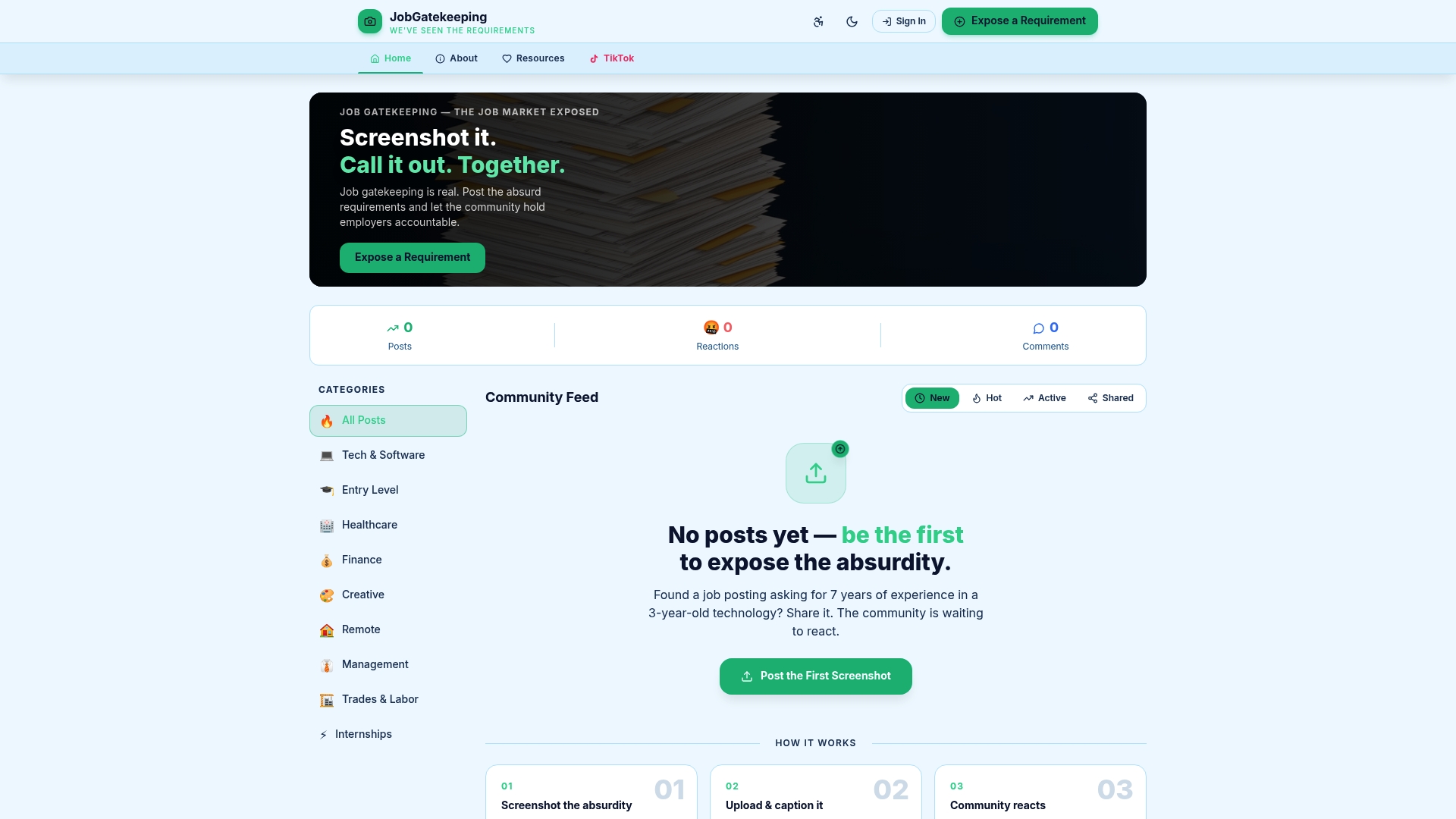
At JobGatekeeping, you'll find community-driven transparency, tools for evaluating job postings, and a growing library of practical resources for entry-level job seekers. From hiring process guides to hiring process transparency tips, we've got the tools to help you search smarter and apply with real confidence. Together, we can make the job market a little less ridiculous.
Frequently asked questions
What should be included in an entry-level job checklist?
Your checklist should include role targeting, a tailored resume, cover letter, job tracking, interview preparation, and readiness for post-application stages. Yale OCS guidance confirms that materials, tracking, and practice are the three essential pillars.
How do I know if an entry-level job post is truly entry-level?
Check for inflated requirements: avoid roles demanding more years of experience than you have, and map your internships or projects directly to the must-have skills. Research shows 35% of entry-level roles actually required prior relevant experience.
What if I don't have all the required experience?
You can often use internships, academic projects, leadership roles, or volunteering to show you have the essential skills. During interviews, highlight your ability to learn quickly, since internships and projects consistently help candidates evidence essential skills when direct experience is limited.
How should I track my entry-level job search?
Set up a spreadsheet or use job board tracking features to log roles, deadlines, contacts, and follow-up actions. Yale OCS recommends combining tracking systems with job alerts so nothing falls through the cracks.
What hiring stages do I need to prepare for?
Typical stages include application screening, assessments or interviews, background checks, and reviewing offers. According to research on hiring process stages, entry-level roles often have fewer stages than senior positions, which means each stage carries more weight.