

Fairness in hiring isn't just about picking the most qualified person. It never was. The real role of HR in hiring fairness covers legal exposure, process design, technology governance, and organizational culture. HR professionals who treat fairness as a checkbox are leaving their organizations wide open to discrimination claims, regulatory penalties, and the kind of reputational damage that doesn't go away quietly. This guide breaks down the legal foundations, the best practices that actually work, and the emerging compliance risks that are reshaping what responsible hiring looks like in 2026.
Table of Contents
- Key takeaways
- The role of HR in hiring fairness: legal foundations
- Best practices for bias-resistant hiring
- Managing compliance risk from automated hiring tools
- The strategic HR role in long-term recruitment equity
- My honest take on where HR gets this wrong
- How Jobgatekeeping can help your hiring process
- FAQ
Key takeaways
| Point | Details |
|---|---|
| Four-fifths rule is a starting point | The 80% rule flags potential adverse impact but does not guarantee legal protection on its own. |
| Structured interviews reduce bias | Behaviorally anchored rating scales and scoring rubrics cut subjective bias and improve predictive validity. |
| AI tools carry real legal risk | NYC Local Law 144 requires independent bias audits of automated hiring tools and candidate notice before use. |
| HR bridges risk and advocacy | HR's structural role balances organizational risk management with genuine employee fairness commitments. |
| Transparency builds employer trust | Publishing hiring criteria and audit results strengthens candidate trust and reduces discrimination exposure. |
The role of HR in hiring fairness: legal foundations
Most HR professionals know what adverse impact means. Fewer understand how it actually works in practice, and that gap is where lawsuits live.
Adverse impact does not require any discriminatory intent. A policy that looks completely neutral on paper can still land an employer in serious legal trouble if it disproportionately excludes a protected group. Once adverse impact is demonstrated, the burden shifts to the employer to prove the practice is job-related and driven by business necessity. That's a harder argument to make than most organizations expect.
What the four-fifths rule actually tells you
The four-fifths rule is the primary quantitative test used in U.S. hiring to flag potential discrimination. You calculate it by dividing the selection rate of a protected group by the selection rate of the highest-selected group. If that ratio falls below 0.80, you have a signal worth investigating.
Here's what the math looks like in a simple example:
| Group | Applicants | Selected | Selection rate | Ratio to highest |
|---|---|---|---|---|
| Group A (highest) | 100 | 40 | 40% | 1.00 |
| Group B | 100 | 28 | 28% | 0.70 ✗ |
| Group C | 100 | 34 | 34% | 0.85 ✓ |
Group B triggers the four-fifths threshold. That doesn't automatically mean discrimination occurred. It means you need to look deeper.
Here's the part many HR teams miss: passing the four-fifths rule does not guarantee immunity from disparate impact claims. Courts use a totality-of-evidence approach that weighs multiple factors beyond a single ratio. You can clear the 0.80 threshold and still face a successful discrimination claim if other evidence stacks against you.
Pro Tip: Run adverse impact analyses at every stage of your hiring funnel, not just at the final selection point. Screening, testing, and interviews each carry independent risk.
Best practices for bias-resistant hiring
Legal compliance sets the floor. What separates organizations that genuinely promote fairness from those that just avoid lawsuits is process design.
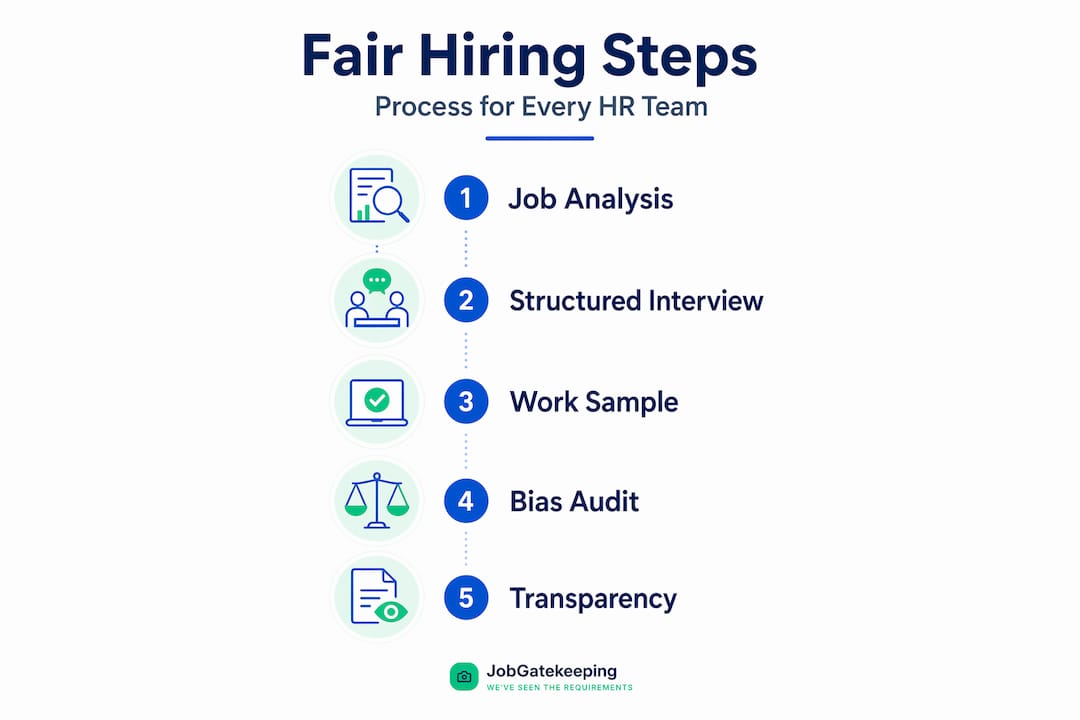
The single most evidence-backed change any HR team can make is adopting structured interviews. Structured interviews have a validity around 0.51. Combined with work samples, that validity increases to 0.63. Compare that to unstructured interviews, which hover around 0.20 in predictive validity, and the case is overwhelming.

Here's how to implement structured interviews that hold up:
01. Build job-relevant questions from a task analysis. Every question should connect directly to a documented job requirement. "Tell me about a time you managed competing priorities" only counts if managing competing priorities is actually in the role.
02. Use behaviorally anchored rating scales (BARS). Instead of a 1 to 5 scale with no definitions, BARS ties each score level to specific observable behaviors. This reduces the "gut feel" problem dramatically.
03. Train every interviewer before they enter the room. Inter-rater reliability scores (measured by Intraclass Correlation Coefficient) above 0.70 are the target. Below 0.70 means your interviewers are not evaluating the same things, which makes your scores legally and practically worthless.
04. Score independently before discussing. The moment interviewers share opinions before scoring, you introduce anchoring bias. Lock in scores first, then calibrate.
05. Document everything. Scores, notes, and rationale for every candidate. If a decision is ever challenged, your documentation is your defense.
Work samples deserve more attention than they typically get. They reduce disparate impact risk by shifting the evaluation from credentials and presentation style to demonstrated ability. A candidate who didn't attend a target school but can do the actual job shows up clearly in a work sample. They may not in a résumé review.
Pro Tip: Avoid informal screening calls before official structured interviews. Those unscripted conversations are where bias gets baked in, and they're almost impossible to defend.
Managing compliance risk from automated hiring tools
This is the part of hiring fairness where a lot of organizations are currently exposed without knowing it.
Automated employment decision tools (AEDTs) now handle résumé screening, video interview analysis, and candidate ranking at scale. Many HR teams adopted these tools because they seemed more objective. The problem is that an algorithm trained on biased historical data reproduces and scales that bias. Faster.
What NYC Local Law 144 requires right now
NYC Local Law 144 mandates annual independent bias audits of any AEDT used to screen candidates or employees in New York City. It also requires publishing audit summaries online and giving candidates at least 10 business days' notice before an AEDT is used on them, with a real opt-out option.
The law's reach is broader than many assume. If you're hiring for roles based in New York City, even remotely, you likely fall under its scope. HR's job is to:
- Inventory every AEDT in use. This means your ATS screening logic, your video interview scoring tool, your pre-employment assessment platform. All of it.
- Commission independent audits annually. The auditor cannot be affiliated with the tool vendor. Results must be published.
- Set up candidate notification workflows. The 10-business-day notice requirement needs to be built into your process, not bolted on as an afterthought.
- Create and communicate opt-out pathways. Candidates must have a real alternative if they decline automated screening.
The cost of ignoring this is significant. Non-compliance penalties start at $500 for a first violation and escalate to daily penalties up to $1,500 per violation. Those add up fast. Worse, published audit results can be used as evidence in discrimination litigation, meaning a bad audit doesn't just cost you fines. It hands plaintiffs documentation.
| Requirement | Deadline/Frequency | Consequence of failure |
|---|---|---|
| Independent bias audit | Annual | Fines, legal exposure |
| Publish audit summary online | Within 30 days of audit | Regulatory violation |
| Candidate notice before AEDT use | 10 business days prior | Per-violation fines |
| Opt-out pathway available | Ongoing | Regulatory violation |
Organizations that treat this as a New York problem are underestimating it. Regulators in other jurisdictions are watching NYC's enforcement and building similar frameworks. Getting compliant now means you're ahead of the wave, not scrambling when the next city follows.
The strategic HR role in long-term recruitment equity
Compliance and process optimization address symptoms. The organizations that actually move the needle on hiring fairness treat HR as a strategic function, not a transaction processor.
Ethical leadership within HR allows HR professionals to ally for fairness, but that advocacy always operates within the organization's risk management parameters. Knowing that tension exists is the first step to working within it effectively. HR leaders who pretend the tension isn't there end up either ineffective advocates or compliance scapegoats.
The shift toward what some researchers call the Talent Architect model changes the game. HR leaders acting as talent architects combine data literacy, AI governance, and scalable ethical policies to lead fair hiring across the organization. They don't just enforce rules. They design systems.
Practically, this means:
- Shifting from fit-for-role to growth potential. An aligned talent management approach reduces regretted attrition and opens roles to candidates who can grow into them, not just perform them on day one.
- Using adverse impact data as a continuous feedback loop. Monthly or quarterly analysis, not a once-a-year audit.
- Making hiring criteria visible externally. Publish what you're evaluating and why. This practice alone filters out gatekeeping behavior before it starts and builds employer brand credibility. Learn how publicizing hiring practices creates accountability.
"Fairness in hiring is not a destination. It's a system you maintain, measure, and improve continuously."
Transparency isn't just good ethics. It's a talent acquisition strategy. Candidates who trust your process are more likely to complete it and accept offers. That trust shows up in your offer acceptance rates, your Glassdoor scores, and your ability to reach candidates from underrepresented groups who have learned to be skeptical of companies with opaque processes.
My honest take on where HR gets this wrong
I've watched organizations pour resources into diversity initiatives while their screening processes quietly filtered out the candidates those initiatives were meant to reach. The disconnect is almost never malicious. It's structural.
The most common mistake I've seen is treating the four-fifths rule as a pass/fail test rather than a diagnostic tool. If you clear 0.80 at the final selection stage and call it done, you've missed four or five earlier stages where the funnel may be leaking. Adverse impact compounds. A small bias at each stage adds up to a very large disparity at the end.
The second mistake is over-trusting technology. Automated tools feel objective because they remove the human decision in the moment. What they don't remove is the human judgment that shaped the training data and the evaluation criteria. If your algorithm was trained on historical hires and your historical hires skewed toward one demographic, your algorithm is encoding that skew at speed.
What I've found actually works is relentless calibration. Structured interviews help, but only when interviewers are retrained regularly, scoring drift is caught early, and the questions themselves are reviewed for job relevance. Most organizations do the initial setup and then let the process run on autopilot. That's where the bias creeps back in.
HR's influence in hiring fairness grows most when it's grounded in evidence, not policy documents. Numbers, audit trails, and documented rationale for every decision. That's what holds up. That's what builds credibility internally and legally.
— Steggy
How Jobgatekeeping can help your hiring process
The job market is full of gatekeeping, and Jobgatekeeping exists to call it out. But this platform isn't just for frustrated candidates. HR professionals and organizational leaders use it too, because knowing what bad hiring looks like in the wild is some of the best training available.
When your team reviews the kinds of discriminatory job postings that get flagged on Jobgatekeeping, you see exactly the patterns that generate legal exposure: absurd experience requirements, unpaid roles dressed up as opportunities, and vague criteria that have nothing to do with the actual job. Community-sourced accountability is a mirror. Use it to check your own processes. Visit Jobgatekeeping to explore the platform, review flagged postings, and stay ahead of the hiring practices that are drawing public scrutiny right now.
FAQ
What is the role of HR in hiring fairness?
HR's role in hiring fairness covers legal compliance, process design, technology oversight, and organizational culture. HR professionals set evaluation criteria, conduct adverse impact analyses, manage automated hiring tools, and build transparent hiring systems that reduce discriminatory outcomes.
What is the four-fifths rule in hiring?
The four-fifths (80%) rule is the primary U.S. standard for detecting adverse impact. If a protected group's selection rate falls below 80% of the highest-selected group's rate, it signals potential discrimination that requires further investigation.
Does passing the four-fifths rule mean you're legally protected?
No. Courts use a totality-of-evidence approach, so passing the 80% threshold does not guarantee immunity from disparate impact claims. Additional evidence of discrimination can still support a successful legal challenge against an employer.
What does NYC Local Law 144 require from HR teams?
NYC Local Law 144 requires annual independent bias audits of automated hiring tools, published audit summaries, and at least 10 business days' notice to candidates before an AEDT is used. Non-compliance carries escalating daily fines.
How do structured interviews promote fairness in hiring?
Structured interviews with behaviorally anchored rating scales and independent scoring reduce subjective bias and improve predictive validity. Combined with work samples, they produce measurably fairer evaluations while strengthening legal defensibility.