


You're scrolling through job postings, and something feels off. Maybe the salary is missing. Maybe they want 8 years of experience for an "entry-level" role. These aren't accidents. Red flags in job postings are everywhere, and they cost job seekers real time, real money, and real mental energy. This article breaks down the most common warning signs in job descriptions, from outright scams to legally questionable requirements, so you can spot them fast and protect yourself before you hit apply.
Table of Contents
- Key takeaways
- The core red flags in job postings you need to know
- 1. Unsolicited contact through random messaging apps
- 2. Requests for money upfront
- 3. Absurdly high pay for minimal work
- 4. Vague or mismatched job descriptions
- 5. An overly fast or frictionless hiring process
- 6. Pre-offer questions about disabilities or medical history
- 7. Hiring technology with no accommodation options
- 8. No salary range, or a range so wide it's meaningless
- 9. Entry-level roles demanding years of experience
- 10. A long, unexplained requirements list
- Red flags by category: a quick comparison
- What to do when you spot a red flag
- My honest take on job posting red flags
- See what others are calling out on Jobgatekeeping
- FAQ
Key takeaways
| Point | Details |
|---|---|
| Scam postings follow a pattern | Unexpected contact, vague job details, and money requests are the clearest signals of fraud. |
| Missing salary is a red flag | Pay transparency laws in many regions now require salary ranges; an absent range often signals bad intent. |
| Pre-offer medical questions are illegal | Employers cannot ask about disabilities or require medical exams before a conditional job offer under the ADA. |
| "Rockstar" ads exploit candidates | Vague, overloaded job descriptions often mean one salary covering three roles worth of work. |
| You have power to push back | Asking direct questions about pay, timelines, and role scope helps you filter out bad actors fast. |
The core red flags in job postings you need to know
Before you go line by line through every job ad, it helps to have a framework. Not every warning sign is a scam. Some postings are just badly written. Others are actively designed to exploit you. Knowing the difference saves you from both wasting your time and walking into a bad situation.
Three categories cover most of the red flags you'll encounter:
- Transparency failures: No salary range, vague role descriptions, unclear reporting structures, or no mention of hiring timelines.
- Communication red flags: Recruiters reaching out through WhatsApp, Telegram, or generic messaging apps. Real employers don't use chat apps for initial outreach.
- Legal compliance gaps: Postings that ask for information they have no legal right to collect, or that use hiring technology without disability accommodations.
Pay attention to salary. Pay transparency laws in many jurisdictions now mandate salary ranges in postings. If a company operating in one of those regions omits pay entirely, that's not an oversight. It's a choice.
Pro Tip: Before applying, check if the company's location requires salary disclosure by law. If it does and the posting has none, ask directly before spending time on a cover letter.
1. Unsolicited contact through random messaging apps
You never applied, but someone just messaged you on WhatsApp offering a job. This is one of the most common entry-level job red flags right now. Job scammers rely on generic messaging apps because they make identity and legitimacy nearly impossible to verify.
Legitimate hiring processes have friction. There's an application, a recruiter email from a company domain, a scheduled call. If someone skips all of that and slides into your DMs with an offer, be suspicious. The FTC has documented wave after wave of fake remote job scams that start exactly this way. Reply "YES" or "INTERESTED," and suddenly you're being asked to complete paid tasks that turn out to involve fraudulent checks.
2. Requests for money upfront
This one is non-negotiable. No legitimate employer asks for money before you start. Not for training. Not for equipment. Not for a background check service they've "partnered with." Any posting or recruiter that asks you to pay anything before you receive your first paycheck is running a scam. Full stop.
The framing varies. Sometimes it's "we'll reimburse you after 90 days." Sometimes it's a "small processing fee." The dollar amount doesn't matter. The request itself is the red flag.
3. Absurdly high pay for minimal work
If a posting promises $5,000 a week for flexible, remote, part-time work with no real qualifications required, that's not an opportunity. That's a trap. Unusually high salaries for low-skill roles paired with immediate offers and vague job descriptions are a signature pattern of job scams.
Real jobs with high compensation come with clearly defined responsibilities, specific qualifications, and a hiring process that takes more than 24 hours. If the pay-to-effort ratio makes no sense, trust your gut.
4. Vague or mismatched job descriptions
"We're looking for a self-starter who wears many hats, thrives in a fast-paced environment, and can do whatever is needed to get the job done."
Sound familiar? This kind of language is a warning sign in job descriptions because it usually means one of two things: the role has no actual definition, or it has too much definition and they don't want you to see it all at once. Fake recruitment postings often show vague or overly broad language alongside a mismatch between the branding and what's actually being described. You deserve to know what you're applying for.
5. An overly fast or frictionless hiring process
Legit hiring takes time. There are applications, screens, interviews, and references. Legitimate hiring processes incorporate friction like verification steps and refuse to move things entirely off platform. If a "recruiter" offers you a job after a 10-minute chat on Telegram with no formal interview, that's not efficiency. That's a scam moving fast before you think too hard.
Watch for hiring timelines that jump from first contact to offer within hours. Watch for processes that never ask for references, never verify your credentials, and never want you to speak to anyone else at the company.
6. Pre-offer questions about disabilities or medical history
This one has legal teeth. Employers cannot make disability inquiries or require medical exams before making a conditional job offer under the Americans with Disabilities Act. If a job posting or application asks about your health conditions, physical limitations, or medical history before you've received an offer, that's not just a red flag. It's potentially illegal.
Some applications disguise these questions as "fitness for work" assessments or include them in pre-screening forms without flagging them as medical inquiries. Read everything carefully.
7. Hiring technology with no accommodation options
As AI screening tools become more common, a new category of red flags in job ads has emerged. ADA requires that hiring tests measure relevant job skills and must accommodate individuals with disabilities unless an undue hardship exists. If a posting mentions an automated video interview, cognitive assessment, or AI screening tool with zero mention of accommodation options, that's worth flagging.
Hiring technology design choices can unintentionally exclude qualified disabled candidates. Employers are responsible for auditing these tools. If they haven't and the posting gives no accommodation pathway, that's a problem.
Pro Tip: If you need an accommodation for any part of the application process, request it in writing before you begin. This creates a paper trail if issues arise later.
8. No salary range, or a range so wide it's meaningless
"Competitive compensation" tells you nothing. Neither does "$40,000 to $150,000 depending on experience." A posting that omits salary or uses an overly wide range is signaling that they either haven't decided what the role is worth or they're leaving room to lowball whoever they hire. Both are problems.
You can learn more about why job postings lack transparency and what to do about it. The short version: ask directly and early. If a recruiter can't give you a number within the first conversation, that tells you something.
9. Entry-level roles demanding years of experience
This is one of the most notorious entry-level job red flags, and the community at Jobgatekeeping has the screenshots to prove it. "Entry-level position, 5 to 7 years of experience required" is not a typo. It's gatekeeping. It filters out candidates who would be perfectly qualified, often targeting younger workers or career changers who don't meet an arbitrary bar.
If you see this, you are not underqualified. The posting is overreaching. You can apply anyway if the role fits, or you can use it as a signal about how that company values its workers.
10. A long, unexplained requirements list
A job posting that demands AWS Certified, React experience, fluency in three languages, a master's degree, and five years in a niche specialty for a mid-level coordinator role is not looking for one person. It's either a wish list that means nothing or a deliberate way to justify rejecting everyone. Identifying red flags in job ads like these helps you avoid companies that treat candidates as replaceable from the first interaction.
Look for requirements that are clearly unrelated to the core job function. Those are almost always filler used to justify the hiring team's preferences, not actual needs.
Red flags by category: a quick comparison
This table gives you a fast reference for the most common red flags, organized by type.
| Category | Example red flag | What it might mean |
|---|---|---|
| Scam warning signs | Unsolicited WhatsApp message with a job offer | Identity cannot be verified; likely fraud |
| Scam warning signs | Upfront payment for training or equipment | Classic advance fee scam |
| Legal compliance | Pre-offer disability or medical questions | Potential ADA violation |
| Legal compliance | No accommodation info for AI screening tools | Risk of disability discrimination |
| Unfair requirements | Entry-level role requiring 5+ years experience | Gatekeeping; unrealistic expectations |
| Unfair requirements | "Rockstar" or "wear many hats" language | Undefined role masking excessive workload |
| Transparency failures | Missing or unusably wide salary range | Intentional vagueness to enable lowballing |
| Transparency failures | No hiring timeline or process details | Disorganized or deceptive hiring team |
What to do when you spot a red flag
Spotting a red flag is step one. Acting on it is step two. Here's how to handle the most common scenarios:
- Verify the company. Search the business name, check LinkedIn, look for a real website with contact details. Cross-reference the recruiter's email with the company domain.
- Ask directly about salary and timelines. Any recruiter worth your time can answer these questions. Vagueness here is a signal.
- Know your legal rights. Under the ADA, you have the right to request accommodation at any stage of the hiring process. Pre-offer medical questions are off-limits.
- Report scam postings. The FTC accepts reports at reportfraud.ftc.gov. Many job platforms also have built-in reporting tools. Use them.
- Walk away without guilt. You do not owe an explanation to a posting that wasted your time. Move on and protect your energy for real opportunities.
Pro Tip: Screenshot any suspicious posting or recruiter message before reporting or moving on. Documentation matters if you decide to file a complaint later.
For more on building a fair job search strategy, read about hiring process transparency tips that actually work in your favor.
My honest take on job posting red flags
I've spent years reading job postings, and here's what I've found most people get wrong: they assume red flags only appear in obviously sketchy ads. They don't. Some of the most harmful postings come from real, established companies.
The "rockstar who wears many hats" language isn't just lazy writing. In my experience, it almost always means the company lost two or three people and decided to replace them with one hire at a fraction of the cost. That's not an opportunity. That's a setup.
What I've also learned is that the absence of information is just as telling as what's actually written. No salary. No timeline. No description of the team. These omissions are deliberate. A company that respects candidates enough to hire them should be willing to tell them what they're getting into.
The mindset shift that changed how I evaluated postings: I stopped asking "Am I qualified?" first and started asking "Does this company deserve my application?" That reframe puts the accountability where it belongs. You can also check out what fair hiring actually looks like to build a better baseline for comparison. The job market has real problems, but you don't have to accept them quietly.
— Steggy
See what others are calling out on Jobgatekeeping
You've now got the knowledge. The next step is using it, and you don't have to do it alone.
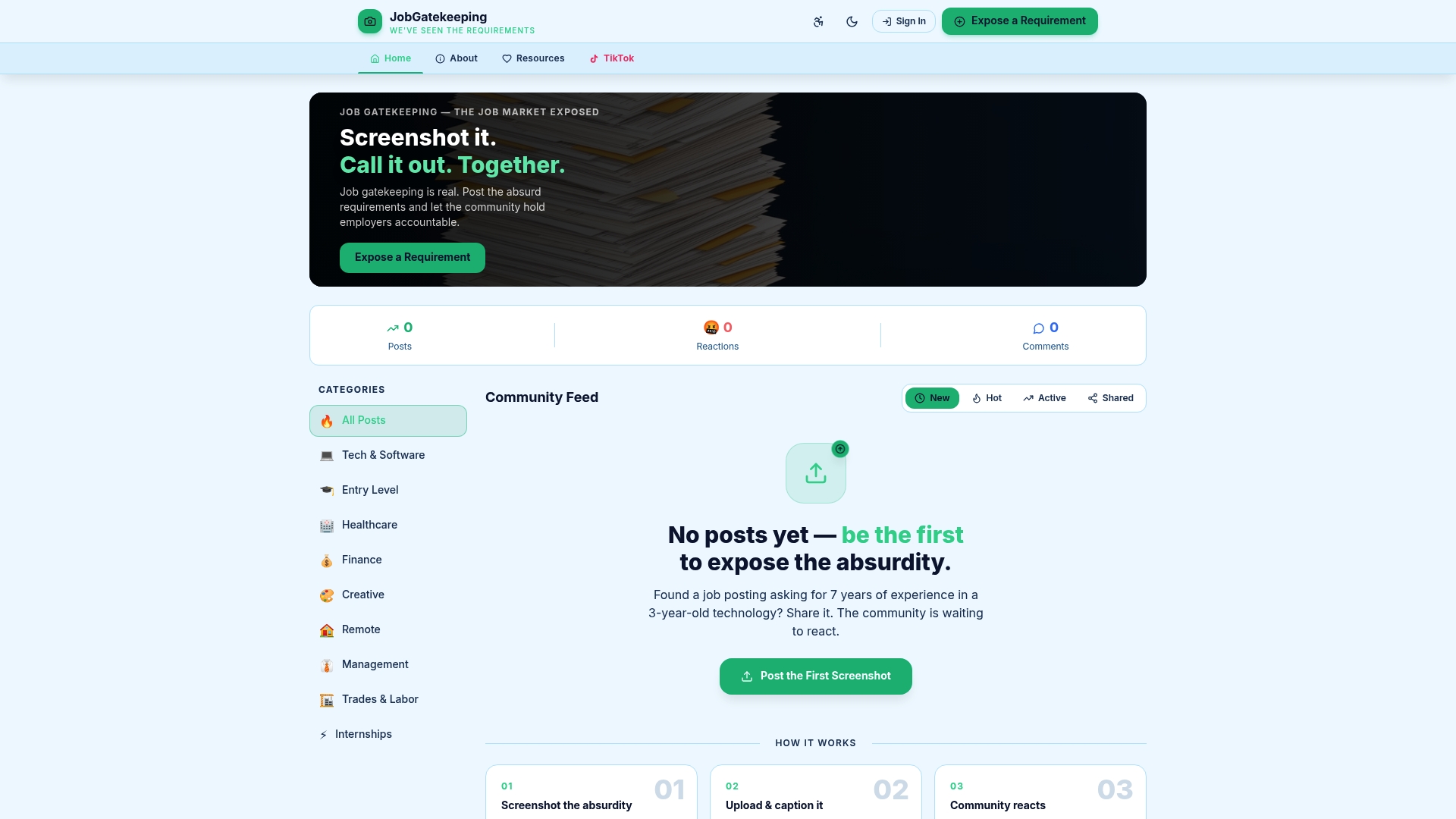
Jobgatekeeping is where the community comes together to call out the absurd, the exploitative, and the just plain ridiculous in job postings. Members share real screenshots, add their own captions explaining the issue, and pile on in the comments with reactions ranging from outrage to dark laughter. It's collective accountability in action.
If you've seen a posting demanding 7 years of experience for an "entry-level" role, or a recruiter who slid into your WhatsApp at midnight with a "great opportunity," share it on Jobgatekeeping and let the community see it too. Your screenshot could save someone else hours of wasted effort. Together, we make the bad actors visible.
FAQ
What are the most common red flags in job postings?
The most common red flags include missing salary ranges, vague job descriptions, excessive experience requirements for entry-level roles, unsolicited recruiter contact through messaging apps, and upfront payment requests. Any one of these signals a posting worth questioning before you apply.
How can I tell if a job posting is a scam?
Watch for unexpected contact through WhatsApp or Telegram, offers with unusually high pay for minimal work, and requests for payment before you start. The FTC notes that scam job offers often involve fake checks or fraudulent task payments after initial contact.
Can employers legally ask about disabilities in a job posting?
No. Under the ADA, employers cannot make disability inquiries or require medical exams before a conditional job offer. Any posting or application that asks about health conditions before an offer is made may be violating federal law.
What should I do if I spot a red flag in a job ad?
Document it with a screenshot, verify the company's legitimacy independently, ask direct questions about salary and process, and report scam postings to the FTC at reportfraud.ftc.gov. If the red flag involves a legal violation like a pre-offer disability question, you can also file a complaint with the EEOC.
Why do so many job postings leave out salary information?
Some employers use vague or absent salary data to preserve negotiating leverage or avoid internal pay equity scrutiny. Pay transparency laws in growing numbers of jurisdictions are pushing back on this practice, making a missing salary range a clearer signal than ever that something is off.