

Hiring decisions feel objective. A resume lands on a desk, a recruiter scans it, and supposedly the best person gets the call. But bias in recruitment is everywhere, and most of the time nobody involved even knows it's happening. Hiring bias examples range from a recruiter gravitating toward a candidate who went to their alma mater to an AI tool quietly filtering out resumes with women's college names. These aren't edge cases. They're the norm. If you want to understand what's actually driving hiring decisions and how to push back, this is where to start.
Table of Contents
- Key takeaways
- Where hiring bias examples actually show up
- 1. Affinity bias
- 2. Confirmation bias
- 3. The halo effect
- 4. Attribution bias
- 5. Recency bias
- 6. Structural bias in job postings
- 7. AI and algorithmic bias
- 8. Name-based bias
- 9. Beauty and appearance bias
- Comparing bias types at a glance
- Practical strategies to reduce hiring bias
- My take on why awareness training alone doesn't cut it
- See what real hiring gatekeeping looks like
- FAQ
Key takeaways
| Point | Details |
|---|---|
| Bias is usually unconscious | Most hiring bias stems from cognitive shortcuts, not deliberate discrimination. |
| AI tools can amplify bias | Algorithms trained on historical data replicate past patterns and disadvantage underrepresented candidates. |
| Structured interviews reduce bias | Standardized questions with independent scoring cut bias effects dramatically compared to unstructured formats. |
| Blind resume review helps | Removing names, schools, and demographic signals before shortlisting improves diversity at the interview stage. |
| Systemic fixes beat awareness training | Process redesign, audits, and multi-layered safeguards create lasting change. |
Where hiring bias examples actually show up
Before you can spot bias, you need to know where it hides in the recruitment funnel. It doesn't just live in one place. It's threaded through every stage.
Resume screening is the first trap. Recruiters spend an average of six seconds on a resume before deciding. In that window, a candidate's name, the college listed, or an employment gap can trigger a snap judgment with zero connection to the person's actual ability. Hiring bias is often unintentional, driven by cognitive pattern matching rather than deliberate discrimination. That doesn't make it less damaging.
Unstructured interviews are another hotbed. When an interviewer can ask whatever they want, cognitive biases flood in fast. The halo effect, affinity bias, and confirmation bias all thrive in loose, conversational interview formats with no scoring rubric.
AI screening tools are newer but no less dangerous. AI hiring algorithms disadvantage women and candidates from underrepresented groups when the systems aren't audited. The algorithm looks neutral. It isn't.
The offer stage also deserves scrutiny. Salary negotiation disparities, different framing of benefits, and inconsistent offer communication can all reflect bias even after a "fair" process.
Here's what structured processes can do instead:
- Use written, standardized scoring rubrics for every interview question
- Require all evaluators to score independently before any group discussion
- Recruit diverse interview panels so no single perspective dominates
- Audit job descriptions for exclusionary language before posting
Pro Tip: Structured interviews have a predictive validity coefficient of 0.51 compared to 0.38 for unstructured interviews. That gap matters when you're trying to hire the right person fairly.
1. Affinity bias
This is the most common one, and it's sneaky. Affinity bias happens when a hiring manager favors a candidate simply because that person reminds them of themselves. Same school, same hometown, same hobby mentioned in small talk. Affinity bias is the most pervasive hiring bias, impacting decisions by familiarity rather than merit.
Picture two equally qualified candidates. One grew up in the same city as the hiring manager and mentions it. The other doesn't. Guess who gets the callback.
2. Confirmation bias
A recruiter glances at a resume and forms an impression in seconds. From that point on, they look for evidence that confirms what they already think. If they liked the candidate early, they overlook red flags. If something turned them off, they hunt for more negatives. The interview becomes a validation exercise, not an evaluation.
This is why blind resume review matters so much at the shortlisting stage. It removes the trigger before confirmation bias can lock in.
3. The halo effect
One impressive detail takes over the whole evaluation. A candidate worked at a brand-name company, so suddenly everything about them glows. The interviewer stops questioning critically and starts building a case for hiring them. The horn effect works in reverse. One awkward moment or unconventional background casts a shadow over genuinely strong qualifications.

Both distort judgment in opposite directions, and both are harder to catch than you'd think.
4. Attribution bias
This one is where implicit bias in hiring gets uncomfortable. The same behavior gets interpreted differently depending on who's doing it. A white male candidate who pushes back on a salary offer is seen as confident and assertive. A woman or candidate of color who does the same thing is labeled difficult or demanding. Same action. Completely different read.
Attribution bias often shows up in post-interview debriefs. "I just didn't get a good feeling" often traces back here.
5. Recency bias
You interview ten people over two weeks. By the time you sit down to compare notes, the candidates you met last are sharper in your memory. You unconsciously rate them higher. The person you interviewed first, who may have been the strongest, fades. Recency bias is especially common in high-volume hiring rounds where interviews aren't scored in real time.
Pro Tip: Score each candidate immediately after their interview, before you speak with anyone else about them. This protects against recency bias and anchoring when the group debrief happens later.
6. Structural bias in job postings
This one isn't about one person's mindset. It's baked into the system. Excessive requirements and referral-only sourcing narrow candidate pools in ways that structurally affect equity. A job description that demands ten years of experience for an entry-level role, or lists a brand-name degree as a hard requirement, will filter out candidates before they ever get a chance. Referral programs also compound this. When your workforce lacks diversity, your referral network will too.
Understanding what is hiring discrimination means recognizing that it doesn't always come from a bad actor. Sometimes it comes from a poorly written job posting nobody bothered to question.
7. AI and algorithmic bias
AI hiring tools are sold as objective. They're not. AI screening tools trained on historical data replicate past discrimination patterns, and the EEOC holds employers accountable for discriminatory outcomes even when the tool comes from a third-party vendor. You cannot outsource the liability.
A real-world example: Amazon scrapped an internal AI recruiting tool after discovering it systematically downgraded resumes that included the word "women's" as in women's college organizations. The training data reflected a decade of male-dominated hiring. The machine learned the bias and amplified it.
8. Name-based bias
Studies using identical resumes with stereotypically white-sounding versus Black-sounding names consistently show lower callback rates for the latter. This is one of the clearest hiring bias case studies in social science research. The resumes are the same. Only the name changes. The outcome shouldn't change. It does.
Blind resume review directly addresses this. Organizations report improved diversity at the interview stage through blind screening because you remove the trigger before bias can act on it.
9. Beauty and appearance bias
This one rarely gets discussed openly, but it operates constantly. Studies show candidates perceived as more conventionally attractive receive higher evaluations in face-to-face interviews. Conversely, candidates whose appearance, age, weight, or presentation doesn't match an unspoken cultural norm face penalties that have nothing to do with their ability to do the job.
This bias type is particularly relevant when video interviews replace in-person ones. The visual channel is wide open.
Comparing bias types at a glance
| Bias type | Main cause | Common example | Typical impact | How to counter it |
|---|---|---|---|---|
| Affinity bias | Similarity to evaluator | Favoring same-school candidates | Reduced diversity, lower merit focus | Structured scoring, diverse panels |
| Confirmation bias | Early impressions | Discounting contradictory evidence | Unfair evaluations | Blind screening, standardized rubrics |
| Halo/Horn effect | One standout trait | Brand-name employer overshadows all else | Inflated or deflated scores | Competency-based scoring |
| Attribution bias | Demographic assumptions | Same action, different interpretation | Disadvantages women and minorities | Calibration sessions, written scores |
| Recency bias | Memory limitations | Last candidate rated highest | Earlier strong candidates overlooked | Real-time scoring after each interview |
| Structural bias | System design | Degree requirements, referral-only hiring | Narrows candidate pool inequitably | Audit job descriptions, diversify sourcing |
| AI/algorithmic bias | Biased training data | Tool filters out women's organizations | Amplifies historical discrimination | Regular audits, EEOC compliance checks |
Practical strategies to reduce hiring bias
Knowing the examples is step one. Fixing the process is step two. Here's what actually works:
- Blind resume review. Strip out names, graduation years, and college names before resumes reach the screener. This removes demographic signals that trigger name-based and affinity bias before they can act.
- Structured interviews. Same questions, same order, same scoring rubric for every candidate. Independent evaluator scoring before group discussion reduces anchoring effects and groupthink in hiring decisions.
- Diverse panels. When one person runs every interview, their blind spots run every interview. Bring in evaluators from different backgrounds and require their scores before any joint debrief.
- AI tool audits. If your organization uses algorithmic screening, run regular disparate impact analyses. Employers remain liable for discriminatory outcomes from third-party AI tools under Title VII. You can't blame the vendor.
- Bias training with accountability. Awareness workshops alone don't stick. Pair them with process audits, clear scoring requirements, and consequences for deviating from structured formats.
- Transparent job descriptions. Audit every requirement. Ask: is this genuinely necessary, or is it a gatekeeping habit? Learn how labor laws shape fair hiring so your postings stay compliant and inclusive.
Pro Tip: The EEOC's four-fifths rule is a practical benchmark. If a selection method results in a pass rate for a protected group that's less than 80% of the highest-scoring group, that's a legal red flag regardless of intent.
My take on why awareness training alone doesn't cut it
I've watched companies roll out unconscious bias workshops, congratulate themselves, and then hire the exact same demographic spread they always did. The training felt good. The system didn't change.
Here's what I've come to believe: bias awareness without process redesign is theater. You can't train a person into objectivity and then put them back into an unstructured interview with no rubric and no accountability. The cognitive shortcuts come right back. The system needs to do the work, not just the individual.
What actually moves the needle? Systemic process redesign, not just awareness. Structured interviews, blind screening, and multi-rater scoring are boring and procedural. That's exactly why they work. They don't rely on a recruiter having a good day or checking their bias at the door.
I'm also suspicious of companies leaning hard into AI hiring tools without governance. The vendor says the tool is bias-free. The EEOC doesn't care what the vendor says. Employers must actively govern AI tools with audits and human oversight, period. The liability is yours. The scrutiny should be too.
The job market already has too many gates. The last thing candidates need is an algorithm trained on discriminatory historical data standing between them and a fair shot. Call it out. Fix the process. Demand transparency.
— Steggy
See what real hiring gatekeeping looks like
You've just read the theory. Jobgatekeeping is where the real examples live.
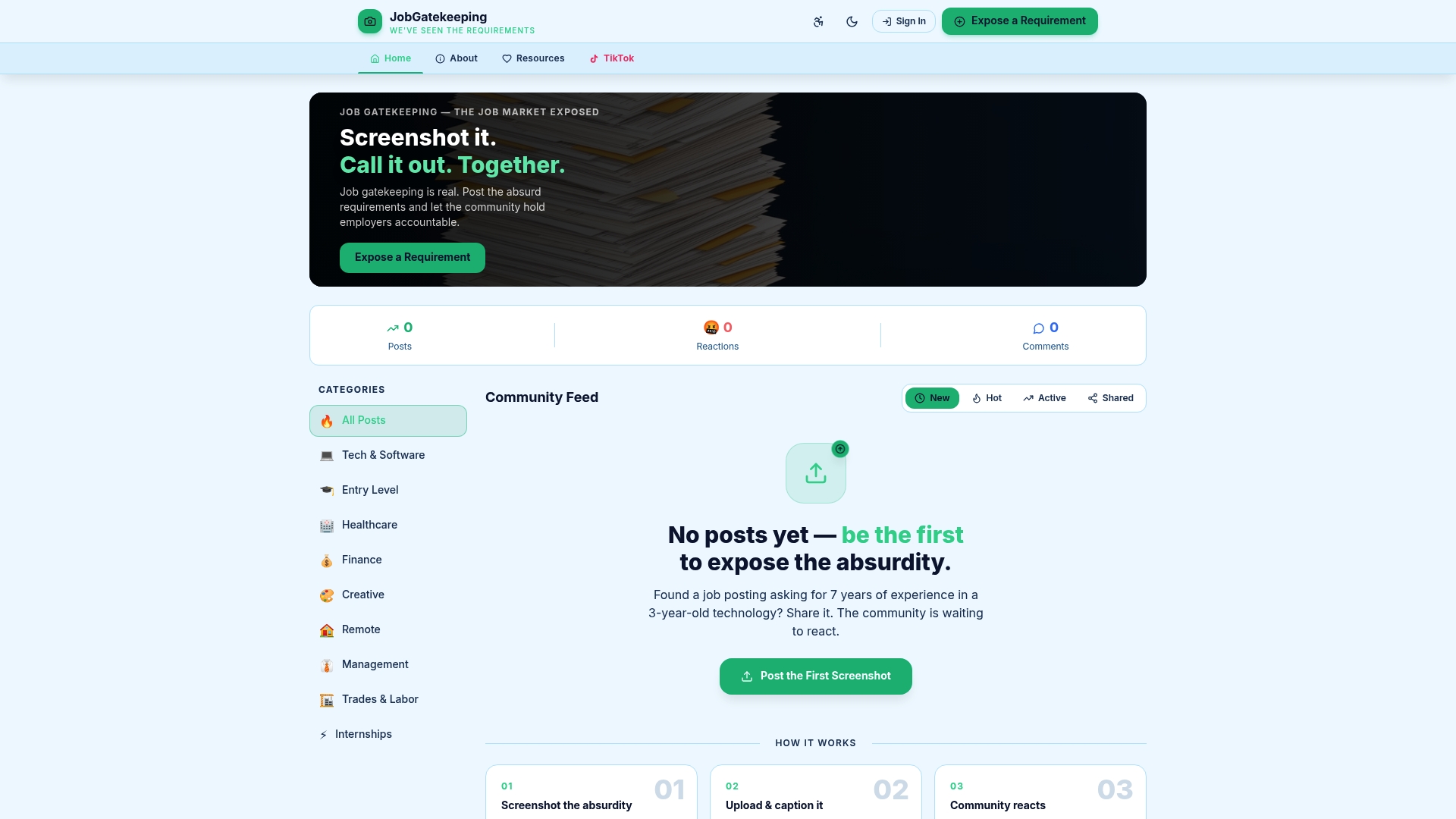
At Jobgatekeeping, our community shares actual screenshots of job postings that exhibit exactly the bias types covered in this article: absurd experience requirements for entry-level roles, degree gatekeeping that excludes qualified candidates, and requirements that do nothing but narrow the pool unfairly. You can upload your own screenshot, write a caption, and let the community react. Outrage, laughter, relatability. All of it welcome. Together, we hold employers accountable in a way that no HR policy document ever will. Explore our resources on fair hiring practices and start calling out the gatekeeping around you. Visit Jobgatekeeping to join the conversation.
FAQ
What is hiring bias?
Hiring bias is when factors unrelated to job performance influence recruiting decisions, often unconsciously. It can stem from cognitive shortcuts, structural systems, or flawed tools like unaudited AI screening software.
What are the most common examples of hiring bias?
The most common hiring bias examples include affinity bias, confirmation bias, the halo effect, name-based bias, and algorithmic bias from AI tools trained on historically skewed data.
How does AI contribute to bias in recruitment?
AI screening tools trained on historical hiring data can replicate and amplify past discrimination. Under Title VII, employers remain legally responsible for discriminatory outcomes even when the tool comes from a third-party vendor.
What is the most effective way to reduce hiring bias?
Structured interviews with standardized questions and independent scoring reduce bias effects significantly. Combining them with blind resume review and diverse panels creates the strongest protection against biased decisions.
Is hiring bias the same as hiring discrimination?
Not exactly. Hiring discrimination usually refers to deliberate or legally prohibited treatment based on protected characteristics. Hiring bias is broader and often unconscious, but unchecked bias can cross into illegal discrimination under laws enforced by the EEOC.