

You send in your resume, you meet 90% of the listed qualifications, and you still don't hear back. That frustration you're feeling? It may not be random. What are exclusionary job requirements? They're the job criteria that quietly filter out qualified candidates, often people with disabilities or from protected groups, before a human even sees their application. These requirements may look neutral on paper. In reality, they can be illegal. Understanding how they work, where they hide, and what you can actually do about them is the first step to pushing back.
Table of Contents
- Key takeaways
- What are exclusionary job requirements under the law
- How exclusionary hiring practices hide in plain sight
- Essential vs. marginal job functions
- How to spot and challenge exclusionary criteria
- My take on why this keeps happening
- You don't have to navigate this alone
- FAQ
Key takeaways
| Point | Details |
|---|---|
| Exclusionary requirements defined | Job criteria that screen out protected groups without a genuine link to actual job duties may be illegal under U.S. law. |
| The ADA sets the legal standard | Requirements must be job-related and consistent with business necessity to hold up under scrutiny. |
| AI tools can exclude you silently | Automated screening systems can filter out qualified candidates before a recruiter ever reviews their profile. |
| Essential vs. marginal matters | If a requirement connects to a marginal task rather than a core job function, it may not legally justify excluding you. |
| You can push back | Job seekers have the right to request accommodations, ask for evidence, and report unfair criteria to the EEOC. |
What are exclusionary job requirements under the law
Let's get specific. An exclusionary job requirement is any hiring criterion that screens out people from a protected group unless it's directly tied to job performance and backed by a legitimate business reason. Under the Americans with Disabilities Act, criteria that screen out protected groups are only lawful when they are job-related and consistent with business necessity. That's not a gray area. That's the law.
The key legal standards at play here are job-relatedness and business necessity. If an employer can't demonstrate that a requirement actually predicts success in the role, it's not defensible. The EEOC Uniform Guidelines reinforce this: selection criteria causing adverse impact must be tied to actual job performance, not just general preference or operational convenience.
The ADA also protects what it calls a "qualified individual with a disability." That means someone who can perform the essential functions of a job, with or without a reasonable accommodation. If an employer's requirement rules that person out because of a marginal or non-essential task, that's where the legal exposure starts.
Here's a real-world example: a desk-based data analyst role that lists "must have valid driver's license" as a hard requirement. If there's no driving involved in the job, that requirement likely can discriminate against qualified candidates with certain disabilities. The burden falls on the employer to prove why it's there.
Pro Tip: When you see a requirement that feels off, ask yourself: "Does this directly connect to the main tasks of this job?" If the answer is no, it may be worth questioning.
How exclusionary hiring practices hide in plain sight
This is where it gets frustrating. Exclusionary hiring practices don't always announce themselves. Sometimes they're buried in a job posting. Sometimes they're built into the software that reviews your application before any person does.
Here are the most common ways job requirement exclusions show up:
-
Rigid degree requirements for experience-based roles. "Bachelor's degree required" for a job that a skilled, experienced candidate could perform without one. No evidence the degree predicts job success. Just tradition.
-
Blanket physical standards not tied to the role. Vision or mobility requirements listed for sedentary office jobs. Unless those functions are truly essential, they may cross a legal line.
-
Driver's license requirements for non-driving jobs. This one shows up constantly. It's one of the most cited examples of a requirement that can unfairly screen out people with certain disabilities.
-
Automated screening tools. This one is sneaky. AI tools that screen out disabled applicants can violate the ADA even when there's no discriminatory intent at all. The algorithm doesn't care about intent. Neither does the law.
-
Experience thresholds that exclude entry-level candidates. "5 years of experience required" for a role titled "Entry Level." This is gatekeeping dressed up as a standard.
"Employers can violate the ADA without any intent to discriminate if their tools or criteria result in qualified individuals with disabilities being screened out." — ADA.gov
The automated screening point deserves extra attention. Exclusionary screening often happens before interviews via these tools, which means many candidates never get a chance to explain their qualifications or request an accommodation. Awareness at this stage is critical. Some states, including Illinois and Colorado, now require employers to conduct bias audits on AI hiring tools and notify applicants about their use. That trend is expanding.
Essential vs. marginal job functions
Here's the distinction that changes everything when you're trying to identify discriminatory hiring standards. The law doesn't ask whether you can do every task on a job description. It asks whether you can do the essential functions of the role.
| Feature | Essential function | Marginal function |
|---|---|---|
| Definition | Core reason the job exists | Occasional or incidental task |
| Impact on hiring | Can legally justify requirements | Cannot legally justify exclusion |
| Accommodation applies | Yes, employer must explore options | Not a valid basis for exclusion |
| Example | Writing code in a software developer role | Occasionally lifting boxes in an office job |
Marginal tasks are where employers get into trouble. An employer might list a physical lifting requirement for a billing coordinator role because one or two employees occasionally move boxes. That's not an essential function. Employers often confuse operational convenience with actual essential job requirements, and successful legal challenges come from parsing these apart.

A qualified individual with a disability can perform essential functions with or without accommodation and is protected from exclusion. Reasonable accommodation is part of the equation. If an employer can adjust how a task is done, remove a marginal task, or provide a tool that makes the function accessible, they are generally required to do so unless it creates an undue hardship for the business.
Pro Tip: Look up the actual job title and its typical duties on ONET OnLine or a similar resource. If the "must-have" requirement you're questioning doesn't appear in the typical duties, that's a signal worth noting before your interview.*
How to spot and challenge exclusionary criteria
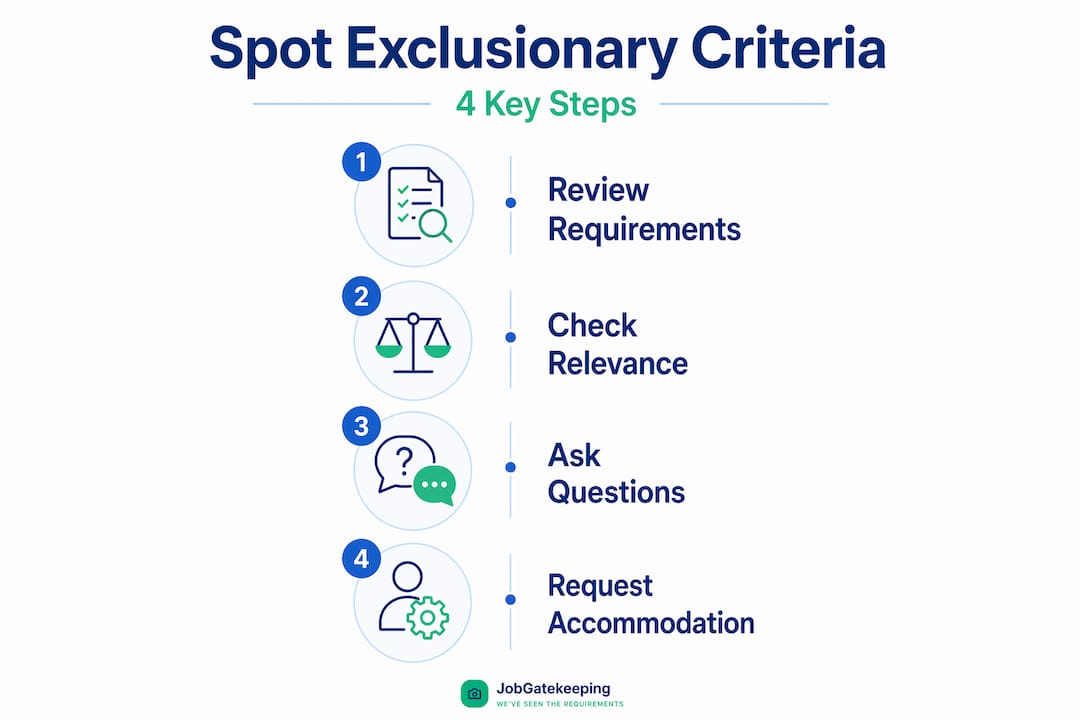
You don't have to accept unfair job criteria quietly. Here's how to identify what's happening and take steps to address it.
-
Read every requirement against the actual job duties. Go line by line. Ask yourself which tasks each requirement connects to. If you can't draw a clear line between the requirement and a core duty, note it.
-
Apply even when you don't meet every listed requirement. Studies show many requirements exist out of habit, not necessity. Minimum qualifications must link to job performance through documented job analysis. Many don't have that documentation at all.
-
Request accommodations early and explicitly. You don't have to disclose a specific diagnosis. You can say, "I may need an accommodation during the application or interview process." Employers are required to engage with that request. This applies to online applications, assessments, and interviews alike.
-
Ask the employer to explain a requirement. You can phrase it professionally: "Can you help me understand how this requirement connects to the day-to-day responsibilities of the role?" That question puts the burden where it belongs.
-
Document everything. Save copies of the job posting. Keep records of your communications. If you believe you were screened out because of an unlawful criterion, documentation is what makes a complaint viable.
-
Report to the EEOC. If you believe you've experienced discrimination based on disability or another protected characteristic, you can file a charge with the Equal Employment Opportunity Commission. EEOC enforcement actions have targeted employers for exactly these kinds of patterns. You have standing to use that process.
Pro Tip: When requesting an accommodation in writing, keep your language simple and direct: "I am requesting a reasonable accommodation in connection with my application for [role]." No medical details required at this stage.
For a deeper breakdown of how to read discriminatory job postings before you apply, Jobgatekeeping has put together a full resource on spotting discriminatory postings that's worth bookmarking.
My take on why this keeps happening
I've spent a lot of time looking at job postings, talking to people who've been filtered out of roles they were more than qualified for, and thinking about why exclusionary job requirements persist even when the law is clear.
My honest take? Most exclusionary requirements aren't the result of deliberate discrimination. They're the result of laziness dressed up as rigor. An HR team copies a job description from three years ago. A hiring manager adds a degree requirement because that's what they have. Nobody checks whether any of it actually predicts who succeeds in the role.
That's the uncomfortable truth about job qualification standards in practice. They often reflect what the last person in the role looked like, not what the role actually needs. And when you layer automated screening on top of that? You've built a system that excludes people before anyone with decision-making power even sees their name.
What I've learned is that pushing back works more often than people think. Not every employer will respond well. But asking about a requirement, requesting an accommodation, or even declining to apply and sharing the posting publicly creates pressure. It shifts the accountability back where it belongs.
The candidates who get filtered out aren't the problem. The requirements that have no business being there are. And until employers are consistently forced to justify their criteria with real evidence, this will keep happening. Collective awareness is one of the few tools job seekers actually have. Use it.
— Steggy
You don't have to navigate this alone
Exclusionary hiring practices are everywhere, and they're often hiding in plain sight inside job postings that look totally routine. If you've ever stared at a job description and thought "this doesn't add up," you're probably right.
Jobgatekeeping exists because job seekers deserve a place to call this stuff out. Share a screenshot of a job posting with absurd or suspicious requirements, add your caption, and let the community react. Your experience matters, and it might be exactly what someone else needs to see to recognize the same pattern in their own job search. Together, we make these practices visible. Check out how labor laws shape fair hiring and explore the full Jobgatekeeping platform at jobgatekeeping.com to find resources, real examples, and a community that's done with the gatekeeping.
FAQ
What makes a job requirement legally exclusionary?
A job requirement becomes legally exclusionary when it screens out people from a protected group without being directly tied to job performance and business necessity. Under the ADA, requirements must be job-related and essential to the role to be lawfully enforced.
Can AI hiring tools create exclusionary hiring practices?
Yes. AI screening tools can violate the ADA even when there's no intent to discriminate. If the tool filters out qualified individuals with disabilities based on non-essential criteria, the employer is still liable.
How do I request a reasonable accommodation during a job application?
You can request an accommodation at any stage of the hiring process, including during the online application. Simply notify the employer in writing that you need an accommodation. You are not required to share your specific diagnosis.
What's the difference between essential and marginal job functions?
Essential functions are the core tasks the job exists to perform. Marginal functions are occasional or incidental tasks. Exclusionary requirements tied to marginal functions generally cannot be used to screen out qualified applicants.
Where do I report unfair job criteria?
File a charge with the Equal Employment Opportunity Commission at eeoc.gov. You can also contact your state's civil rights agency. Documenting the job posting and any communications with the employer before filing will strengthen your case.