
Identifying and addressing biased or exploitative hiring practices is often hampered by limited transparency and insufficient community-driven reporting on job boards and employer review platforms. Many traditional job sites and reputation databases either require identifiable accounts to post complaints or gate useful hiring data behind paywalls and inconsistent moderation policies. This comparison helps you weigh anonymous reporting, evidence sharing, and research features across four platforms so you can choose the best tool to highlight unfair job requirements and evaluate employers without compromising privacy.
Table of Contents
JobGatekeeping
At a Glance
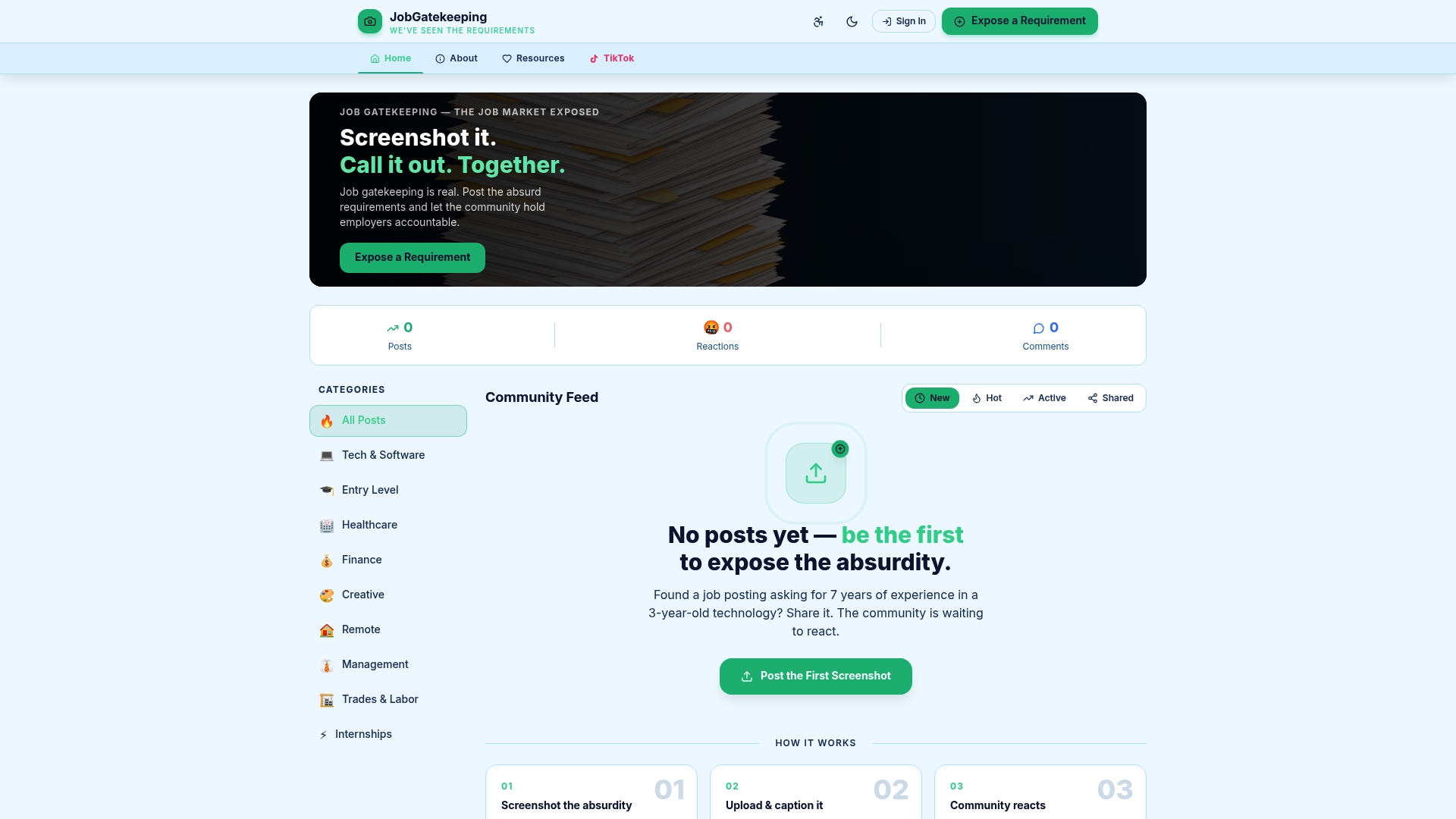
Accessible design meeting WCAG 2.1 AA standards is built into the site, alongside an anonymous posting option that lowers barriers for people who fear employer retaliation. The platform centers on screenshot evidence rather than hearsay.
Core Features
- Community-driven screenshot uploads that let members show exact job posting text and images.
- Anonymous posting and privacy controls so contributors can publish without attaching their real identity.
- Reactions and comment threads for quick community response and follow up discussion.
- Educational resources that explain common gatekeeping tactics and how to spot exploitative language.
- WCAG 2.1 AA accessibility support for readers and contributors with disabilities.
Key Differentiator
The platform’s concrete focus is on public screenshot sharing as a tool for accountability. Instead of long editorial pieces or legal action, JobGatekeeping makes evidence visible and discussable so community pressure and visibility highlight unreasonable hiring demands.
Pros
-
Provides a focused place to expose absurd job requirements. Posting a screenshot makes the original phrasing part of the record, which helps conversations stay specific instead of vague.
-
Privacy-forward posting lowers fear of retaliation. That safety feature encourages people to report problematic listings they might otherwise ignore.
-
The site includes accessible design that supports contributors using assistive technology. That detail widens participation and keeps conversations from excluding people with disabilities.
-
Educational resources give readers concrete language to identify gatekeeping tactics and understand why certain requirements are problematic.
-
Community reactions and threaded comments create quick signal and context. A post that draws consistent outrage or relatable reactions becomes a teachable example for other job seekers.
Cons
- Content relies on user submissions which can be subjective or unverified, so readers must treat each post as community evidence rather than a definitive audit.
Who It’s For
Job seekers fed up with unreasonable job requirements who want a public forum to call out and discuss them. Also useful for advocates, researchers, and career advisors who collect examples to teach others about fairness in hiring.
Unique Value Proposition
Anonymous screenshot uploads plus an evidence-first posting workflow turn individual complaints into shareable examples that others can react to and discuss. That mechanic shortens the path from a single frustrating listing to a visible pattern that peers can cite when warning others.
Real World Use Case
A candidate spots a listing demanding 10 years experience for an entry level role. They upload the screenshot anonymously. The post gathers reactions and a comment thread that points out industry norms, links to educational resources, and helps other job seekers avoid wasting time.
Website: https://jobgatekeeping.com
career.place
At a Glance
Per-hire screening runs $150 to $300 while bundled programs range from $8,000 to $18,000. Career.Place pairs anonymous candidate screening with DEIB training and consulting to tighten evaluation and reduce bias across hiring funnels.
Core Features
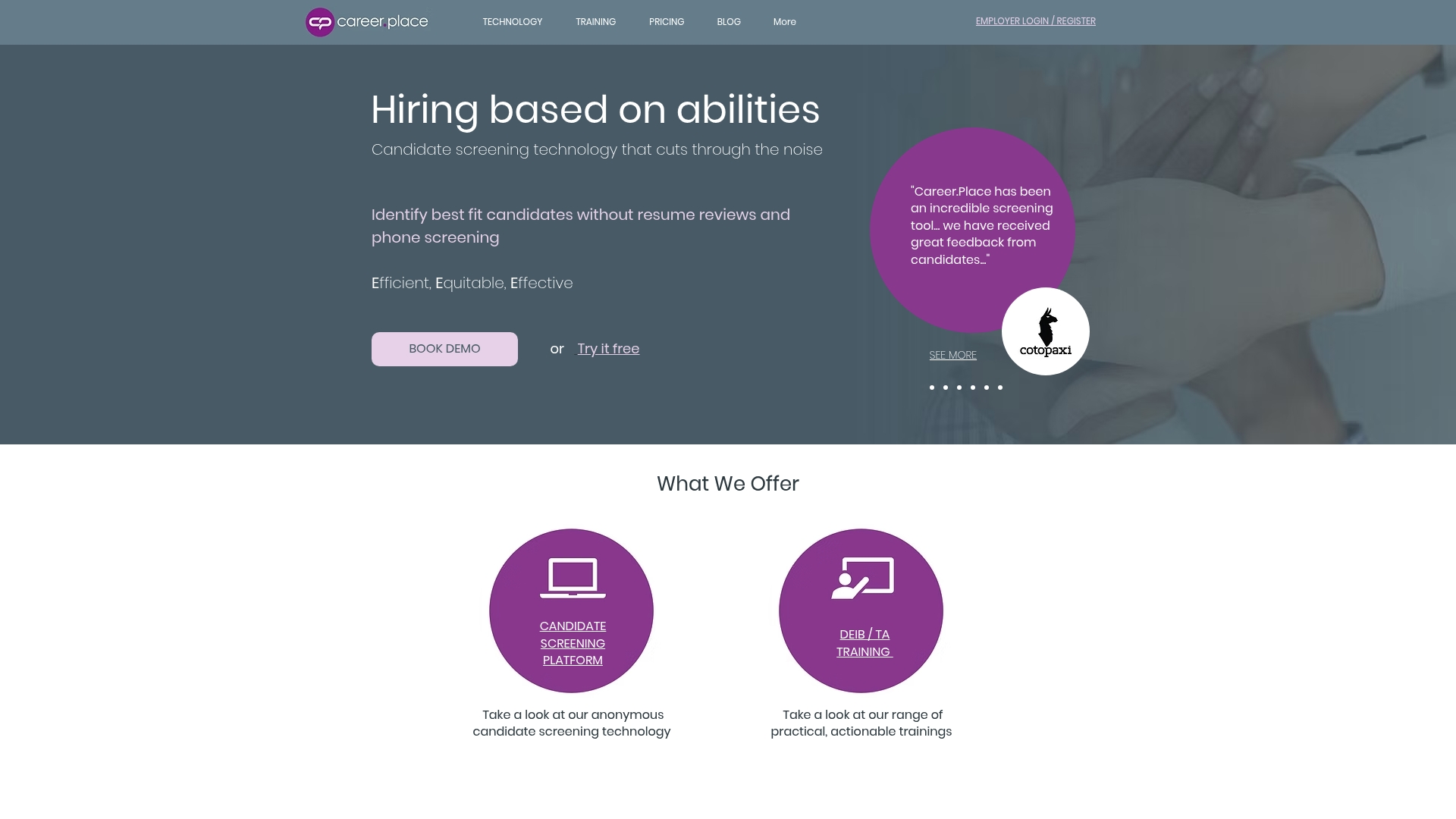
- Anonymous candidate screening for blind evaluation workflows that hide identifying details during early review.
- Practical DEIB training modules and consulting for job description and interview question review.
- Solution bundles for internships, fellowships, and short-term hiring programs with unlimited access for defined periods.
Key Differentiator
Career.Place combines anonymous screening technology with targeted DEIB training and strategic consulting in one delivery model. That integration aims to move teams from one-off bias workshops to measurable process changes tied directly to candidate evaluation.
Pros
- Saves recruiter time and ad spend by standardizing early-stage screening workflows. The platform aims to reduce review cycles and lower posting costs.
- Drives diversity and inclusion by removing identifying signals and coupling that with interviewer training, which helps hiring teams make fairer choices.
- Increases candidate quality and retention by aligning screening criteria with role needs and inclusive interview design.
- Comprehensive training and consulting bundles help organizations build out internships or fellowship pipelines without stitching multiple vendors together.
- Flexible program options let medium and large organizations choose per-hire pricing or multi-week bundled engagements.
Cons
- Limited third-party review data makes overall user sentiment hard to verify beyond vendor claims.
- Volume and scope based pricing can be a budget barrier for small organizations or early-stage startups.
- Some solutions require additional customization or integration work with existing ATS platforms, adding implementation time.
When It May Not Fit
If your team has fewer than a handful of hires per year and no budget for program bundles, the per-hire and package structure may feel heavy. If your ATS is rigid or you lack internal implementation bandwidth, the required customization could delay launch.
Who It's For
Medium to large organizations that want to institutionalize equitable hiring across multiple roles. Best for talent teams that can invest in training plus tech and want to cut attrition and posting waste while improving diversity measures.
Real World Use Case
Career.Place reports a customer who used the screening platform and training and saw a 75% reduction in hiring attrition and a 50% cut in job posting costs. Those vendor-reported results illustrate how combining anonymous review with interviewer training can change pipeline outcomes when both are applied together.
Pricing
Technology pricing is listed at $150 - $300 per hire depending on volume. Training ranges from $500 to $5,000 per program. Bundled programs are $8,000 to $18,000, with a Center of Excellence option at $18,000.
Website: https://career.place
Glassdoor
At a Glance
User reports and product notes point to persistent usability and moderation issues that affect how transparent reviews feel. Glassdoor remains widely used for company research because its core content comes from employee and candidate contributions: reviews, salaries, and interview notes.
Core Features
- Company reviews and ratings contributed by current and former employees, searchable by employer and role.
- Salary data and compensation reports aggregated from submitted figures and job postings.
- Interview insights and workplace notes that help job seekers prepare for interviews and assess culture.
- Large searchable employer database that ties reviews, salaries, and interview threads together.
Key Differentiator
Glassdoor's strength is its large, searchable repository of user-contributed employer information. That data model is research first. Unlike JobGatekeeping, which centers public accountability and calling out gatekeeping posts, Glassdoor is focused on compiling and surfacing employer signals for personal decision making.
Pros
- Broad name recognition makes it a common first stop when you want quick salary ranges or a company rating before applying.
- The extensive database links ratings to job titles and locations, which helps you compare compensation across cities and roles.
- Interview notes often contain specific questions and timing details, useful for tailoring preparation rather than guessing at fit.
- Accessible to anyone with a free account, so you can gather multiple perspectives without paywalls or membership steps.
Cons
- Navigation can feel clunky; locating historical reviews or filtering by role often requires multiple clicks and repeated searches.
- The site prompts for personal data in ways some users find intrusive, which interrupts research flow and risks survey fatigue.
- Moderation decisions have drawn complaints about inconsistency, which leaves some reviews feeling opaque or selectively removed.
- Those moderation and usability issues can combine to reduce confidence in objectivity for sensitive topics like discrimination or layoffs.
When It May Not Fit
If you want a community that publicly names and shames obviously unreasonable job posts and focuses on collective accountability, Glassdoor is not optimized for that use. Also avoid it if you need a platform with transparent, community-published moderation policies and minimal data prompts during browsing.
Who It's For
Job seekers who need a quick, searchable way to check employer ratings, typical salaries by role, and interview question trends before applying or negotiating. HR professionals will also find employer reputation signals useful for benchmarking and outreach.
Glassdoor suits people who prioritize research and comparison over public callouts. If you need community-led exposés of problematic job ads, look to platforms that emphasize user submissions and public commentary.
Real World Use Case
A candidate shortlists three companies, uses Glassdoor to pull median salary ranges and recent interview reports for the specific role, and then tailors questions for each interview. The result is targeted prep and a clearer offer negotiation baseline.
Website: https://glassdoor.com
At a Glance
The provided link redirects to LinkedIn's general site rather than a standalone product page, which explains the lack of page-specific review data. That redirection matters because you will hit the main network experience, not a focused tool landing page.
Core Features
LinkedIn centers on professional networking and connection features, letting you build first and second degree networks and follow industry peers. Profile pages support rich resumes, media, and work samples for personal branding.
The site also includes job search and recruitment tools for sourcing candidates and applying to roles. Company pages, posting tools, and algorithmic job matches compress discovery into a single feed.
Content sharing and community groups let members publish articles, short posts, and discussion threads. That mix turns the feed into a hybrid newswire and resume bulletin for your sector.
Key Differentiator
LinkedIn claims the largest global network of professionals and comprehensive career tools, which positions it as a one stop place for hiring, networking, and branding. For job seekers wanting reach over community policing, that scale is useful, though it trades grassroots accountability for breadth.
Pros
- Large network reach speeds introductions. Recruiters and hiring managers can find passive candidates by title company location and industry, shortening outreach cycles.
- Rich profile pages support work samples and publications, which helps you show impact rather than relying on a one page resume.
- Job listing and application workflows keep employer and candidate signals in one place, reducing the number of separate job boards you need to monitor.
- Company pages and employee posts provide rapid context about hiring cultures and recent announcements, which helps you tailor outreach and interviews.
- Group discussions and long form posts let you build thought leadership, useful when you want recruiters to find you by expertise rather than keywords.
Cons
- The feed surface attracts networking spam and irrelevant connection requests, which increases noise and can hide useful signals.
- Premium tiers gate advanced recruiter and candidate features behind a paywall, so some workflows require budget to unlock full value.
- Moderation quality varies across groups, leaving some discussion threads prone to low signal or heated arguments rather than constructive reporting.
Who It's For
Professionals, recruiters, marketers, and founders who prioritize reach and discoverability over community driven accountability. Use LinkedIn when you want your profile visible to hiring teams, to broadcast accomplishments, or to tap recruiting tools at scale.
Real World Use Case
A recruiter searches candidate lists by skill and location, narrows to active profiles, and messages prospects directly. The candidate reviews the company page, checks employee posts for culture signals, then replies with a tailored pitch and work samples attached.
Website: https://lnkd.in/ghrA_z9u
Comparative Analysis
When evaluating platforms for addressing hiring practices and employment-related challenges, the featured options showcase distinct approaches and strengths. Understanding the variances between the highlighted platforms provides clarity for selecting the best fit for specific user requirements.
Community Focus vs. Professional Networking
JobGatekeeping excels in creating a community-driven space where job seekers can anonymously share and discuss challenging job postings. This focus fosters public accountability by highlighting unreasonable job requirements, facilitated through anonymous screenshot uploads. In contrast, LinkedIn emphasizes professional visibility and networking, allowing users to showcase their qualifications and connect directly with recruiters. LinkedIn's tools cater more to individuals seeking visibility for career advancement rather than fostering public discourse around hiring practices.
Anonymous Evaluation Tools
For institutions aiming to enhance equity in hiring processes, Career.Place offers structured tools for anonymous candidate reviews coupled with DEIB training. This makes it advantageous for medium to large organizations looking to institutionalize equitable hiring processes. However, JobGatekeeping surpasses Career.Place in accessibility for individual job seekers who may not require organizational-level customization but instead seek a supportive community to address exploitative job practices.
Data Availability and Transparency
Glassdoor serves as a valuable resource for users requiring aggregated salary data, company reviews, and interview insights. Its searchable database simplifies collecting benchmarking information. However, its moderation concerns may lower confidence in reported data integrity—a drawback for users prioritizing objectivity in reviews or commentary. Conversely, JobGatekeeping's reliance on community-driven evidence via screenshots offers transparency and accountability but with the caveat of reader discernment regarding subjective submissions.
Best Fit
- JobGatekeeping: Best for individuals seeking to expose problematic job listings through community dialogue while maintaining contributor anonymity.
- Career.Place: Suitable for organizations ready to implement structured DEIB programs alongside technology-facilitated anonymous screening.
- Glassdoor: Recommended if collecting comparative salary data and interview specifics is a priority for preparation and decision-making.
- LinkedIn: Beneficial for professionals aiming to increase visibility among recruiters and hiring teams while showcasing their accomplishments directly.
Our Pick
JobGatekeeping stands out for its unique ability to foster transparency and public accountability regarding unreasonable job demands, emphasizing its community-based screenshot-sharing model. While this approach may not suit professionals prioritizing visibility or institutional tools like Career.Place, JobGatekeeping's accessibility and focus on grassroots evidence-sharing align well with its intended audience seeking collective insights into hiring fairness.
Job and Hiring Platforms Comparison
Explore how these platforms prioritize transparency, accessibility, and community engagement in the job market space to meet diverse user needs.
| Platform | Key Differentiator | Best For | Pricing | Notable Limitation |
|---|---|---|---|---|
| JobGatekeeping | Focus on community-led accountability via screenshots | Job seekers opposing unreasonable demands | Not disclosed | Relies heavily on user-submitted content, which may be subjective |
| career.place | Anonymous screening with DEIB training integration | Medium/large teams improving hiring equity | $150–$300 per hire | Custom implementation may extend launch timeline |
| Glassdoor | Extensive employer reviews and salary databases | Job seekers analyzing company culture | Not disclosed | Usability and moderation issues reduce data confidence |
| Large professional network combining tools and reach | Professionals prioritizing visibility | Not disclosed | Networking spam can obscure meaningful connections |
Expose Unfair Job Requirements With JobGatekeeping
Job seekers frustrated by gatekeeping tactics and unreasonable job demands need a platform that makes these issues visible and actionable. JobGatekeeping tackles the problem of excessive experience requirements and exploitative listings by letting users anonymously share screenshots that reveal exactly what employers are asking. This community-driven approach brings specificity and transparency to the conversation.
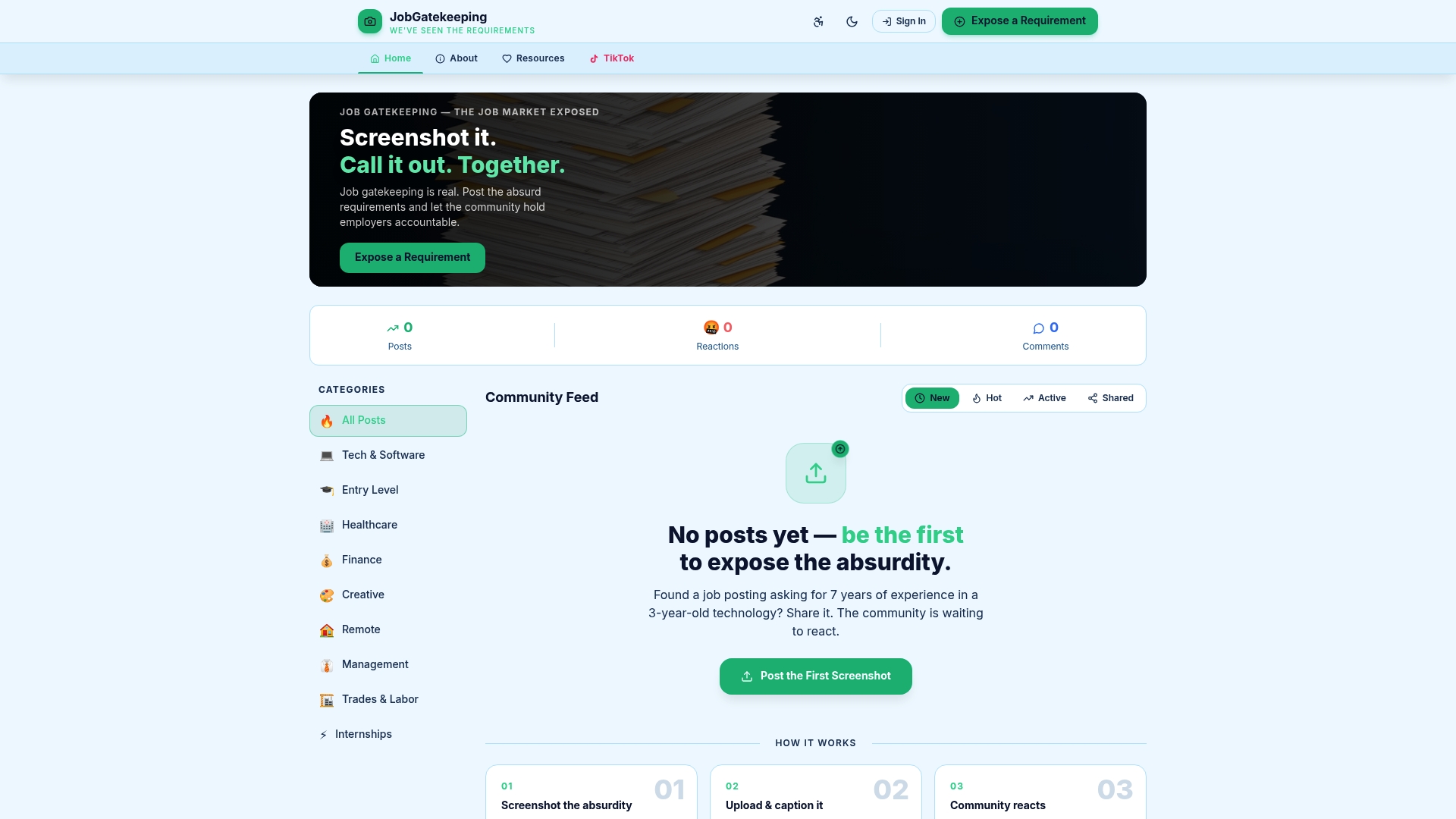
Join the conversation at JobGatekeeping where you can upload screenshots, react, and learn how to identify unfair hiring practices. Take control of your job search by turning individual frustrations into public awareness. Visit https://jobgatekeeping.com and upload your first screenshot to help reshape hiring standards today.
Frequently Asked Questions
How does Jobgatekeeping handle anonymous posting?
Jobgatekeeping allows users to publish job listings anonymously, maximizing privacy when reporting unfair job demands. The platform's anonymous posting feature ensures contributors can share their experiences without revealing their identities. Users can report problematic listings without fearing employer retaliation.
What is the difference between Career.Place and Jobgatekeeping in terms of DEIB training?
Career.Place provides targeted DEIB training modules and consulting services to improve hiring processes within organizations. This is particularly beneficial for companies focusing on institutionalized bias reduction, while Jobgatekeeping focuses on community sharing of screenshot evidence to highlight unreasonable job requirements. Organizations aiming to enhance their inclusive hiring practices may find Career.Place's offerings more suited to their needs.
Which platform offers more educational resources for identifying job gatekeeping?
Jobgatekeeping stands out with its educational resources that explain common gatekeeping tactics and how to identify exploitative language in job postings. This feature equips users with the knowledge to recognize unfair job criteria effectively. Job seekers who want to understand the nuances of job postings and advocacy will greatly benefit from these resources.
Can I use Jobgatekeeping if I am concerned about the validity of user submissions?
Users should be aware that Jobgatekeeping's content relies on community submissions, which can be subjective or unverified. While the platform creates a space for sharing experiences, it's essential to treat each post as community evidence rather than definitive audits. This encourages a more cautious approach when reviewing reported job requirements.
How does the WCAG 2.1 AA compliance benefit users of Jobgatekeeping?
Jobgatekeeping's design is compliant with WCAG 2.1 AA standards, making it accessible for users with disabilities. This feature ensures that all participants can engage with the platform, regardless of their abilities. Those utilizing assistive technology will find an inclusive environment to share and access job postings.